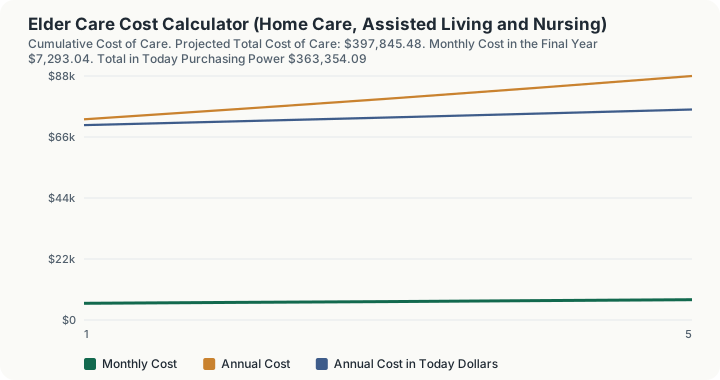
Quick Answer: Five years of assisted living starting at $6,000 a month and escalating 5% a year costs $397,845.48, with the monthly rate reaching $7,293.04 by the final year. Unpaid family care, priced at the wages and retirement saving a caregiver gives up, comes to $177,169.22 over the same period, which is cheaper but is not free.
What does this calculator do?
Two facts drive everything on this page, and both are usually left out of a family's planning.
The first is that care costs escalate faster than general prices. Care is labour that cannot be made much more productive: an hour of an aide's time in five years is still an hour of an aide's time. A plan built on today's monthly rate, or projected at general inflation, understates the bill. This calculator takes both rates from you and reports the gap between them explicitly, so you can see how much of the projected total is care inflation rather than ordinary inflation.
The second is that unpaid family care is not free. It is paid for in wages the caregiver does not earn, in retirement contributions they therefore do not make, and in the compounding those contributions would have produced. No cash leaves an account, and it is still real money. This page prices it and sets it beside the paid options on the same terms.
One thing needs saying plainly: no authority publishes what elder care costs. There is no federal or state schedule of assisted living rates, and the figures that circulate come from industry surveys of providers, not from a regulator. Every price on this page, and the care inflation rate itself, is a number you supply. The defaults are placeholders to be replaced with real quotes from real facilities in your area. Prices vary enormously by region and by level of care, and the difference between a base rate and what a resident with meaningful care needs actually pays is often large.
How is this calculated?
Care costs are escalated annually and totalled, with each year paid in arrears:
Total = ∑(y = 1 to n) 12 × M₀ × (1 + g_care)^(y − 1)
The caregiver's opportunity cost is forgone wages plus the terminal value of the retirement contributions those wages would have funded:
Cost_family = ∑(y = 1 to n) W_y + ∑(y = 1 to n) (W_y × c) × (1 + r)^(n − y), W_y = S₀ × (1 + g_w)^(y − 1) × h/H
Step 1: Escalate the monthly rate year by year. Year 1: $6,000.00 Year 2: $6,000 x 1.05 = $6,300.00 Year 3: $6,300 x 1.05 = $6,615.00 Year 4: $6,615 x 1.05 = $6,945.75 Year 5: $6,945.75 x 1.05 = $7,293.04
Step 2: Annualise each year. $72,000.00, $75,600.00, $79,380.00, $83,349.00 and $87,516.48
Step 3: Sum them for the nominal total. $72,000 + $75,600 + $79,380 + $83,349 + $87,516.48 = $397,845.48
Step 4: Deflate each year at general inflation to express the bill in today's purchasing power. Each year's cost is divided by 1.03 raised to that year's power, giving $363,354.09 in today's dollars.
Step 5: Isolate the cost of care inflation alone. The same care escalated at 3% rather than 5% would total $382,257.72, so the extra cost caused by care rising faster than general prices is: $397,845.48 - $382,257.72 = $15,587.76
Step 6: Project the other two settings on identical assumptions. Home care at $5,000 a month: $331,537.92 Nursing home at $10,000 a month: $663,075.72 The spread between cheapest and dearest is $331,537.80, which is larger than the cheapest option itself.
Step 7: Price the caregiver's forgone wages. Twenty caregiving hours against a forty hour week is half a career: $60,000 x 0.5 = $30,000 in year one, growing at 3%. Over five years that totals $159,274.07.
Step 8: Price the retirement saving forgone. Each year's forgone wages are multiplied by the 10% contribution rate and compounded at 6% to the end of the caregiving period. Year one's $3,000 grows for four years to $3,787.43; the five contributions together reach $17,895.15.
Step 9: Add them for the full cost of unpaid family care. $159,274.07 + $17,895.15 = $177,169.22
Step 10: Express that as a monthly invoice, so it is comparable with a facility rate. $177,169.22 / 60 months = $2,952.82 a month
Worked Example
The comparison people actually face is between paying a facility and having a family member cut their hours, so it is worth setting the two side by side properly.
Step 1: Take the paid option's total. Five years of assisted living: $397,845.48
Step 2: Take the family option's total. Half-time caregiving by a $60,000 earner, wages and retirement compounding included: $177,169.22
Step 3: Take the difference. $397,845.48 - $177,169.22 = $220,676.26 in favour of family care
Step 4: Convert both to a monthly rate. Assisted living: $397,845.48 / 60 = $6,630.76 a month Family care: $177,169.22 / 60 = $2,952.82 a month
Step 5: Test what happens when the caregiver stops working entirely. Raise caregiving hours from 20 to 40 against the same forty hour week and the fraction doubles from 0.5 to 1.0, doubling both the forgone wages and the forgone retirement value. The family option's cost rises to $354,338.45, or $5,905.64 a month, and the gap against assisted living narrows from $220,676.26 to $43,507.03.
That is the honest shape of the decision. Part-time family care is genuinely cheaper on these numbers. A whole career paused is not, and the arithmetic says so before anyone has to discover it.
Carrying The Facility Bill Across The Five Years
Step 6: Year one. $6,000.00 a month, $72,000.00 for the year, worth $69,902.91 in today's money
Step 7: Year two, after 5% care inflation. $6,300.00 a month, $75,600.00 for the year, and the running total reaches $147,600.00
Step 8: Year five. $7,293.04 a month, $87,516.48 for the year, running total $397,845.48
Step 9: What the last year costs against the first. $87,516.48 - $72,000.00 = $15,516.48, a 21.6% rise on an unchanged level of care
The bill in year five is more than a fifth larger than the bill in year one for exactly the same room. Families who budget from the brochure price rather than from the fifth-year figure are the ones who run out midway, which is why the total, not the monthly rate, is the number to plan against.
What does this calculator not account for?
- Medicaid. Eligibility rules, the five-year look-back on transfers, spend-down requirements, spousal impoverishment protections and estate recovery are not modelled at all. For long stays Medicaid is frequently the largest single factor and it is entirely absent here.
- Medicare. Skilled nursing coverage is limited and conditional and none of it is modelled. Medicare does not pay for custodial long-term care.
- Long-term care insurance. No benefit design, elimination period, daily benefit cap or inflation rider is applied.
- Veterans benefits, including Aid and Attendance, and any state programme.
- Care level escalation. Assisted living base rates typically sit on top of a care level charge that rises as needs increase. Here a single monthly rate escalates at a single rate.
- Transitions between settings, which are the normal path: home care, then assisted living, then nursing. This page projects one setting for the whole period.
- Tax. The medical expense deduction, the dependent care credit and the tax character of any funds used to pay are not modelled.
- The caregiver's own costs beyond wages and retirement: health insurance lost with the job, Social Security credits not earned, career progression forgone after the caregiving ends, and the health effects of caregiving itself.
- Any income the person receiving care has. The total is the cost of care, not a shortfall against their resources.
What mistakes do people make with this?
- Planning on today's monthly rate. At 5% care inflation, the year-five rate here is $7,293.04, more than 21% above where it started. A fund sized on $6,000 a month runs out early.
- Projecting care at general inflation. That understates this five-year bill by $15,587.76, and the understatement compounds badly over longer horizons.
- Treating family care as free. It costs $177,169.22 on these inputs, borne almost entirely by one person, and most of it is invisible until retirement.
- Assuming home care is the cheap option. It is cheapest per month here, but its cost scales with hours. Around the clock it becomes the most expensive setting of the three, and duration rather than the hourly rate is what makes it expensive.
- Guessing the duration. The total is more sensitive to the number of years than to any price. Nobody can know this number, which is the honest reason to model a range rather than a point.
- Quoting a national average. No authority publishes one. The figures in circulation are industry survey data, and local rates vary by a factor of several.
- Forgetting the caregiver's retirement. The forgone wages are noticed. The $17,895.15 of forgone contributions and compounding is not, and it lands decades later.
Frequently Asked Questions
How much does assisted living cost per month?
Why does the calculator use a higher inflation rate for care than for everything else?
Is it cheaper for a family member to provide care?
What is the caregiver's opportunity cost made of?
Does Medicare or Medicaid pay for any of this?
How many years should I plan for?
Sources
- Medicare's position that it does not cover custodial long-term care, and the scope of its skilled nursing benefit, are set out at medicare.gov/coverage/long-term-care
Also consulted: No figure on this page is taken from any authority. There is no federal or state schedule of long-term care prices, and the national averages in circulation come from industry surveys of providers rather than from a regulator. Every cost, inflation rate, salary and return on this page is supplied by the user; For the prices to enter, written quotes from the specific facilities and agencies you would use are the only reliable source, and they should include the care level charges that sit on top of a base rate; Medicaid long-term care eligibility, including the transfer look-back, is administered by each state within federal rules at 42 U.S.C. 1396p. Your state Medicaid agency is the authority for your own case.