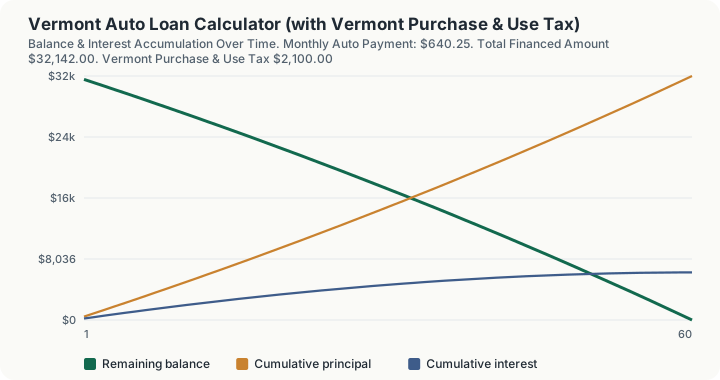
Quick Answer: A $35,000 car in Vermont with $5,000 cash down, a 60-month term, and a 7.25% APR carries a $640.25 monthly payment. That includes $2,100.00 of Vermont purchase and use tax at 6% and the $42 title fee, financing $32,142.00 in total. The tax on a passenger car is not capped, whatever a cap figure you may have read elsewhere suggests.
Overview
The most common error in a Vermont car tax estimate is a cap that does not apply to your car.
32 V.S.A. § 8903 sets the purchase and use tax at 6%, and it does contain a maximum tax amount, currently $2,486. But read the section structure rather than the number. The ceiling attaches to "any other motor vehicle," a residual category that means trucks rated at 10,100 lbs and above. Pleasure cars, motorcycles, and motor homes are handled separately and pay a straight 6% with no ceiling at all.
The difference is not academic. A $2,486 cap corresponds to a price of $41,433. Any car above that, which today includes a large share of new SUVs and trucks under 10,100 lbs, would be understated by a calculator that applies the cap. At $60,000 the real tax is $3,600 and a capped model reports $2,486, a $1,114 error that lands on the buyer at the DMV counter. This calculator applies no cap for that reason, and one of its test vectors exists specifically to keep it that way.
Beyond the cap question, Vermont is straightforward. The purchase and use tax is a state-level tax administered by the DMV under Title 32, Chapter 219, imposed in lieu of the general sales and use tax. The 1% municipal local option sales tax that some Vermont towns adopted does not attach to a vehicle registered under that chapter. Every town is 6%.
Auto Loan APR by Credit Score
The APR columns below are national averages, not Vermont figures. No primary source publishes average auto loan APR by state: Experian's report has no geographic cut, the CFPB publishes state origination volume but no rates, and the New York Fed publishes state delinquency only. The payment column is the part that is specific to Vermont, because it runs this calculator's own Vermont tax and fee rules at each tier's rate.
| Credit Tier | VantageScore 4.0 | Avg New APR | Avg Used APR | Est. Payment in Vermont |
|---|---|---|---|---|
| Super prime | 781-850 | 4.55% | 6.30% | $599.95 |
| Prime | 661-780 | 6.23% | 8.77% | $624.84 |
| Nonprime | 601-660 | 9.67% | 14.03% | $677.72 |
| Subprime | 501-600 | 13.44% | 19.42% | $738.59 |
| Deep subprime | 300-500 | 16.01% | 21.77% | $781.80 |
Payment assumptions: $35,000 vehicle price, $0 trade-in, $5,000 cash down, $0 dealer documentation fee, 60-month term, new-vehicle APR applied to the Vermont delivered price including tax and statutory fees. At the 6.39% overall new-car average the same purchase costs $627.24 a month.
The score bands are VantageScore 4.0, not FICO. The same borrower can land in a different tier under each model, so a FICO score pulled from a card issuer will not always match the band here. Source: Experian, State of the Automotive Finance Market, Q1 2026, slide 45.
What Moves Your Payment
Each row changes one input and leaves the rest at the baseline below. The dollar effects are this calculator's own output for Vermont, not a rule of thumb.
| Factor | What Changes | Effect on Monthly Payment | Effect on Total Interest |
|---|---|---|---|
| Vehicle Price | Each extra $1,000 of price raises both the amount financed and the sales tax base, so the tax rises with it. | +$21.11 | +$206.87 |
| Trade-In Allowance | A $1,000 allowance cuts the amount financed by $1,000 and reduces the sales tax base by the same amount, so it saves tax as well as principal. | -$21.12 | -$206.87 |
| Cash Down Payment | A $1,000 larger down payment cuts the amount financed by $1,000. It never reduces the sales tax, which is assessed on the price, not on what you borrow. | -$19.92 | -$195.16 |
| Dealer Doc Fee | A $100 higher documentation fee adds $100 to the amount financed and is inside the sales tax base, so it is taxed on top of itself. | +$2.11 | +$20.68 |
| Longer Term | Stretching the same balance from 60 months to 72 months spreads the principal over twelve more payments at the same rate. | -$88.39 | +$1,318.73 |
Baseline: $35,000 vehicle price, $0 trade-in, $5,000 cash down, $0 documentation fee, 60 months at 7.25% APR, giving a $640.25 payment and $6,272.86 of total interest.
How This Is Calculated
Vermont credits a trade-in only if the vehicle was previously or currently registered or titled in your own name, with no intervening change of ownership. Four steps.
1. Taxable cost. Under 32 V.S.A. § 8902, taxable cost excludes the value the seller allows on a motor vehicle accepted as part of the consideration, provided you owned that vehicle and it was previously or currently registered or titled in your name with no intervening change of ownership. The Vermont DMV treats a dealer documentation fee as part of the purchase price, so it stays in the base.
2. Purchase and use tax. One rate, statewide, with no dollar ceiling for a passenger car.
3. Title fee. A fixed $42 for a certificate of title, outside the tax base. A lien notation adds $14 for each lien, which most financed purchases will incur.
4. Amount financed and amortization. The trade-in works twice, cutting the tax base and reducing the balance borrowed.
The balance amortizes as a fixed-rate installment loan:
where $P$ is the financed amount, $i$ is the monthly rate (APR ÷ 12), and $n$ is the term in months. Each period's interest is the outstanding balance times $i$, the remainder reduces principal, and the schedule reconciles to zero at maturity.
Worked Example
Vermont's purchase and use tax is 6% statewide with no local layer, and the trade-in is excluded from taxable cost provided you owned the vehicle you are handing over. The baseline is deliberately below the price where the pickup truck ceiling starts to matter.
- Vehicle price: $35,000
- Trade-in allowance: $0
- Cash down: $5,000
- Documentation fee: $0
- Term: 60 months at 7.25% APR
Step 1 -- The taxable cost. Purchase price excluding the value allowed on a vehicle accepted as consideration: $35,000 - $0 = $35,000.00
Step 2 -- Purchase and use tax at 6%. $35,000.00 x 6% = $2,100.00
Step 3 -- The title fee, outside the base. $42.00
Step 4 -- Total delivered price. $35,000 + $2,100.00 + $42.00 = $37,142.00
Step 5 -- Amount financed. $37,142.00 - $0 trade-in - $5,000 cash down = $32,142.00
Step 6 -- The monthly payment. $32,142.00 at 7.25% over 60 months = $640.25
Step 7 -- Month 1. $32,142.00 x (7.25% / 12) = $194.19 interest, $446.06 principal, balance $31,695.94
Step 8 -- Month 2. $31,695.94 x (7.25% / 12) = $191.50 interest, $448.75 principal, balance $31,247.19. Cumulative interest: $385.69
Step 9 -- The accumulation. Interest through month 12 is $2,148.81, balance $26,607.81. Over the full term, $6,272.86
Add a $10,000 trade-in and the taxable cost falls to $25,000, the tax falls to $1,500, and the payment drops to $429.10. The trade-in saved $600.00 in tax by itself.
Now change only the price, to $60,000. The tax is $3,600.00 and the delivered price is $63,642.00. This is the case where the truck cap matters: a calculator that reports $2,486 here is off by $1,114 and you will find out at the DMV, not at the dealership. At $41,433 the tax is $2,485.98, one step under the truck ceiling, which is exactly where the two models stop agreeing.
If your dealer charges a $500 documentation fee, the taxable cost rises to $35,500 and the tax to $2,130. The fee costs $530 all in, because it carries its own 6%.
What This Does Not Account For
- The book value floor. Vermont taxes the greater of the purchase price or the J.D. Power clean trade-in value. A price-only model understates tax on a below-book purchase. A Vermont dealer appraisal form can rebut the book value where the car's condition justifies it.
- The annual registration fee. The pleasure-car registration is reported at $91 per year, or $167 for two years, inclusive of a $2 Clean Air Fund fee. That figure could not be confirmed against the official DMV fee schedule, so it is left out of the delivered price rather than financed into a number the source does not support. Add it yourself once you have the current amount.
- EV and plug-in hybrid infrastructure fees. Battery electric vehicles owe an additional $89 per year and plug-in hybrids $44.50 per year at registration.
- Lien notation fees, $14 for each lien recorded, which applies to nearly every financed purchase.
- The private-sale credit. Vermont allows a credit for a vehicle you sold privately rather than traded, if it was last registered in your name and the sale happens within three months of the taxable purchase, capped at the clean trade-in book value. This calculator models only the dealer trade-in path. If you sold privately, the credit may still be available to you.
- The 9% short-term rental rate, which is a different tax on a different transaction and is often confused with the 6% purchase rate.
- The indexed cap amount. The $2,486 figure supersedes an older $2,075 statutory amount and has been adjusted more than once. It does not affect a passenger car either way, but confirm the current figure before relying on it for a heavy truck.
Common Pitfalls
- Applying the $2,486 cap to a car. This is the big one. The cap belongs to trucks of 10,100 lbs and over. On a $60,000 passenger vehicle it understates the tax by $1,114.
- Assuming your town's 1% local option tax applies. It does not. A vehicle registered under 32 V.S.A. ch. 219 is outside the general sales and use tax entirely, so the local option surcharge never attaches.
- Assuming the price you negotiated is the tax base. Vermont takes the greater of price or clean trade-in book value. A deal that looks good because it is well under book will not produce a tax bill that is under book.
- Trading in a car titled in someone else's name. The § 8902 exclusion requires that the vehicle was previously or currently registered or titled by you, with no change of ownership since. A car in a spouse's or parent's name does not automatically qualify.
- Forgetting the documentation fee is taxed. Vermont sets no cap on it and the DMV treats it as purchase price, so every dollar of it costs six cents more.
- Judging the loan by the payment alone. Stretching this $32,142.00 balance from 60 to 72 months lowers the payment to $551.86 and raises total finance charges to $7,591.62, a difference of $1,318.73.
Frequently Asked Questions
Is Vermont's car tax capped at $2,486?
What is the sales tax on a car in Vermont?
Does a trade-in reduce the tax in Vermont?
Can I get the credit if I sold my old car privately instead of trading it?
Does my town's local option sales tax apply to a car?
Does Vermont charge an annual property tax on my car?
Sources
- Consumer Financial Protection Bureau, Truth in Lending Act (Regulation Z, 12 CFR § 1026.22) disclosure requirements for installment credit. ecfr.gov/current/title-12/chapter-X/part-1026
- Vermont Department of Taxes, the official state tax authority for Vermont rates, rules and forms. tax.vermont.gov
Also consulted: 32 V.S.A. § 8903 (motor vehicle purchase and use tax at 6%; maximum tax amount limited to the residual "any other motor vehicle" class); 32 V.S.A. § 8902 (definitions, taxable cost, trade-in and private-sale credit) and § 8907 (determination of taxable cost); Vermont Department of Motor Vehicles, Vehicle Taxation guidance (dealer documentation fee treated as part of the purchase price; greater of price or J.D. Power clean trade-in value); Vermont Department of Motor Vehicles fee schedule (certificate of title $42.00; lien notation $14.00 each); Vermont Legislature and Justia published text of Title 32, Chapter 219; Experian, State of the Automotive Finance Market, Q1 2026, slide 45 (average new and used auto loan APR by VantageScore 4.0 credit tier; national, no state level cut published).