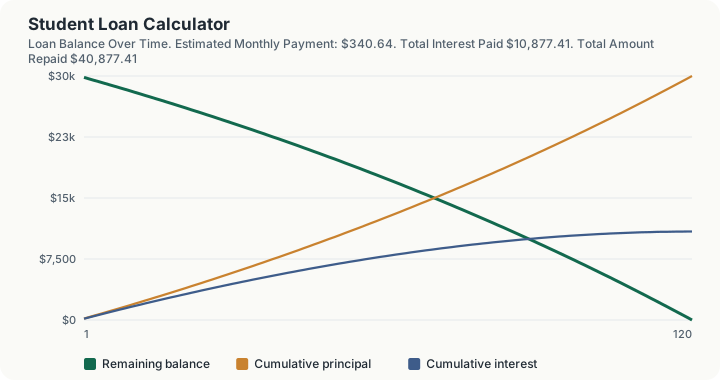
Quick Answer: A $30,000 student loan at 6.5% interest over the standard 10-year (120-month) term carries a monthly payment of $340.64, with $10,877.27 in total interest and $40,877.41 repaid in total.
Overview
This calculator answers the question most people ask before they've even finished borrowing: given a loan amount, a rate, and a term, what will the monthly payment actually be? It is built for students and parents estimating a payment on a loan that either hasn't disbursed yet or has, but hasn't started repayment, so the amount owed is treated as a single fixed principal rather than something accumulating interest during in-school deferment.
That makes this a different tool from this platform's student loan payoff calculator, which starts from an existing balance already in repayment and models the effect of extra payments on how fast it disappears. This calculator is the "what will my payment be" question; the payoff calculator is the "how do I get rid of this faster" question. Use this one first, when you're comparing loan offers or estimating affordability, and the payoff calculator later, once you're actually repaying and want to see what extra payments buy you.
The math itself is the standard fixed-rate amortization formula used across every loan calculator on this platform. Federal Direct Loans use a fixed rate for the life of the loan once disbursed, so this calculator's fixed-rate assumption matches how federal student loans actually work; private loans may carry either fixed or variable rates, and this tool assumes fixed unless you enter a rate that reflects your loan's current terms.
How This Is Calculated
- Monthly interest rate. The entered annual rate is divided by 12 to get the periodic rate applied each month.
- Monthly payment. The loan amount is amortized over the chosen term using the standard fixed-payment formula:
where $P$ is the loan amount, $i$ is the monthly interest rate, and $n$ is the number of monthly payments.
- Total interest. The monthly payment multiplied by the number of payments, minus the original loan amount.
- Interest as a percentage of principal. Total interest divided by the loan amount, which is a quick way to see how much a longer term or higher rate inflates the true cost of borrowing beyond the amount originally borrowed.
Worked Example
Using the calculator's default inputs:
- Loan Amount: $30,000.00
- Interest Rate: 6.5%
- Term: 120 months (10 years, the standard federal repayment term)
Step by step:
- Monthly interest rate: 6.5% divided by 12 equals approximately 0.5417%
- Monthly payment at 6.5% over 120 months: $340.64
- Total interest paid, summed across all 120 scheduled payments: $10,877.27
- Total of all 120 payments: $40,877.41
- Interest as a percentage of the original loan: $10,877.27 divided by $30,000, or about 36.26%
What This Does Not Account For
- Interest that accrues during in-school deferment. Unsubsidized federal loans and most private loans accrue interest while a student is still enrolled, even though payments aren't due yet. If that accrued interest capitalizes (gets added to principal) at repayment, the real starting balance will be higher than the amount originally disbursed, and this calculator does not model that capitalization.
- Income-driven repayment plans. Federal income-driven plans base the payment on income and family size rather than a fixed amortization schedule. This calculator only models standard, fixed-payment amortization; for an income-driven estimate, use this platform's dedicated repayment plan calculator.
- Multiple loans with different rates. Most borrowers, especially federal borrowers, hold several loans disbursed at different times with different rates. This calculator models one loan at one rate; combine balances only if you're comfortable using a single blended average rate as an approximation.
- Loan origination fees. Federal Direct Loans carry an origination fee deducted from the disbursement, meaning the amount that actually reaches the borrower is less than the amount owed. This calculator's loan amount input is the amount owed, not the amount received.
- Variable interest rates. If a private loan's rate can change over time, the actual payment and total interest will differ from this calculator's fixed-rate projection as the rate moves.
Common Pitfalls
- Entering the amount disbursed instead of the amount owed. Because of origination fees, the amount owed on a federal loan is typically higher than what shows up in your bank account or tuition account. Use the balance shown on your loan servicer statement, not the disbursement amount, for an accurate payment estimate.
- Ignoring capitalized interest from deferment. A loan that accrued interest for four years of school and then capitalized it into principal has a materially larger starting balance than the amount originally borrowed. Update the loan amount input to reflect your actual post-capitalization balance once you know it.
- Comparing a 10-year standard payment to an income-driven payment without noting the tradeoff. A lower income-driven payment can mean more total interest paid over a longer timeline, sometimes decades, even when it feels more affordable month to month.
- Averaging multiple loan rates incorrectly. A simple average of several loan rates overstates the blended rate if the loans have different balances; a balance-weighted average is more accurate when modeling several loans as one.
- Forgetting that private loan rates and terms vary loan to loan. Unlike federal loans, private student loan terms depend entirely on the lender and the borrower's or cosigner's credit; the entered rate should reflect the actual loan's disclosed APR, not a federal program rate.
Frequently Asked Questions
How is this different from the student loan payoff calculator?
Does this calculator account for interest that accrues while I'm in school?
What is the standard federal student loan repayment term?
Should I use my loan's stated interest rate or something else?
Does a longer repayment term always cost more?
Can I use this for private student loans too?
Sources
- Federal Student Aid (U.S. Department of Education): Direct Loan interest rates, origination fees, and Standard Repayment Plan terms. studentaid.gov
- Consumer Financial Protection Bureau: Student loan repayment and servicing guidance. consumerfinance.gov
Also consulted: Higher Education Act of 1965, as amended: Statutory basis for federal student loan interest rate setting and repayment plans.