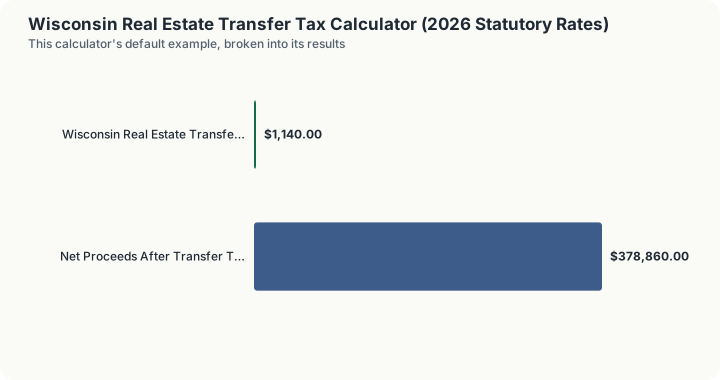
Quick Answer: A $380,000 home sale in Wisconsin owes $1,140.00 in state real estate transfer fee, a flat 0.3% rate applied to the full sale price with no brackets or high-value surcharge.
Overview
Wisconsin's real estate transfer fee under Wis. Stat. Section 77.22 is set at $3.00 per $1,000 of value, an even 0.3% of the sale price, a single flat statewide rate with no county or municipal add-on layered on top anywhere in Wisconsin. That places it just below neighboring Michigan's combined 0.86% and just above neighboring Minnesota's 0.33% and neighboring Iowa's 0.16%, four neighboring Upper Midwest states charging four different flat rates.
Wisconsin custom places the transfer fee on the seller, though the specific allocation is ultimately a matter of the purchase contract and can be negotiated between the parties. At 0.3%, a $380,000 Wisconsin sale generates $1,140 in tax due, a figure that scales in exact proportion to price since there is no bracket schedule to account for.
Register of deeds offices across all 72 Wisconsin counties apply the identical $3.00-per-$1,000 calculation, so unlike a Michigan or an Ohio transaction, a Wisconsin seller does not need to confirm a separate county rate before estimating the fee due at closing.
How This Is Calculated
Wisconsin's real estate transfer fee is $3.00 per $1,000 of value, a flat 0.3%, and no county or municipality is authorized to add a surcharge on top of it.
The engine reads the 0.003 rate under Wis. Stat. 77.22 and multiplies the full sale price by it, then reports fee due, effective rate, and net proceeds. With no bracket schedule and no value threshold, the effective rate reads 0.300% at every price, and a $70,000 vacant lot and a $7,000,000 commercial property are charged the same proportion of value.
Worked Example
Wisconsin's real estate transfer fee on the calculator's default price, one operation per line.
Step 1 -- The consideration. Value of the interest conveyed = $380,000
Step 2 -- The statutory rate. Wis. Stat. 77.22, $3.00 per $1,000 of value = 0.3%
Step 3 -- Apply the rate. $380,000 x 0.003 = $1,140.00
Step 4 -- Cross-check by the per-$1,000 method. 380 x $3.00 = $1,140.00
Step 5 -- Net proceeds after the fee. $380,000.00 - $1,140.00 = $378,860.00
Step 6 -- The effective rate. $1,140.00 / $380,000 = 0.300%
Take the price to the calculator's $1,500,000 scenario.
Step 7 -- The luxury sale. $1,500,000 x 0.003 = $4,500.00
Step 8 -- The effective rate at $1.5M. $4,500.00 / $1,500,000 = 0.300%
Wisconsin's fee is charged on the value of the interest conveyed rather than on the contract price as such, a distinction that matters when a transfer is partial or when consideration and value diverge; for an arm's-length sale of the whole fee simple, which is what this calculator assumes, the two are the same figure and Step 1 needs no adjustment. The seller files the electronic return and pays the fee at recording. Because there is no bracket schedule, the difference between Steps 6 and 8 is zero, and a Wisconsin seller can price the fee at three dollars per thousand from the first offer onward.
Thirty Cents Per Thousand, Walked Up The Price Ladder
The marginal cost of the next $10,000 of sale price. Moving the price from $380,000 to $390,000 moves the tax from $1,140.00 to $1,170.00. Every additional $10,000 of consideration costs $30.00, at every price, because the engine multiplies the full sale price by 0.003 with no bracket, no exemption floor and no high-value surcharge anywhere in the code path.
The price ladder, end to end. $250,000 owes $750.00. $380,000 owes $1,140.00. $500,000 owes $1,500.00. $750,000 owes $2,250.00. $1,000,000 owes $3,000.00. $1,500,000 owes $4,500.00. $2,000,000 owes $6,000.00. The reported effective rate is 0.300% at every one of those prices and the mansion-tax output is $0.00 at all of them: Wisconsin carries no mansionCliff entry, so the surcharge line exists on the page only because the calculator shares a configuration with the states that have one.
The reverse question. A seller working to a closing-cost budget can invert the line directly. $3,000.00 of tax corresponds to a $1,000,000 sale, $1,500.00 to $500,000, and $750.00 to $250,000. To keep the transfer charge under $1,500.00, the price has to stay under $500,000, and there is no threshold anywhere in that range where the answer would change shape.
Right method against wrong method, priced. The statute is not written as a percentage. It reads $3.00 per $1,000 of value, under Wis. Stat. 77.22, and a register of deeds applying it literally counts whole increments and rounds up. This engine does not: it multiplies by 0.003 and reports the exact product. On the $380,000 default the two methods agree exactly, because $380,000 is a whole number of increments: 380 whole $1,000 increments at $3.00 each is $1,140.00. On a price that is not, they diverge. A $380,100 sale returns $1,140.30 from this calculator, while 380.1 increments rounded up to 381 at $3.00 each gives $1,143.00. The gap is $2.70, small in dollars and reliably present on any sale price that is not a round multiple of the statutory increment.
Where the flat rate leaves the seller exposed. The rate is applied to whatever value is entered, and Wis. Stat. 77.25 exempts a long list of conveyances entirely: transfers between spouses, to or from a trust the grantor controls, by gift without consideration, and on partition among co-owners. None of those exemptions exists in this code path. Entering the value of an exempt conveyance returns a fee that is not owed, and the calculator has no input that would say so.
What This Does Not Account For
- The Wis. Stat. 77.25 exemptions are not tested. Transfers between spouses, gifts without consideration, transfers to a controlled trust and partitions among co-owners are exempt in law and fully taxed here.
- The engine multiplies rather than counting increments. $380,100 returns $1,140.30 against the $1,143.00 a register of deeds counting whole $1,000 increments would charge.
- There is no schedule on this page. The configuration returns an empty table, so the price ladder above was produced by re-running the calculator rather than read off a chart.
- County recording fees. Wisconsin register of deeds offices charge separate flat recording fees per document, unrelated to sale price, which this calculator does not include.
- Exemptions for certain transfer types. Transfers between spouses, transfers into certain trusts, and transfers by gift, inheritance, or operation of law may be exempt from the transfer fee under Wisconsin law. This calculator assumes a standard arm's-length taxable sale.
- Title insurance, attorney fees, and survey costs. The transfer fee is only one line item on a Wisconsin closing statement; title search fees, attorney charges, and survey costs are separate and not modeled here.
- The Real Estate Transfer Return filing requirement. Wisconsin requires an electronic Real Estate Transfer Return to accompany most deeds, a compliance step separate from the fee calculation itself and not modeled by this calculator.
Common Pitfalls
- Assuming the buyer pays by default. Wisconsin's transfer fee is customarily paid by the seller (grantor), the reverse of the assumption some buyers relocating from other states might make. Confirming allocation in the purchase contract avoids confusion at closing.
- Forgetting the fee applies even to low-value transactions. Because Wisconsin sets no minimum threshold, even a modest-value transfer owes the flat 0.3% fee, and buyers or sellers of inexpensive properties sometimes overlook it when budgeting.
- Applying an out-of-state rate by habit. Buyers and agents relocating from bracket-heavy states sometimes overestimate Wisconsin's fee by applying a marginal rate structure that does not exist here.
- Skipping the Real Estate Transfer Return. Wisconsin requires this electronic filing alongside most deed recordings; overlooking it can delay recording even when the transfer fee itself has been correctly calculated and paid.
Frequently Asked Questions
What is Wisconsin's real estate transfer tax rate?
Who pays the real estate transfer fee in Wisconsin?
Does Wisconsin have a mansion tax on expensive homes?
Are any property transfers exempt from Wisconsin's transfer fee?
Does Wisconsin also charge a local transfer tax on top of the state fee?
Sources
- Wisconsin Department of Revenue: Real Estate Transfer Fee guidance under Wis. Stat. 77.22. revenue.wi.gov