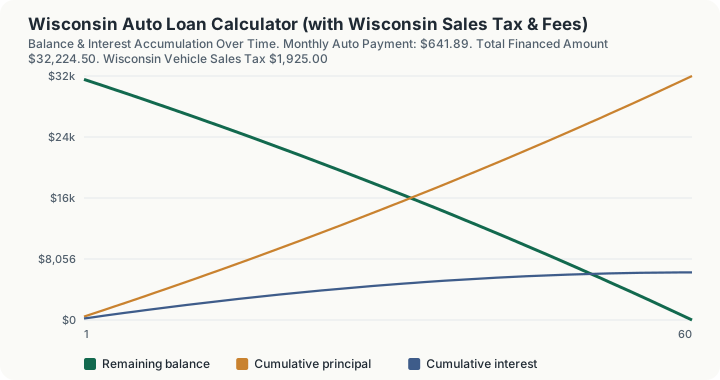
Quick Answer: A $35,000 vehicle in Wisconsin with $5,000 cash down, a 60-month term, and a 7.25% APR carries a $641.89 monthly payment in a standard 0.5% county. That figure includes $1,925.00 of sales tax at the 5.5% combined rate and $299.50 in title and registration fees, financing $32,224.50 in total. Inside the City of Milwaukee, where the combined rate is 7.9%, the payment rises to $658.62.
Overview
Two Wisconsin details change the answer more than the headline rate does.
The first is the title fee. 2025 Wisconsin Act 15 raised it from $164.50 to $214.50 effective 1 October 2025. That is a $50 jump in a fee that most rate tables and dealer estimates copied years ago, and it lands on every titled vehicle regardless of price. Combined with the $85 annual registration, fixed fees here total $299.50, which is four to seven times what most states charge at the counter.
The second is that your county and city tax follows you home, not the dealership. For motor vehicles, Wisconsin sources the county and city sales tax to the location where the vehicle will be customarily kept, meaning your residence or garaging address. Driving to a dealer in a different county does not change your rate. Neither does buying from a dealer inside Milwaukee if you live outside it, which is the version of this that costs real money: the City of Milwaukee's 2% tax applies to city residents, not to city purchases.
The state rate itself is straightforward. Wisconsin charges 5% under ch. 77 subch. III with no reduced automotive rate, so a car carries the same combined rate as any other purchase.
Auto Loan APR by Credit Score
The APR columns below are national averages, not Wisconsin figures. No primary source publishes average auto loan APR by state: Experian's report has no geographic cut, the CFPB publishes state origination volume but no rates, and the New York Fed publishes state delinquency only. The payment column is the part that is specific to Wisconsin, because it runs this calculator's own Wisconsin tax and fee rules at each tier's rate.
| Credit Tier | VantageScore 4.0 | Avg New APR | Avg Used APR | Est. Payment in Wisconsin |
|---|---|---|---|---|
| Super prime | 781-850 | 4.55% | 6.30% | $601.49 |
| Prime | 661-780 | 6.23% | 8.77% | $626.44 |
| Nonprime | 601-660 | 9.67% | 14.03% | $679.45 |
| Subprime | 501-600 | 13.44% | 19.42% | $740.49 |
| Deep subprime | 300-500 | 16.01% | 21.77% | $783.81 |
Payment assumptions: $35,000 vehicle price, $0 trade-in, $5,000 cash down, $0 dealer documentation fee, 60-month term, new-vehicle APR applied to the Wisconsin delivered price including tax and statutory fees. At the 6.39% overall new-car average the same purchase costs $628.85 a month.
The score bands are VantageScore 4.0, not FICO. The same borrower can land in a different tier under each model, so a FICO score pulled from a card issuer will not always match the band here. Source: Experian, State of the Automotive Finance Market, Q1 2026, slide 45.
What Moves Your Payment
Each row changes one input and leaves the rest at the baseline below. The dollar effects are this calculator's own output for Wisconsin, not a rule of thumb.
| Factor | What Changes | Effect on Monthly Payment | Effect on Total Interest |
|---|---|---|---|
| Vehicle Price | Each extra $1,000 of price raises both the amount financed and the sales tax base, so the tax rises with it. | +$21.02 | +$205.89 |
| Trade-In Allowance | A $1,000 allowance cuts the amount financed by $1,000 and reduces the sales tax base by the same amount, so it saves tax as well as principal. | -$21.01 | -$205.90 |
| Cash Down Payment | A $1,000 larger down payment cuts the amount financed by $1,000. It never reduces the sales tax, which is assessed on the price, not on what you borrow. | -$19.92 | -$195.16 |
| Dealer Doc Fee | A $100 higher documentation fee adds $100 to the amount financed and is inside the sales tax base, so it is taxed on top of itself. | +$2.10 | +$20.59 |
| Longer Term | Stretching the same balance from 60 months to 72 months spreads the principal over twelve more payments at the same rate. | -$88.62 | +$1,322.12 |
Baseline: $35,000 vehicle price, $0 trade-in, $5,000 cash down, $0 documentation fee, 60 months at 7.25% APR, giving a $641.89 payment and $6,289.01 of total interest.
How This Is Calculated
Wisconsin's 5% state rate is low, but Milwaukee stacks a county rate and a separate city rate on top of it. Five steps.
1. Net taxable sales price. Wis. Stat. § 77.51(15b) excludes the amount allowed for property traded toward an article of greater value in the same transaction, with no dollar cap. The dealer's service fee is inside the taxable sales price.
The allowance cannot exceed the price of the car you are buying, so an oversized trade leaves the service fee taxable rather than driving the base below zero.
2. Sales tax. The 5% state rate plus your county rate under § 77.70, plus the City of Milwaukee rate under § 77.701 if you live inside the city.
3. Title and registration. A fixed $299.50, being the $214.50 title fee and the $85 standard automobile annual registration. Registration is flat, not weight- or value-based. Neither charge is taxed.
4. Amount financed. The trade-in works twice. It lowered the tax base in step one, and it also reduces the balance you borrow.
5. Amortization. The financed amount amortizes as a fixed-rate installment loan:
where $P$ is the financed amount, $i$ is the monthly rate (APR ÷ 12), and $n$ is the term in months.
Wisconsin Vehicle Tax Rates
Only the Milwaukee County figures are published here, because those two are the ones confirmed to the Department of Revenue rate components. Most other Wisconsin counties impose the standard 0.5% county tax, but a handful impose none, and county tax has come and gone in some counties over the years. Confirm yours on the Department of Revenue county rate list before you rely on it.
| Where you keep the vehicle | County | County | City | State | Combined |
|---|---|---|---|---|---|
| City of Milwaukee | Milwaukee | 0.900% | 2.000% | 5% | 7.900% |
| Milwaukee County outside the city (Wauwatosa, West Allis, and the rest) | Milwaukee | 0.900% | 0.000% | 5% | 5.900% |
| Counties imposing the standard county tax | various | 0.500% | 0.000% | 5% | 5.500% |
| Counties imposing no county tax | various | 0.000% | 0.000% | 5% | 5.000% |
Both Milwaukee taxes took effect 1 January 2024, so any table older than that shows 5.5% for Milwaukee and understates the tax on a $35,000 car by $840.
Worked Example
Wisconsin's 5% state rate is joined by a 0.5% county tax almost everywhere, and inside the City of Milwaukee by two further layers. The baseline uses the standard county case, and the city comparison follows.
- Vehicle price: $35,000
- Trade-in allowance: $0
- Cash down: $5,000
- Dealer service fee: $0
- Local rate: 0.5% (standard county)
- Term: 60 months at 7.25% APR
Step 1 -- The taxable sales price. Sales price excluding the amount allowed for the article traded: $35,000 - $0 = $35,000.00
Step 2 -- Combined state and county rate. 5.0% state + 0.5% county = 5.5%
Step 3 -- The sales tax. $35,000.00 x 5.5% = $1,925.00
Step 4 -- Title and registration, outside the base. $214.50 title + $85.00 registration = $299.50
Step 5 -- Total delivered price. $35,000 + $1,925.00 + $299.50 = $37,224.50
Step 6 -- Amount financed. $37,224.50 - $0 trade-in - $5,000 cash down = $32,224.50
Step 7 -- The monthly payment. $32,224.50 at 7.25% over 60 months = $641.89
Step 8 -- Month 1. $32,224.50 x (7.25% / 12) = $194.69 interest, $447.20 principal, balance $31,777.30
Step 9 -- Month 2. $31,777.30 x (7.25% / 12) = $191.99 interest, $449.90 principal, balance $31,327.40. Cumulative interest: $386.68
Step 10 -- The accumulation. Interest through month 12 is $2,154.32, balance $26,676.14. Over the full 60 months, $6,289.01
Move the same buyer inside Milwaukee city limits and the rate goes to 7.9%. Tax rises to $2,765.00 and the payment to $658.62. Move them to Wauwatosa, still in Milwaukee County but outside the city, and the rate is 5.9%: tax of $2,065.00 and a payment of $644.68. The city line is worth $700 on this purchase.
Add a $10,000 trade-in in the standard county case and the taxable price drops to $25,000, tax to $1,375.00, and the payment to $431.74. The trade-in saved $550 in tax. In the City of Milwaukee the same trade-in saves $790, because the exclusion is worth the allowance times your full combined rate.
What This Does Not Account For
- County and municipal wheel taxes. Many Wisconsin communities, including the City of Milwaukee and Milwaukee County, add a flat annual vehicle registration fee on top of the $85. These run from about $10 to $40 or more and recur every year, so they are not part of the amount financed.
- The $6 per-plate issuance fee, which applies when new plates are issued rather than transferred.
- The typical dealer service fee. Wisconsin sets no dollar cap and no reliable market average was available, so the input starts at $0. The fee is taxable, so enter yours to see its full effect. Wisconsin administrative rules require only that it be reasonable and disclosed on the buyer's guide.
- County rates outside Milwaukee County. Dane, Brown, and Outagamie were not confirmed against a Department of Revenue county list, so no rate is asserted for Madison, Green Bay, or Appleton. Use the standard 0.5% scenario only after checking your own county.
- Electric vehicle and hybrid registration surcharges, which Wisconsin charges annually in addition to the $85.
- GAP insurance, service contracts, and aftermarket add-ons, unless you fold them into the vehicle price yourself.
Common Pitfalls
- Using a $164.50 title fee. The figure has been $214.50 since 1 October 2025. Estimates built on the old number are $50 light before anything else is counted.
- Assuming the dealer's county rate is your rate. For motor vehicles the county and city tax follows the address where the vehicle is customarily kept. A Waukesha County resident buying in Milwaukee pays Waukesha's rate, and a Milwaukee city resident buying in Waukesha pays 7.9%.
- Treating Milwaukee County and the City of Milwaukee as the same rate. They are 5.9% and 7.9%. The 2% city tax stops at the city limits, so West Allis and Wauwatosa are not Milwaukee for this purpose.
- Assuming your county charges 0.5%. Most do, but not all, and the difference is $175 on a $35,000 car. Check rather than assume.
- Forgetting the service fee is taxable. A $300 fee adds $16.50 of tax in a standard county and $23.70 inside Milwaukee.
- Judging the loan by the payment. Stretching this $32,224.50 balance from 60 to 72 months drops the payment to $553.27 and raises total finance charges from $6,289.01 to $7,611.16.
Frequently Asked Questions
What is Wisconsin's sales tax rate on cars?
Which county's rate applies if I buy in a different county?
Does a trade-in reduce sales tax in Wisconsin?
How much is the Wisconsin title fee in 2026?
Is the dealer service fee taxable in Wisconsin?
Do I pay annual property tax on a vehicle in Wisconsin?
Sources
- Wisconsin Department of Revenue, Publication 2113, Sales and Use Tax Treatment of Used Motor Vehicles, and Fact Sheet 2414 (Milwaukee County and City of Milwaukee taxes effective 1 January 2024) revenue.wi.gov
- Consumer Financial Protection Bureau, Truth in Lending Act (Regulation Z, 12 CFR § 1026.22) disclosure requirements for installment credit. ecfr.gov/current/title-12/chapter-X/part-1026
Also consulted: Wis. Stat. ch. 77 subch. III (5% state sales and use tax), § 77.70 (county sales tax), and § 77.701 (City of Milwaukee sales tax); Wis. Stat. § 77.51(15b) (trade-in exclusion from the taxable sales price); 2025 Wisconsin Act 15 (title fee increase to $214.50 effective 1 October 2025); Wisconsin Department of Transportation, vehicle title and registration fee schedule; Experian, State of the Automotive Finance Market, Q1 2026, slide 45 (average new and used auto loan APR by VantageScore 4.0 credit tier; national, no state level cut published).