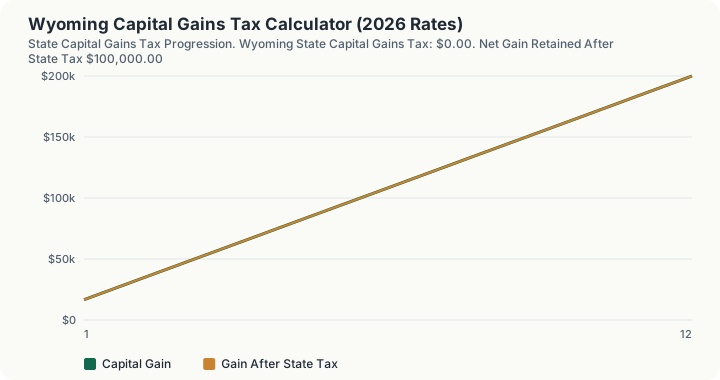
Quick Answer: Wyoming imposes no state-level tax on capital gains, so an investor realizing a $100,000 gain owes $0 in Wyoming state tax and keeps the full $100,000, subject only to federal tax.
Overview
Wyoming has no state individual income tax, so capital gains realized by Wyoming residents are taxed only at the federal rate (0%, 15%, or 20% plus the 3.8% Net Investment Income Tax where applicable), resulting in a 0.00% state tax liability.
Wyoming is one of the handful of states with no state income tax on capital assets, stocks, real estate, or cryptocurrency, and residents don't file an individual state income tax return for capital asset transactions at all. Compare that to a state with a progressive income tax running as high as 13.3%, and the advantage is obvious: Wyoming investors keep 100% of their net capital profits before federal taxation ever applies.
That matters for high-net-worth individuals, portfolio managers, corporate executives, and real estate investors alike, since state income taxes significantly affect net internal rates of return (IRR) on capital dispositions, 1031 exchange planning, installment sale structuring, and equity compensation exercises (ISOs, NSOs, and RSUs).
Institutional wealth managers and private equity underwriters have to weigh both statutory tax rates and multi-jurisdictional residency rules when running these numbers. Publicly traded securities, privately held business interests, real property, digital assets: whatever is being sold, evaluating the state-level tax exposure is a key part of pre-liquidity tax modeling and post-sale wealth preservation.
Planning around a Wyoming sale runs on the federal calendar alone. There is no state return and no state estimate, so what changes the result is the holding period, the federal adjusted gross income in the year of the sale, and where the asset itself is located.
How This Is Calculated
Wyoming levies no individual income tax, and no separate capital gains tax exists in its place. A gain of $50,000 and a gain of $5 million are treated identically by the state: neither is taxed. The number this page returns is $0, and the retained-gain figure equals the gain you entered.
There is no rate schedule to reproduce, so the two identities the calculator applies are simply these.
What the calculator does with your inputs:
- Start with the net gain. The figure you enter is the gain left after capital losses and loss carryforwards have been netted against it.
- Look for a Wyoming rate schedule. There is none to look up, so the state line resolves to zero before any bracket arithmetic runs. The other-income field has no effect here; it is kept so the page compares cleanly against states where it does matter.
- Effective rate. Zero divided by the realized gain is 0.00%, and it stays 0.00% whether the gain is $10,000 or $10 million.
- Net proceeds. The gain passes through the state layer whole.
- What is still owed. Federal capital gains tax and the federal net investment income tax are unaffected by residence in a no-tax state and are calculated separately.
Worked Example
Consider an investor residing in Wyoming who realizes $100,000 in capital gains alongside $75,000 in ordinary income during the year.
- Check the state rate. Wyoming does not levy an individual income tax, and it does not carve out a separate tax on investment gains either, so the state rate applied to this sale is 0.00%.
- Compute the state tax. $100,000 × 0.00% = $0.00. No state return, no state estimated payments, and no state withholding apply to this capital gain.
- Net proceeds. The investor retains the full $100,000 gain after state tax, compared to an investor in a high-tax state who might lose 5% to 13% of the same gain to state liability.
- Federal liability remains. Wyoming's 0% state rate does not eliminate federal exposure: the gain is still subject to federal long-term or short-term capital gains brackets under IRC § 1(h), plus the 3.8% NIIT surtax where applicable.
Federal Rules That Still Apply
The state figure is $0, and everything that is actually owed is federal: - Holding period. An asset held more than one year yields a long-term gain taxed at 0%, 15%, or 20%; a year or less is taxed at ordinary federal rates. - Net Investment Income Tax. The federal 3.8% tax under IRC § 1411 applies to net investment income once modified AGI passes $200,000 single or $250,000 joint. - Federal estimated payments. They are generally expected when you will owe $1,000 or more after withholding and credits, with 90% of the current year's tax or 100% of the prior year's generally treated as a safe harbor. Wyoming collects no counterpart, so the federal payment is the only one to schedule. - Loss offsets. Federal law under IRC § 1211 nets losses against gains, allows up to $3,000 of excess loss against ordinary income, and carries the rest forward.
What Wyoming Charges Instead
Wyoming's Department of Revenue is organized into an excise tax division, a mineral tax division, and a property tax division, and that list is the answer: consumption, minerals, and property, with no income tax division because there is no individual or corporate income tax to administer. Severance taxes on oil, natural gas, coal, and trona, together with federal mineral royalties returned to the state, carry a share of the budget that no other state's extraction revenue matches, which is what makes the absence of an income tax sustainable in a state of well under a million people.
For an investor the consequences are specific. A capital gain is untouched at the state level whatever its size or source. Someone selling mineral interests or royalty rights in Wyoming is dealing with severance and ad valorem production taxes on the production itself, which are separate from and unrelated to the gain on the sale of the interest. And Wyoming's LLC and trust statutes attract entities from out of state, which affects state filing fees and asset protection rather than the federal tax on gain that flows through to the owner.
Residency and Source Rules
Wyoming's neighbors include Colorado, Montana, Utah, Idaho, and Nebraska, all of which tax capital gains, so cross-border ownership is common. The gain generally belongs to the state where you were a resident at recognition, plus any state that sources the gain to itself. A Wyoming resident selling a Colorado condominium files in Colorado on the Colorado source gain. Someone who moved to Cheyenne mid-year has a split year and should expect the former state to test the move against its own domicile rules. Forming a Wyoming LLC to hold an out-of-state property does not change where the property is, and the state where the real estate sits generally taxes the gain regardless of where the entity is registered.
What The Sweep Shows When Every Row Reads Zero
Every row of the twelve-row schedule reads $0.00. Row one, at $16,666.67 of gain, is $0.00. Row six, the $100,000 default, is $0.00. Row twelve, at $200,000, is $0.00. Raise the gain to $500,000 and the tax is $0.00; raise it to $5,000,000 and the tax is still $0.00, with a reported effective rate of 0.00% and a marginal rate of 0.00% at every point.
The marginal cost of the next $1,000 of gain is $0.00. So is the marginal cost of the next million. There is no threshold, no phase-out, no cap and no cliff anywhere in the Wyoming code path, because the state carries no income tax schedule at all and the engine returns a zero result before any bracket walk begins.
The reverse question has no answer here, and that is the answer. "How much can be realized before crossing into the next bracket" is the question this family of calculators is usually asked. In Wyoming there is no next bracket, so the timing of a realization is a purely federal decision. The other-income input on this page changes nothing: $0 of other income and $1,000,000 of other income both return the same $0.00.
What the zero does not cover, priced against a neighbour. The figure is a state result only. A $500,000 gain that costs $0.00 in Wyoming costs $22,900.00 in West Virginia and $28,750.00 in Virginia at the same $75,000 of other income, which is the practical size of the residency question. None of the federal exposure on the same gain is computed anywhere on this page.
What This Does Not Account For
- No federal tax is computed anywhere on this page. The $0.00 is a state figure. Federal long-term rates, the 3.8% net investment income tax, and any state tax owed to a source state on the same gain all sit outside it.
- Source-state tax on non-Wyoming property is not modelled. A Wyoming resident selling real estate in a taxing state generally owes that state's tax, and the engine has no concept of where the asset sits. This page is exact about the state answer, which is zero. Everything below sits outside the calculator and still has to be worked out separately:
- Federal capital gains tax: long-term rates of 0%, 15%, or 20%, and short-term gains taxed at ordinary rates reaching 37%.
- Net Investment Income Tax: the 3.8% federal tax under IRC § 1411 on net investment income above $200,000 of modified AGI for single filers and $250,000 for married filing jointly.
- Alternative Minimum Tax: federal AMT under IRC § 55, which reaches the bargain element on an incentive stock option exercise.
- Section 1031 like-kind exchanges: federal deferral for real property held for productive use in a trade or business or for investment.
- Qualified Small Business Stock: the federal gain exclusion under IRC § 1202, which has its own holding period and issuer tests.
- Tax owed to another state: a gain sourced to a state that does tax it, which this calculator does not model.
Common Pitfalls
- Assuming a Wyoming entity moves the tax. Real property is taxed where it sits, not where the LLC was formed.
- Treating the state zero as the final answer. The federal bill on a large long-term gain, plus NIIT, is the real number.
- Forgetting the federal quarterly payment. Nothing at the state level prompts it, and the federal threshold is $1,000 of expected tax.
- Mixing up severance tax with capital gains tax. Severance tax falls on production of minerals, not on the profit from selling an interest.
- Losing track of basis in ranch or mineral property held for decades. Improvements, depletion, and a step-up at death all change the federal gain.
Frequently Asked Questions
Does Wyoming have a state capital gains tax?
How are short-term and long-term gains taxed in Wyoming?
Can capital losses offset capital gains in Wyoming?
Do I make estimated payments to Wyoming after a sale?
Does forming a Wyoming LLC reduce capital gains tax?
Are retirement distributions taxed in Wyoming?
Sources
- Wyoming Department of Revenue (revenue.wyo.gov): the department administers excise, mineral, and property taxes. No individual income tax is administered. revenue.wyo.gov
- IRS, Topic no. 409, Capital Gains and Losses.. irs.gov
- IRS, Publication 550, Investment Income and Expenses (Including Capital Gains and Losses).. irs.gov/publications/p550
Also consulted: IRS, Estimated Taxes: the $1,000 threshold and the current-year and prior-year safe harbors.