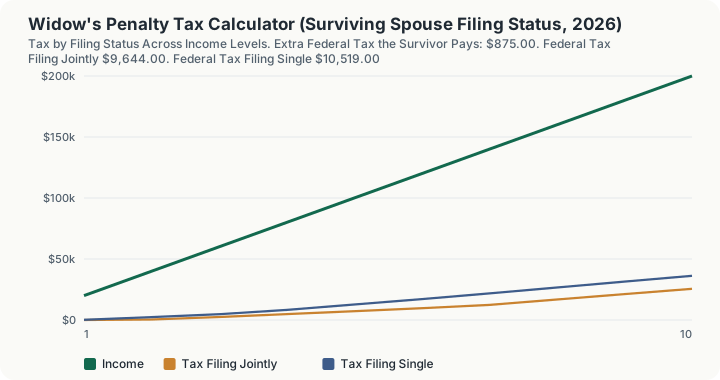
Quick Answer: A survivor left with $90,000 of ordinary income pays $875 more federal income tax than the couple did on $120,000, both aged 65 or over. The joint bill was $9,644; the survivor's is $10,519. That is $875 more tax on $30,000 less income, and after-tax income falls from $110,356 to $79,481, a drop of $30,875.
What does this calculator do?
The "widow's penalty" is what happens to a household's federal income tax when one spouse dies and the survivor moves from married filing jointly to single. Nothing about the survivor's spending, investments or behaviour changes. The tax code changes around them.
Three things happen at once. The standard deduction roughly halves. The single brackets are narrower, so the same taxable income reaches higher rates sooner. And household income usually falls at the same moment, because Social Security drops to the larger of the two benefits and a pension may stop or step down to a survivor percentage. Less income, more tax.
There is a timing wrinkle worth stating up front. A joint return may still be filed for the year of death under IRC 6013(a)(3), and IRC 2(a) allows "qualifying surviving spouse" status, with joint rates and the joint standard deduction, for up to two years afterwards if a dependent child lives in the home. This calculator prices the jump that arrives when those transitional statuses run out. Whether they apply to you is a timing question, not a maths question, so the engine simply compares the two filing statuses directly.
The calculator also separates the two causes. The headline is the raw change in the tax bill. Alongside it, the engine recomputes the survivor's income at joint rates, which isolates the pure filing-status effect from the income drop.
How is this calculated?
The engine computes federal ordinary income tax three times, using the same routine each time and changing only the filing status and the income.
Extra Tax Paid = T_single(I_survivor) − T_joint(I_couple)
Filing-Status Penalty = T_single(I_survivor) − T_joint(I_survivor)
Step 1: Build the joint deduction. The 2026 joint standard deduction is added to $1,650 for each spouse who was 65 or over (IRC 63(f)), plus twice any "Other Per-Person Deduction" you supplied. The default for that last input is zero and nothing is assumed.
Step 2: Compute the couple's tax. The joint deduction is subtracted from the couple's income and the remainder is run through the 2026 married-filing-jointly brackets.
Step 3: Build the survivor's deduction. The 2026 single standard deduction is added to $2,050 if the survivor is 65 or over. IRC 63(f) sets that higher figure for an individual who is unmarried and not a surviving spouse for filing purposes. The other per-person deduction is added once rather than twice.
Step 4: Compute the survivor's tax. The survivor's deduction is subtracted from the survivor's income and the remainder is run through the 2026 single brackets.
Step 5: Take the difference. Survivor tax minus joint tax is the headline extra tax paid.
Step 6: Isolate the structural effect. The engine runs the survivor's income a third time through the joint structure, using the joint deduction and joint brackets, and subtracts that result from the survivor's actual tax. The difference is the pure filing-status penalty on identical income.
Step 7: Compute the rates and the cash position. Marginal rate is the top bracket reached in each case; effective rate is total tax divided by gross income. After-tax income is gross income minus tax on each side.
Worked Example
Couple with $120,000 of ordinary income, both 65 or over. Survivor left with $90,000 and aged 65 or over. Other per-person deduction: $0.
Step 1: Build the joint deduction. $32,200 + (2 x $1,650) = $35,500
Step 2a: Find joint taxable income. $120,000 - $35,500 = $84,500
Step 2b: Apply the 2026 joint brackets. $24,800 x 10% = $2,480, and ($84,500 - $24,800) x 12% = $7,164, so the joint tax is $9,644
Step 3: Build the survivor's deduction. $16,100 + $2,050 = $18,150
Step 4a: Find the survivor's taxable income. $90,000 - $18,150 = $71,850
Step 4b: Apply the 2026 single brackets. $12,400 x 10% = $1,240, plus ($50,400 - $12,400) x 12% = $4,560, plus ($71,850 - $50,400) x 22% = $4,719, so the survivor's tax is $10,519
Step 5: Take the difference. $10,519 - $9,644 = $875 of extra tax
Step 6a: Tax the survivor's income at joint rates. $90,000 - $35,500 = $54,500 taxable, giving $2,480 + ($54,500 - $24,800) x 12% = $6,044
Step 6b: Isolate the filing-status penalty. $10,519 - $6,044 = $4,475
Step 7a: Compare the marginal rates. Joint tops out at 12%; single reaches 22%
Step 7b: Compare the effective rates. $9,644 / $120,000 = 8.04% against $10,519 / $90,000 = 11.69%, an increase of 3.65 points
Step 7c: Compare after-tax income. $120,000 - $9,644 = $110,356 against $90,000 - $10,519 = $79,481, a fall of $30,875
The $875 headline understates the damage. The pure structural cost, holding income constant, is $4,475.
What does this calculator not account for?
- Only federal ordinary income tax is modelled. State income tax, the net investment income tax and the capital gains rate brackets are all outside the calculation.
- Social Security is treated as ordinary income at whatever amount you type in. The IRC 86 provisional-income test that decides how much of a benefit is taxable is not applied, and the section 86 thresholds are themselves lower per person for a single filer. The real penalty is therefore usually larger than this page shows.
- The Medicare IRMAA surcharge is not priced. It also switches to single thresholds after the first spouse dies. Use the IRMAA calculator for that.
- The blindness addition under the same IRC 63(f) is not modelled. Only the aged component is.
- Any senior deduction outside IRC 63(f) must be supplied by you. The "Other Per-Person Deduction" input defaults to zero, nothing is assumed, and you should confirm the current figure on irs.gov before entering one.
- Itemised deductions are not supported. The standard deduction is always used.
- The transitional statuses are not applied. The engine compares joint against single directly and does not model the year-of-death joint return or the two-year qualifying-surviving-spouse window.
What mistakes do people make with this?
- Reading only the headline. On these figures the extra tax is $875, which sounds trivial. The structural cost on identical income is $4,475, and at higher incomes the absolute bill can even fall while the rate climbs sharply.
- Assuming single brackets are half the joint brackets. They are at the bottom and in the middle, but not at the top: for 2026 the 35% bracket runs to $768,700 jointly and $640,600 single.
- Forgetting the deduction halves too. The couple deducted $35,500; the survivor deducts $18,150. More of a smaller income becomes taxable.
- Overlooking the marginal rate jump. Here the survivor moves from a 12% top rate to 22%, which changes the arithmetic on every discretionary IRA withdrawal or Roth conversion.
- Planning as if income drives everything. Income fell by $30,000 and tax still rose. Filing status, not income, is doing the work.
Frequently Asked Questions
How much extra tax does a widow pay in 2026?
What is the standard deduction difference between joint and single in 2026?
Why does the aged deduction go up from $1,650 to $2,050?
Can my absolute tax bill fall and still leave me worse off?
Does the survivor always lose the joint rates immediately?
Sources
- IRS Revenue Procedure 2025-32 (Internal Revenue Bulletin 2025-45), 2026 federal income tax brackets and standard deduction amounts: irs.gov/pub/irs-drop/rp-25-32.pdf