Quick Answer: When you sell depreciated real estate at a gain, the portion of the gain equal to the depreciation you already deducted is taxed at a federal rate of up to 25%, while any remaining gain above your original cost basis is taxed at the normal 0%, 15%, or 20% long-term capital gains rates.
Overview
Depreciation is one of the most valuable tax benefits available to real estate owners. Every year a rental property is held, the owner gets to deduct a share of the building's cost against rental income, even though the property may be appreciating in market value the entire time. That mismatch between a rising market value and a falling tax basis is exactly what creates depreciation recapture when the property is eventually sold.
The mechanics come from IRC § 1250, which governs depreciable real property. When Section 1250 property is sold at a gain, the tax code splits that gain into two pieces for tax purposes. The first piece, called "unrecaptured Section 1250 gain," equals the depreciation the owner actually claimed (or was entitled to claim, whether or not they actually took it), up to the total amount of gain realized. That piece is taxed at a maximum federal rate of 25%, higher than the standard long-term capital gains rates but lower than the top ordinary income rate of 37%. The second piece, any gain above the unrecaptured depreciation layer, meaning appreciation in the property's actual market value beyond what depreciation gave back as deductions, is taxed at the normal long-term capital gains rates of 0%, 15%, or 20%, depending on the seller's income.
This treatment is meaningfully different from Section 1245 property, which covers most personal and equipment property. For Section 1245 assets, all the depreciation taken is recaptured as ordinary income, taxed at the seller's full marginal rate, which can run as high as 37%. Real property gets the more favorable 25% cap instead. This is a deliberate policy distinction, and it is one of the more commonly confused points in real estate tax planning; the two recapture regimes look similar but produce genuinely different tax bills.
An important nuance in the real property rule is that the 25% figure is a ceiling, not a flat rate. The recapture layer is actually taxed at the lesser of the seller's marginal ordinary tax rate or 25%. A seller whose overall income keeps them in a lower bracket, say the 22% bracket, pays 22% on the recapture layer, not 25%. Only sellers whose marginal ordinary rate would otherwise exceed 25% actually benefit from the cap. This calculator determines which situation applies by testing the seller's actual marginal rate against the statutory ceiling.
How This Is Calculated
The calculation follows the same basic worksheet the IRS uses for the Unrecaptured Section 1250 Gain calculation on Schedule D.
Step 1, adjusted basis: original purchase price, plus any capital improvements made during ownership, minus all depreciation claimed over the holding period.
Step 2, amount realized: the gross sale price minus selling costs (commissions, closing costs, and similar transaction expenses).
Step 3, total gain: amount realized minus adjusted basis.
Step 4, split the gain: the unrecaptured Section 1250 gain is the lesser of the total gain or the accumulated depreciation taken. Anything above that is the remaining gain, taxed at ordinary long-term capital gains rates.
Step 5, tax the recapture layer: the calculator determines the seller's marginal ordinary tax rate by comparing tax computed at two income levels, the seller's other taxable income alone, and the seller's other taxable income plus the recapture layer. The difference between those two tax figures is the tax that would apply to the recapture layer at ordinary rates. That figure is then compared to a flat 25% of the recapture layer, and the calculator uses whichever is smaller, exactly matching the statutory "lesser of" rule.
Step 6, tax the remaining gain: the remaining gain is taxed using the same stacking technique, but against the long-term capital gains bracket table instead of the ordinary bracket table, stacked on top of the seller's other income plus the recapture layer (since the recapture layer occupies the lower income rungs first, per the IRS worksheet ordering).
The two resulting tax amounts are added together for the total federal tax due on the sale. This calculator reports a single combined figure and does not build a full Schedule D; it isolates the mechanics specific to depreciation recapture on real property, which is the piece most sellers find genuinely confusing.
Worked Example
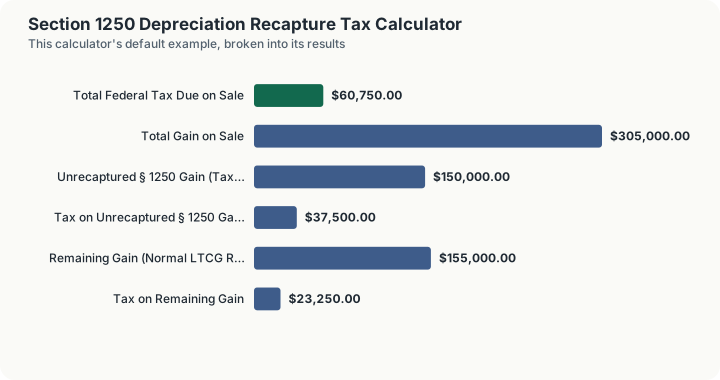
An owner bought a rental property for $500,000, made $50,000 in capital improvements over the years, and claimed $150,000 in accumulated depreciation. They sell it for $750,000, paying $45,000 in selling costs. They are a single filer with $150,000 in other taxable income for the year of sale.
Adjusted basis: $500,000 + $50,000 − $150,000 = $400,000.
Amount realized: $750,000 − $45,000 = $705,000.
Total gain: $705,000 − $400,000 = $305,000.
Unrecaptured Section 1250 gain: the lesser of $305,000 total gain or $150,000 accumulated depreciation, which is $150,000. The remaining $155,000 of gain is taxed at normal long-term capital gains rates.
Tax on the recapture layer: stacking $150,000 of ordinary-rate income on top of $150,000 of other taxable income (2026 single brackets) produces a marginal tax of $45,171.25 on that layer, using the standard bracket math. Since that figure exceeds 25% of $150,000, which is $37,500, the 25% statutory cap applies instead. Tax on this layer: $37,500.
Tax on the remaining gain: stacking $155,000 of long-term capital gain on top of $300,000 of combined ordinary-plus-recapture income (2026 single capital gains brackets, all of which falls in the 15% bracket at this income level) produces a tax of $23,250.
Total federal tax on the sale: $37,500 + $23,250 = $60,750, leaving net proceeds after federal tax of $644,250 out of the $705,000 amount realized.
What This Does Not Account For
- State income tax. Most states tax capital gains and depreciation recapture as ordinary income under their own rules, which are not modeled here.
- The 3.8% Net Investment Income Tax under IRC § 1411, which applies to net investment income (including this gain) above statutory MAGI thresholds for many sellers.
- Installment sale elections under IRC § 453, which can spread recognition of gain (and the associated tax) across multiple years instead of recognizing it all at once, though depreciation recapture generally must be recognized in the year of sale regardless of the installment method used for the rest of the gain.
- Section 1031 like-kind exchanges, which can defer recognition of both the gain and the recapture entirely if the sale proceeds are properly reinvested in replacement property.
- Passive activity loss carryforwards that may be freed up and usable against the gain in the year of a fully taxable disposition.
- Mixed-use or partial personal-use property, where only a business or rental-use portion of the gain and depreciation would be subject to these rules.
Common Pitfalls
- Confusing Section 1250 real property recapture with Section 1245 personal property recapture. Real property recapture is capped at 25%; personal and equipment property recapture is taxed as ordinary income with no cap, which can mean a materially higher rate for a seller in a high bracket.
- Assuming 25% is a flat rate rather than a ceiling. Sellers whose marginal ordinary rate is already below 25% get taxed at their actual marginal rate on the recapture layer, not bumped up to 25%.
- Forgetting that the recapture layer stacks first. The remaining gain, taxed at ordinary capital gains rates, sits on top of both the seller's other income and the recapture layer for purposes of determining which capital gains bracket it falls into. This can push otherwise 0%-bracket gain into the 15% bracket.
- Overlooking a 1031 exchange as an alternative to an outright sale. A properly structured like-kind exchange can defer both the recapture tax and the capital gains tax shown here entirely.
- Ignoring the Net Investment Income Tax. Many sellers with substantial gains from a property sale also cross the NIIT thresholds and owe an additional 3.8% that this calculator does not include.
Frequently Asked Questions
Is the 25% depreciation recapture rate always applied?
What happens if I never actually claimed the depreciation I was entitled to?
Does a 1031 exchange eliminate depreciation recapture?
How is depreciation recapture different for a personal residence?
Can capital losses from other investments offset the depreciation recapture tax?
Sources
- Internal Revenue Code § 1250(a), depreciation recapture rules for real property. law.cornell.edu/uscode/text/26/1250
- Internal Revenue Code § 1(h)(1)(E) and § 1(h)(6), 25% maximum rate on unrecaptured Section 1250 gain. law.cornell.edu/uscode/text/26/1
- Internal Revenue Code § 1245, depreciation recapture for personal property (contrasted here with § 1250 real property treatment). law.cornell.edu/uscode/text/26/1245
- Internal Revenue Code § 1411, Net Investment Income Tax. law.cornell.edu/uscode/text/26/1411
- Internal Revenue Code § 1031, like-kind exchanges. law.cornell.edu/uscode/text/26/1031
Also consulted: IRS Revenue Procedure 2025-32, 2026 ordinary income and long-term capital gains brackets.