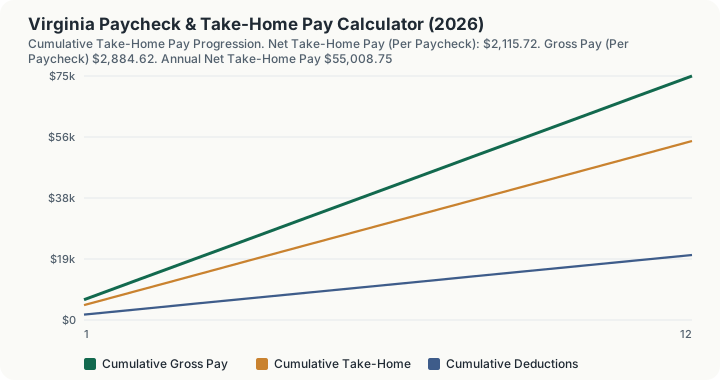
Quick Answer: A $75,000 annual salary in Virginia, paid bi-weekly and filing single, takes home about $2,115.72 per paycheck ($55,008.75 per year) after federal tax, FICA, and Virginia state withholding.
Overview
Compare Virginia to states with a single flat income tax rate and the difference shows up immediately: Virginia runs a graduated schedule with four brackets that top out at a 5.75% marginal rate, so the state's share of a paycheck depends on where taxable wages fall rather than one flat percentage. This calculator applies verified 2026 figures to compute the complete picture: Social Security and Medicare withholding, federal income tax brackets, Virginia's four-tier state tax, and how pre-tax elections like a 401(k) or HSA contribution change the wages those taxes get calculated against. It handles bi-weekly, semi-monthly, monthly, and weekly pay schedules, since identical annual pay produces a different-looking paycheck depending on how often you're paid. Salaried employees, hourly workers, payroll administrators, and HR departments all use the same underlying math here, just for different purposes, whether that's budgeting a household, negotiating an offer, or setting up withholding correctly for a new employee. Four brackets means the calculation has more moving parts than a flat-rate state, and getting each one right matters for the final number.
How This Is Calculated
Virginia's brackets have not moved in decades, and it shows: the 5.75% top rate begins at $17,000 of taxable income, so essentially every full-time worker in the state pays the top marginal rate on most of their salary. The schedule is graduated in form and flat in effect. Here is what that does to a paycheck:
Four steps stand between gross salary and net pay:
- FICA Payroll Tax Computation: - Social Security (OASDI): 6.20% withheld on wages up to the 2026 statutory wage base ($184,500). - Medicare (HI): 1.45% withheld on all gross earnings (no wage cap), plus 0.90% Additional Medicare Tax on earnings exceeding $200,000 (single) or $250,000 (married filing jointly).
- Federal Income Tax Withholding: Evaluated using 2026 progressive federal tax brackets (10%, 12%, 22%, 24%, 32%, 35%, 37%) after applying standard deduction thresholds ($16,100 single / $32,200 married joint).
- Virginia State Income Tax Withholding: Run against the 2026 Virginia schedule (2%, 3% above $3,000, 5% above $5,000, 5.75% above $17,000).
- Pay Period Proration: Annual net compensation is divided across the designated pay frequency (26 bi-weekly, 24 semi-monthly, 12 monthly, or 52 weekly pay periods).
Worked Example
Consider an employee in Virginia earning $75,000 annually, paid bi-weekly (26 paychecks per year), filing single, with $3,500 in annual pre-tax 401(k) contributions.
- Gross pay per paycheck. $75,000 ÷ 26 pay periods = $2,884.62 before any withholding.
- Pre-tax deduction. The $3,500 annual 401(k) contribution reduces each paycheck by $134.62 and also shrinks the wages used to calculate federal and state income tax; FICA is still assessed on the full gross amount.
- FICA payroll taxes. Social Security withholds 6.2% of gross pay ($178.85) and Medicare withholds 1.45% ($41.83), for $220.67 per paycheck.
- Federal income tax withholding. Applying the 2026 IRS withholding tables to the reduced taxable wage withholds $265.38 per paycheck.
- Virginia state tax withholding. Virginia's withholding tables apply to the reduced taxable wage, withholding $148.22 per paycheck.
- Net take-home pay. $2,884.62 gross, minus $134.62 pre-tax, minus $220.67 FICA, minus $265.38 federal tax, minus $148.22 state tax leaves $2,115.72 per paycheck, or $55,008.75 per year, an effective total tax rate of 21.99%.
Carrying Into Month Two And The Full Year
Virginia's brackets top out at 5.75% above $17,000, a threshold last adjusted decades ago, which makes the state a flat 5.75% tax in practice for anyone at this salary.
Step 7 -- Two months of cumulative pay. The schedule's first row shows $6,250.00 of cumulative gross against $4,584.06 of cumulative take-home. Row two doubles both: $12,500.00 gross, $9,168.13 take-home, with $3,331.88 accumulated on the deduction side.
Step 8 -- The full year. By month twelve the schedule reaches $75,000.00 of cumulative gross and $55,008.75 of cumulative take-home, adding $4,584.06 every month without variation.
Step 9 -- What the year actually withheld. The cumulative deduction column closes at $19,991.25. That column carries the $3,500 pre-tax 401(k) contribution alongside the tax, so tax alone is $19,991.25 - $3,500 = $16,491.25, an effective total tax rate of 21.99% on $75,000.00 of gross pay.
Step 10 -- Why the monthly increment never changes. Watch the increments and they never change. The reason is structural: annual FICA is calculated first, with Social Security stopping at $184,500 and Additional Medicare beginning at $200,000 for a single filer, and only the annual total is prorated across the twelve rows. A live payroll system would show the paycheck grow in the month the wage base is hit. This one cannot, and at $75,000 there is nothing to show -- the wage base is $109,500 away.
$55,008.75 is the annual result. Because the top bracket starts at $17,000, Virginia's share of the $16,491.25 total is effectively proportional to gross pay.
The Three Steps The Federal Schedule Puts In A Virginia Paycheck
At $20,500 of gross salary. Virginia's top 5.75% band opens at $17,000 of taxable income, and this engine runs the Virginia schedule on gross less the $3,500 pre-tax election, so $20,500 of gross is exactly $17,000 of Virginia taxable income. The check is $562.38 with $27.69 of Virginia tax, and the year closes at $14,621.75.
At $20,600, one hundred dollars later. The check is $565.32, the Virginia line $27.91, the year $14,698.35. That is $0.22 more per check, $5.75 across the year: the 5.75% rate, exactly. Below the edge, from $20,400 to $20,500, the state line moves $0.19 per check, or $5.00 a year, which is the 5% band. The whole distance between Virginia's second-highest and highest marginal rate is seventy-five cents per $100 of salary.
Why that matters less than it sounds. Virginia's top bracket begins at $17,000 and has not moved since 1990. Every salary this calculator is realistically pointed at sits above it, so the Virginia line is proportional to taxable wages across the entire default sweep: $148.22 per check at $75,000 and $424.66 at $200,000, both of them 5.75% of gross less the pre-tax election, divided by 26.
The federal edges, at $100 spacing. $70,000 of gross is not an arbitrary point for this input set. The $16,100 single standard deduction and the $3,500 pre-tax election shelter $19,600 between them, so $70,000 of gross is exactly $50,400 of federal taxable income, the dollar where the 22% federal band opens. At $70,000 the check is $1,991.49 and the year closes at $51,778.75. At $70,100, one hundred dollars later, the check is $1,993.98 and the year closes at $51,843.35. The federal line moves from $223.08 to $223.92 per check across that step, which is $0.84.
The next edge is the 24% band at $105,700 of taxable income, which is $125,300 of gross under the same election. At $125,300 the check is $3,365.48, the year $87,502.55, the reported effective rate 27.37%. At $125,400 it is $3,367.89, $87,565.15, 27.38%. Two full federal bracket edges therefore sit inside the salary range this calculator is most often pointed at, and neither of them is visible in the twelve-row schedule, which holds gross salary fixed and only walks the calendar.
Where FICA stops behaving like a flat 7.65%. Three probes at the same $100 spacing isolate it, and none of them involve the state line. From $150,000 to $150,100 of gross the FICA figure rises from $441.35 to $441.64 per check, $0.29. From $190,000 to $190,100 it rises from $545.92 to $545.98, $0.06: Social Security has stopped at the $184,500 wage base and only the 1.45% Medicare rate is still running on the next dollar. From $210,000 to $210,100 it rises from $560.54 to $560.63, $0.09, because the 0.9% Additional Medicare surtax switches on above $200,000 for a single filer. The engine applies all three of those rules to the annual figure and then divides by the pay frequency, so a real payroll ledger would show the wage base stopping mid-year while this schedule shows twelve identical steps.
What a $1,000 raise is actually worth. At $75,000 the annual take-home is $55,008.75; at $76,000 it is $55,654.75, so the raise delivers $646.00. At $150,000 the same $1,000 delivers $626.00, because the marginal federal rate is higher there. At $200,000 it delivers $679.00, more than at $150,000, because Social Security has already stopped on those dollars. The retained share is not monotonic in salary, and the wage base is why.
Right method against wrong method, priced. The effective total tax rate this calculator reports is tax divided by gross with the pre-tax election deliberately excluded from the numerator, because a 401(k) contribution is deferred pay rather than tax. Read as a take-home rate it misleads. The engine's own tax total for the worked example is $16,491.25, which would leave $58,508.75 of the $75,000. The check actually delivers $55,008.75 across the year. The $3,500.00 difference is the pre-tax contribution, and the cumulative deduction column in the schedule carries it alongside the tax, which is why that column closes at a larger figure than the tax total.
What This Does Not Account For
- The Virginia standard deduction and personal exemptions are not applied. State taxable income here is gross salary less the pre-tax election, so the $148.22 per check the worked example reports is higher than a return would produce.
- Local municipal, city, or county wage taxes where applicable.
- Post-tax wage garnishments (child support, tax levies, student loans).
- Voluntary post-tax deductions (Roth 401k, charitable giving, supplemental insurance).
Common Pitfalls
- Confusing Bi-Weekly with Semi-Monthly Pay: Bi-weekly pay results in 26 paychecks per year (two 3-paycheck months), whereas semi-monthly pay results in 24 equal paychecks.
- Failing to Update Form W-4: Inaccurate withholding allowances on Form W-4 can lead to substantial underpayment penalties or large unexpected tax bills.
- Forgetting Pre-Tax Deduction Benefits: Contributions to 401(k) and HSA accounts directly reduce taxable income, lowering both federal and state tax burdens.
- Overlooking Additional Medicare Tax: Failing to anticipate the 0.9% surtax on high-earning households with multiple income sources.
Frequently Asked Questions
Does Virginia have a state income tax on paychecks?
How is overtime pay taxed in Virginia?
What is the Social Security wage cap for 2026?
Can I adjust my state tax withholding?
Sources
- Internal Revenue Service (IRS): Publication 15 (Circular E) and Publication 15-T (2026). irs.gov/publications/p15
- Social Security Administration (SSA): 2026 Social Security Wage Base Limit. ssa.gov
- Virginia Department of Taxation: Employer Withholding Tax Tables (2026). tax.virginia.gov