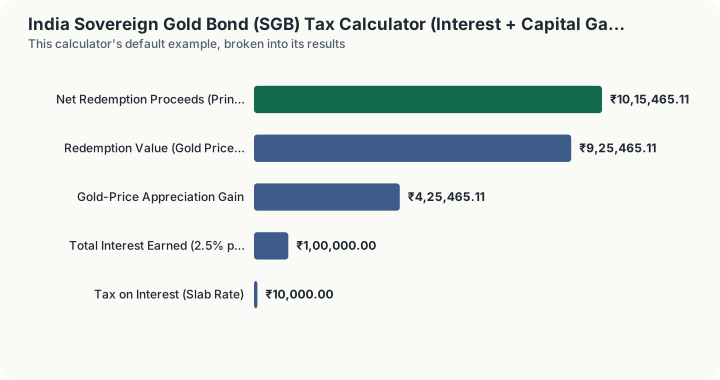
Quick Answer: For an Indian original subscriber who invested ₹5,00,000 in a Sovereign Gold Bond at issue and holds it the full 8-year tenor with gold appreciating 8% annually, the redemption value is about ₹9,25,465, with the ₹4,25,465 gold-price gain fully tax-exempt -- while the ₹1,00,000 of total interest earned over 8 years remains fully taxable (about ₹10,000 at a 10% marginal slab), for net redemption proceeds of roughly ₹10,15,465 after tax.
Overview
This calculator is built for Indian investors holding -- or considering the tax outcome of redeeming -- a Sovereign Gold Bond (SGB) issued by the Reserve Bank of India under the Sovereign Gold Bond Scheme, 2015. All figures are in Indian Rupees (₹); this product does not exist outside India, and RBI has not floated a new SGB tranche since February 2024 (the 2023-24 Series IV issue), with the Finance Ministry confirming during the Union Budget 2025 briefing that no further tranches are currently planned. This calculator therefore models the tax outcome of redeeming an already-held bond, not a live subscription decision.
An SGB carries two entirely separate return components, taxed completely differently. First, a fixed 2.5% per annum interest on the bond's issue-price value (not on the fluctuating market price of gold), paid semi-annually and credited in full at maturity along with the principal -- this interest is always taxable as "Income from Other Sources" at the investor's slab rate, with no exemption available. Second, the gold-price appreciation on the underlying value -- this is the component eligible for a capital-gains exemption, but only under specific conditions.
The exemption rule changed materially and recently: effective 1 April 2026, the Taxation and Other Laws (Amendment) Act 2026 tightened Section 70(1)(x) of the Income-tax Act 2025 (the successor to Section 47(viic) of the old Income-tax Act, 1961). Before that date, the exemption on maturity redemption applied broadly to "an individual" who held the bond to maturity, regardless of whether they were the original subscriber or a secondary-market buyer. As of Tax Year 2026-27, the exemption requires both: (a) the bond was bought at RBI's original issue, not the secondary market, and (b) it was held continuously until the 8-year maturity redemption. A secondary-market purchaser no longer qualifies even if they hold to maturity, and premature/early redemption -- even by the original subscriber, even through RBI's own 5th-year-onward early-exit window -- has never been eligible for this exemption; an early exit is always a fully taxable capital gain.
How This Is Calculated
Step 1: Project the gold-price component. Assuming a constant expected annual appreciation rate:
Step 2: Determine exemption eligibility.
If exempt, capital gains tax is zero. If not -- either because the exit is premature or because the holder was not the original subscriber -- the gain is taxed as a long-term capital gain at 12.5% (SGBs carry no indexation benefit, unlike physical gold or Gold ETFs held long-term before the 2024 reform).
Step 3: Compute interest, always taxable.
Step 4: Combine.
Worked Example
An original subscriber invests ₹5,00,000 at issue, holds the bond the full 8-year tenor, gold appreciates at an assumed 8% annually, and their other income puts them in the 10% new-regime slab.
Step 1: Redemption value = ₹5,00,000 × (1.08)⁸ = ₹5,00,000 × 1.85093... = ₹9,25,465.11. Gold appreciation gain = ₹9,25,465.11 − ₹5,00,000 = ₹4,25,465.11.
Step 2: Held the full 8 years by the original subscriber → fully exempt. Capital gains tax = ₹0.
Step 3: Total interest = ₹5,00,000 × 2.5% × 8 = ₹1,00,000. Tax at the 10% marginal slab = ₹10,000.
Step 4: Total tax = ₹0 + ₹10,000 = ₹10,000. Net redemption proceeds (principal + interest, after tax) = ₹9,25,465.11 + ₹1,00,000 − ₹10,000 = ₹10,15,465.11.
If the same investor had instead bought this exact bond from a secondary-market seller rather than at RBI's original issue, the ₹4,25,465.11 gold-price gain would no longer be exempt under the post-1-April-2026 rule -- it would instead be taxed as a long-term capital gain at 12.5%, adding roughly ₹53,183 of tax that a same-situation original subscriber would not owe.
What This Does Not Account For
This calculator assumes a constant, smooth annual gold-price appreciation rate; actual gold prices are volatile and the realized return over any specific 8-year window can differ substantially from a simple compounded assumption. It excludes the 4% Health and Education Cess on the tax figures shown. It does not model the semi-annual interest payment schedule in detail (it computes the total interest over the holding period rather than crediting and possibly reinvesting each semi-annual payment separately). It does not model RBI's specific early-redemption windows (available from the 5th year onward, on specific interest-payment dates) beyond simply flagging any holding period under 8 years as a premature exit for tax purposes. It does not account for wealth held in demat form versus paper SGB certificates, which does not affect taxation but can affect transferability and secondary-market liquidity. Finally, it does not model TDS, since interest on SGBs is not currently subject to TDS regardless of amount.
Common Pitfalls
- Assuming all SGB gains are tax-free. Only the gold-price-appreciation component redeemed at maturity by the original subscriber is exempt; the interest is always taxable, and the appreciation gain is fully taxable for premature exits or secondary-market holders.
- Missing the post-2026 tightening. Many older articles and even some broker material still describe the exemption as available to "any individual" who holds to maturity -- that broader rule stopped applying to redemptions on or after 1 April 2026.
- Confusing secondary-market SGB purchases with original subscriptions. Bonds bought on a stock exchange from another investor, even if held all the way to the 8-year maturity date, do not currently qualify for the exemption -- only the investor who subscribed at RBI's original issue does.
- Forgetting the interest is calculated on face value, not market value. The 2.5% rate always applies to the original issue-price investment, not to the fluctuating current or redemption value of the gold.
- Treating an early RBI-window exit (year 5 onward) as automatically tax-favorable. It is administratively permitted, but it is still a premature redemption for tax purposes and receives no capital-gains exemption.
Frequently Asked Questions
Can I still buy new Sovereign Gold Bonds?
What are the current sovereign gold bond capital gains exemption rules after the 2026 changes?
Is the interest from Sovereign Gold Bonds tax-free like the capital gains can be?
What happens if I sell my SGB early through the stock exchange rather than waiting for maturity or using RBI's early-redemption window?
Does the exemption change depend on how I hold the bond (demat vs. physical certificate)?
Sources
- Income-tax Act, 2025, Section 70(1)(x) (successor to Section 47(viic), Income-tax Act 1961), as amended by the Taxation and Other Laws (Amendment) Act 2026, effective 1 April 2026. incometax.gov.in/iec/foportal
Also consulted: Reserve Bank of India, Sovereign Gold Bond Scheme, 2015 (master scheme notification): 2.5% per annum fixed interest, paid semi-annually; Union Budget 2025 post-budget press briefing (Ministry of Finance), confirming no new SGB tranches planned.