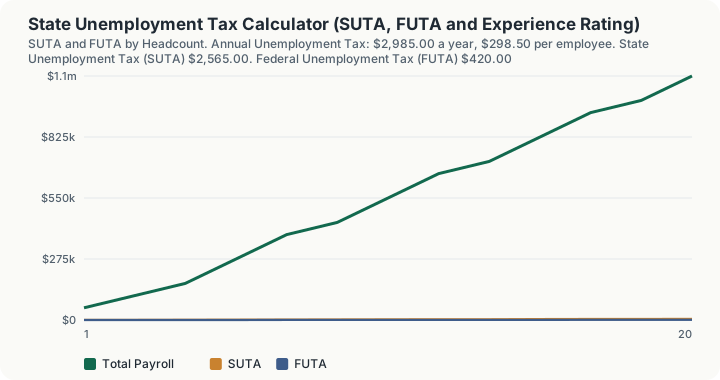
Quick Answer: Ten employees averaging $55,000, on a $9,500 state taxable wage base at a 2.7% assigned SUTA rate, cost $2,985.00 a year in unemployment tax, or $298.50 per employee. That is $2,565.00 of SUTA plus $420.00 of FUTA, and just 0.543% of payroll, because $455,000 of the $550,000 payroll sits above the wage base and is never taxed. The wage base and the assigned rate are both placeholders you must replace with your own state's figures.
What does this calculator do?
Unemployment insurance tax is entirely employer-paid and comes in two layers. FUTA is federal: 6.0% on the first $7,000 of each employee's wages, reduced by a credit of up to 5.4% for state unemployment taxes paid, leaving a net 0.6% for employers in almost every state. SUTA is the state layer, and it is where nearly all the money is.
The defining feature of both taxes is the wage base. Because tax stops at a fixed dollar amount per employee, headcount drives the bill far more than payroll dollars do. In the default case a $55,000 salary and a $155,000 salary produce identical unemployment tax. Hiring a second part-time worker costs more unemployment tax than doubling one existing salary.
Neither state figure on this page is a national one, and neither can be. Wage bases range from the $7,000 federal floor to several times that, with a number of states indexing theirs annually. Assigned rates are set per employer from that employer's own experience rating and are published on an individual rate notice. The defaults here are placeholders chosen to make the arithmetic legible, not anybody's real figures.
The calculator's second job is to price something most layoff budgets omit entirely: the experience rating consequence. When benefit charges hit an employer's account, the state raises the assigned rate, and that higher rate is charged on the employees who remain, for years after the layoff is finished.
How is this calculated?
SUTA = n × min(W, B_state) × r_state; FUTA = n × min(W, $7,000) × (0.6% + c)
where $n$ is headcount, $W$ the average wage, B_state the state wage base, r_state the assigned rate and $c$ any credit reduction.
Step 1: Find the SUTA taxable wages per employee. The lower of the average wage and the state wage base: (\55{,}000,\ \$9{,}500) = $ $9,500
Step 2: Total that across the workforce. $9,500 x 10 = $95,000
Step 3: Apply the assigned rate. $95,000 x 2.7% = $2,565.00 of SUTA Per employee: $9,500 x 2.7% = $256.50
Step 4: Find the FUTA taxable wages per employee. (\55{,}000,\ \$7{,}000) = $ $7,000
Step 5: Total that across the workforce. $7,000 x 10 = $70,000
Step 6: Compute the effective FUTA rate. 6.0% gross less the 5.4% maximum state credit, plus any credit reduction: 0.6% + 0.0% = 0.600%
Step 7: Apply it. $70,000 x 0.600% = $420.00 of FUTA
Step 8: Total the two layers. $2,565.00 + $420.00 = $2,985.00 Per employee: $2,985.00 ÷ 10 = $298.50
Step 9: Express it against payroll. Total payroll is $55,000 x 10 = $550,000 $2,985.00 ÷ $550,000 = 0.543% of payroll
Step 10: Measure the payroll that escapes tax entirely. $550,000 − $95,000 = $455,000 above the state wage base
Step 11: Price the layoff at the post-layoff rate. 8 remaining employees x $9,500 x 5.4% = $4,104.00 a year
Step 12: Take the annual increase. $4,104.00 − $2,565.00 = $1,539.00 a year Note that this compares the post-layoff position to the current one, so it nets the higher rate against the smaller headcount rather than isolating the rate effect alone.
Step 13: Multiply by the years the rate persists. $1,539.00 x 3 = $4,617.00 cumulative
Step 14: Add the severance. $4,617.00 + $40,000.00 = $44,617.00 total layoff cost That is $0.12 of extra tax per $1 of severance.
Worked Example
A 10-person agency pays an average of $55,000. Its state taxable wage base is $9,500 and its rate notice assigns 2.7%. It is not in a credit reduction state.
Step 1: SUTA. Only $9,500 per employee is taxable, so $95,000 in total: $95,000 x 2.7% = $2,565.00
Step 2: FUTA. Only $7,000 per employee is taxable, so $70,000 in total: $70,000 x 0.6% = $420.00
Step 3: The whole bill. $2,985.00 a year, or $298.50 per head, on a $550,000 payroll
Step 4: What that means for hiring decisions. Raising one employee from $55,000 to $155,000 adds zero unemployment tax, because both figures are far above both wage bases. Hiring one more person at $30,000 adds the full $298.50. Unemployment tax is a headcount tax, not a payroll tax.
Step 5: The layoff. The agency lays off two people, pays $40,000 of severance, and its state raises the assigned rate to 5.4% for three years: 8 x $9,500 x 5.4% = $4,104.00 a year, up $1,539.00 from $2,565.00
Step 6: The cumulative charge. $1,539.00 x 3 years = $4,617.00, borne entirely by the eight people who stayed
Step 7: The true cost. $40,000 + $4,617 = $44,617.00
Three variations change the picture completely. In a state with a $52,700 wage base, the same 2.7% rate taxes more than five times the payroll, which is why an assigned rate quoted without its wage base tells you nothing. An account carrying heavy benefit charges at an 8.5% rate pays several times the tax on identical payroll. And in a credit reduction state losing 0.3% of the FUTA credit, the federal rate rises from 0.6% to 0.9%, half again as much.
What does this calculator not account for?
- The state wage base and the assigned SUTA rate are placeholders, not real figures. There is no national SUTA wage base and no national SUTA rate. Both must come from your own state unemployment agency, and the assigned rate is specific to your account and appears on your annual rate notice. No calculator can know it.
- The post-layoff rate is likewise your input. Each state has its own rate-setting formula, its own experience period and its own schedule of rates keyed to the state's trust fund balance. This calculator applies the rate you supply; it does not derive it.
- The FUTA credit reduction list is not encoded. States with outstanding federal unemployment loans lose part of the 5.4% credit, the list changes annually, and it is published on Schedule A of Form 940. Zero is correct for most states in most years, but you should check.
- All employees are assumed to earn the same average wage. Where pay is uneven and some employees earn below the wage base, using an average overstates the taxable wages of the lower-paid and the calculation is approximate.
- The annual increase figure nets a headcount change against a rate change. It compares the post-layoff position, with fewer employees at the higher rate, against the current position. It is the change in the bill, not the isolated effect of the rate.
- The cumulative experience cost is undiscounted and assumes the higher rate persists flat for the number of years entered rather than tapering as the account recovers.
- The FUTA quarterly deposit requirement is noted in the underlying data but not modelled. Annual FUTA liability above $500 must be deposited quarterly.
- No state-specific surcharges, job training taxes, or administrative assessments are included, and several states levy them on top of the assigned rate.
What mistakes do people make with this?
- Comparing assigned rates between states. A 2.7% rate on a $9,500 base and a 2.7% rate on a $52,700 base are not the same tax. The rate is meaningless without the wage base beside it.
- Budgeting unemployment tax as a percentage of payroll. It is a percentage of the wage base times headcount. At these defaults the cost is 0.543% of payroll, but that figure would halve if average pay doubled and nothing else changed.
- Forgetting that unemployment tax is a headcount tax. Part-time and seasonal workers cost close to a full employee's unemployment tax if their wages reach the base.
- Omitting the experience rating cost from a layoff decision. The severance is visible and the rate increase is not. Here it adds $4,617 to a $40,000 severance, and for larger employers with longer experience periods it routinely exceeds the severance itself.
- Assuming the higher rate is charged on the people who left. It is charged on the people who stayed, on their taxable wages, for the whole of the state's experience period.
- Ignoring credit reduction states. Losing 0.3% of the credit is a 50% increase in the federal layer, and the loss compounds each year a state's loan remains outstanding.
- Assuming a new employer gets the lowest rate. New employers receive a state-assigned new-employer rate that has nothing to do with their own record, and it is frequently well above the minimum available to established accounts.
Frequently Asked Questions
What is the FUTA rate for 2026?
Where do I find my SUTA rate and wage base?
Why does my unemployment tax barely change when I give raises?
How much does a layoff really cost in unemployment tax?
What is a FUTA credit reduction state?
Do employees pay any unemployment tax?
Sources
- Internal Revenue Service, Tax Topic 759, "Form 940: Employer's Annual Federal Unemployment (FUTA) Tax Return," verified 2026-08-30. Source of the 6.0% gross FUTA rate, the $7,000 wage base, the 5.4% maximum state credit, the resulting 0.6% net rate, and the $500 annual liability threshold for quarterly deposits. irs.gov/taxtopics/tc759
- Internal Revenue Service, Form 940 Schedule A, which publishes the credit reduction states for each year. irs.gov/pub/irs-pdf/f940sa.pdf
- 26 U.S.C. 3301 and 3302: the federal unemployment tax and the credit for state unemployment contributions. law.cornell.edu/uscode/text/26/3301
Also consulted: Your own state unemployment agency, for the taxable wage base and your assigned experience rate. No national source exists for either figure, and the defaults on this page are placeholders.