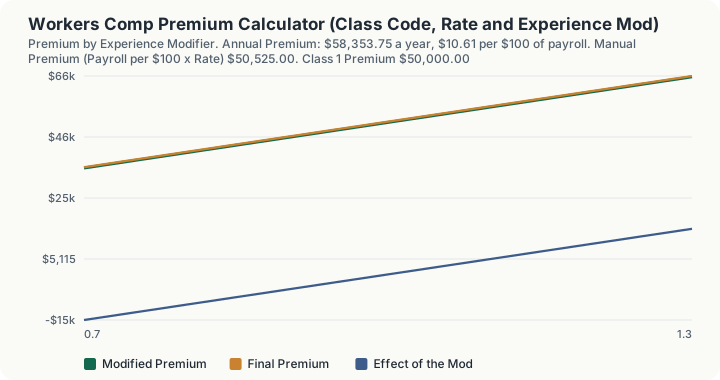
Quick Answer: $400,000 of payroll at a 12.50 rate and $150,000 at a 0.35 rate, run through a 1.15 experience modification factor and a $250 expense constant, produce an annual premium of $58,353.75, or $10.61 per $100 of payroll. The experience modifier alone adds $7,578.75 to the bill. Every rate and factor above is a placeholder: none is a real filed rate, and all of them must come from your own declarations page.
What does this calculator do?
Workers' compensation premium is built up in a fixed sequence, and understanding that sequence tells you where your money actually goes.
It starts with class codes. Payroll is assigned to hazard classifications, each carrying a filed rate expressed in dollars per $100 of payroll. A rate of 12.50 means $12.50 for every $100 of payroll, which is simply 12.5% of that payroll. The gap between a field class and a clerical class is usually enormous, a factor of thirty in the default figures here, which is why how payroll is classified matters far more than any negotiation over the rate.
Then the experience modification factor applies. Computed by the rating bureau from the employer's own three-year loss history, 1.00 is average for the class, above 1.00 is a debit and below 1.00 a credit. It is the only term in the whole build-up that an employer changes by having fewer claims rather than by negotiating.
After that come the discretionary and mechanical adjustments: a schedule credit at underwriter discretion where the state permits it, a size-based premium discount, and a flat expense constant added at the very end, after every factor.
There is no national workers' compensation rate. Class code rates are filed per state by NCCI or an independent state rating bureau and then modified by each carrier's own filed deviations. Nothing on this page is a real rate, and nothing could be.
How is this calculated?
Final = [(∑_c P_c/100 × r_c) × M × (1 − s)] × (1 − d) + E
where $M$ is the experience modifier, $s$ the schedule credit, $d$ the premium discount and $E$ the expense constant.
Step 1: Convert Class 1 payroll to hundreds. $400,000 ÷ 100 = 4,000 hundreds
Step 2: Multiply by the Class 1 rate. 4,000 x $12.50 = $50,000.00
Step 3: Convert Class 2 payroll to hundreds. $150,000 ÷ 100 = 1,500 hundreds
Step 4: Multiply by the Class 2 rate. 1,500 x $0.35 = $525.00 Note how little the clerical payroll contributes: 27% of total payroll producing 1% of the manual premium.
Step 5: Sum the classes for the manual premium. $50,000.00 + $525.00 = $50,525.00
Step 6: Apply the experience modification factor. $50,525.00 x 1.15 = $58,103.75 modified premium
Step 7: Isolate the dollar effect of the modifier. $58,103.75 − $50,525.00 = $7,578.75
Step 8: Apply the schedule credit to the modified premium. $58,103.75 x 0% = $0.00 credit
Step 9: Subtract it to reach the standard premium. $58,103.75 − $0.00 = $58,103.75
Step 10: Apply the premium discount to the standard premium. $58,103.75 x 0% = $0.00 discount
Step 11: Add the expense constant, after every factor. $58,103.75 − $0.00 + $250.00 = $58,353.75 final premium
Step 12: Express the result back per $100 of payroll. Total rating payroll is $550,000, so $5,500 hundreds: $58,353.75 ÷ 5,500 = $10.61 per $100 of payroll, or 10.610% of payroll
Worked Example
A specialty contractor has $400,000 of field payroll in a class carrying a 12.50 rate and $150,000 of clerical payroll at 0.35. Its bureau-issued experience rating worksheet shows a 1.15 modifier after two lost-time claims. No schedule credit was granted, the account is too small for a premium discount, and the state's filed expense constant is $250.
Step 1: Field class manual premium. $400,000 ÷ 100 x $12.50 = $50,000.00
Step 2: Clerical class manual premium. $150,000 ÷ 100 x $0.35 = $525.00
Step 3: Manual premium. $50,525.00
Step 4: The experience modifier. $50,525.00 x 1.15 = $58,103.75 The two claims are costing $7,578.75 a year, and the modifier is computed on a three-year window, so the same claims are charged again in each of the next two policy periods.
Step 5: Standard premium. No schedule credit, so $58,103.75
Step 6: Final premium. No discount, plus the $250 expense constant: $58,353.75
Step 7: The blended rate. $58,353.75 on $550,000 of payroll = $10.61 per $100, even though only one class code carries a rate anywhere near that.
Three levers, in order of size. A clean loss history producing a 0.85 modifier instead of 1.15 would cut the premium to $43,196.19, a saving of over $15,000 with identical payroll and identical rates. Reclassifying $100,000 of payroll from field to clerical, where the reclassification is genuine and defensible on audit, cuts the manual premium by $12,150 before the modifier even applies. And a 10% schedule credit for documented safety controls takes $5,810.38 off the modified premium. The class code and the modifier dominate; everything else is trimming.
What does this calculator not account for?
- No rate, factor or constant here is a real filed figure. Class code rates are filed per state by NCCI or an independent rating bureau and then adjusted by each carrier's filed deviations. The experience modifier is computed by the bureau from your own loss history. All the defaults on this page are placeholders chosen to make the arithmetic legible, and every one must be replaced with the figures from your declarations page.
- The experience modifier is not calculated, only applied. It is produced by the bureau's own formula from three years of losses, expected losses for your class, a primary/excess loss split and state-specific credibility weighting. Nothing here estimates it.
- Only two class codes are modelled. Real policies frequently carry many more, and the arithmetic extends by simple addition.
- Payroll classification is assumed correct. Assigning payroll to the wrong class code is the single largest source of both overpayment and audit adjustment in workers' compensation, and this calculator takes your split at face value.
- The premium audit is not modelled. Premium is charged on estimated payroll and adjusted at year end against actual payroll, which can produce a substantial additional bill or refund. This page computes premium on the payroll you enter.
- No state assessments, terrorism or catastrophe charges, deductible credits, retrospective rating plans or dividend plans are included, and several of those are material on larger accounts.
- Excluded and included officers, sole proprietors and partners are not handled. Whether owner payroll is in the rating basis, and at what statutory minimum or maximum, is state-specific.
- Nothing here is a quote. It is the standard premium build-up applied to figures you supply.
What mistakes do people make with this?
- Negotiating the rate instead of fixing the classification. Field and clerical rates in the default figures differ by a factor of thirty-six. Correctly separating genuinely clerical payroll saves more than any rate discussion, and misclassifying it is uncovered at audit.
- Treating the experience modifier as fixed. It moves in both directions and is recomputed annually from a rolling three-year window, so a single bad year is charged three times.
- Underestimating the cost of frequency. Bureau formulas weight claim frequency more heavily than severity, so several small claims commonly damage the modifier more than one large one.
- Applying the expense constant before the discount. It is added at the very end, after every factor and after the premium discount. Applying it earlier compounds it through the whole build-up.
- Confusing the schedule credit with the experience modifier. The modifier is bureau-calculated from actual losses. The schedule credit is underwriter discretion for controls and safety programmes, is not permitted in every state, and can be a debit as easily as a credit.
- Estimating payroll low to reduce the deposit premium. The audit will find it, and the adjustment arrives as a single bill.
- Comparing a rate between states. Rates are filed per state on state-specific benefit levels. A 12.50 rate in one state and a 12.50 rate in another are not the same price for the same risk.
Frequently Asked Questions
What does a workers' compensation rate of 12.50 mean?
What is an experience modification factor and how do I lower it?
Where do I get my class code rate?
Why is my clerical payroll so cheap to insure?
In what order are the discounts applied?
Will my premium change after the policy year ends?
Sources
- U.S. Small Business Administration, the official authority for the business this calculator relates to. sba.gov
Also consulted: Class code rates are filed on a state-by-state basis by the National Council on Compensation Insurance or by an independent state rating bureau, and are then modified by each individual carrier's filed deviations. Obtain yours from your carrier's declarations page or your state rating bureau; The experience modification factor is computed by the rating bureau from the individual employer's three-year loss history using that bureau's own formula. Obtain yours from your bureau-issued experience rating worksheet; The schedule credit, premium discount and expense constant are filed per state and per carrier and appear on the policy; The one universal element, and the only thing this calculator asserts, is the arithmetic of the build-up: manual premium is the sum over class codes of payroll divided by 100 times the rate; modified premium is manual premium times the experience modifier; standard premium is modified premium less the schedule credit; and final premium is standard premium less the discount, plus the expense constant.
This calculator contains no statutory data and no rate table, deliberately. There is no national workers' compensation rate to cite.