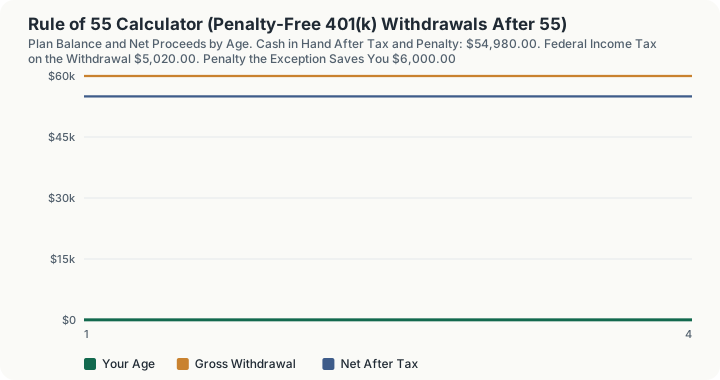
Quick Answer: Separating from service at 55 and drawing $60,000 from a $600,000 employer plan at 56, with no other income, leaves $54,980.00 in hand. The rule of 55 applies, so the 10% additional tax is $0.00 and the only cost is $5,020.00 of federal income tax, an effective cost of 8.37% of the withdrawal. Without the exception the same withdrawal would cost an extra $6,000.00 and leave $48,980.00.
What does this calculator do?
IRC section 72(t) charges a 10% additional tax on distributions from a retirement plan before age 59½. The separation-from-service exception, universally called the "rule of 55," removes it for people who leave an employer in or after the year they reach 55, taking money from that employer's plan.
Two facts about the rule are routinely got wrong, and both of them are expensive.
The test is the age at separation, not the age at withdrawal. Separating at 54 and waiting until 56 to withdraw does not qualify. Separating at 55 and withdrawing at 56 does. There is no way to fix a separation that happened a year too early.
The money must stay in the employer's plan. The exception exists for qualified employer plans. It does not exist for IRAs. Rolling the balance to an IRA is the standard advice on leaving a job, and doing it destroys the exception permanently. This calculator prices that mistake.
How is this calculated?
Income tax = T_ord(other income + withdrawal) − T_ord(other income)
Additional tax = 0.10 × withdrawal, if no exception applies
Net proceeds = withdrawal − income tax − additional tax
Step by step:
Step 1: Test the exceptions, in the order they override each other. Age 59½ or older ends the additional tax for everyone. A governmental 457(b) plan is outside it entirely. A running section 72(t)(2)(A)(iv) substantially-equal-periodic-payments plan removes it. Then the separation-from-service test: a qualified 401(k)-type plan and an age at separation at or above the threshold.
Step 2: Set the threshold. Age 55 normally, or age 50 for a qualifying public safety employee in a governmental plan.
Step 3: Apply the plan-type gate. If the balance has been rolled to an IRA, the plan type becomes an IRA and the separation exception is unavailable regardless of the separation age.
Step 4: Compute the incremental income tax. The withdrawal is stacked on top of the year's other ordinary income and taxed at the 2026 brackets after the standard deduction. It is a difference of two tax computations, not the withdrawal times an average rate.
Step 5: Compute the additional tax. 10% of the withdrawal where no exception applies, and nothing where one does.
Step 6: Subtract both from the gross to get cash in hand.
Step 7: Price the counterfactual. The engine re-runs the identical withdrawal against a deliberately failing status, someone who never qualified, and reports the difference as the penalty the exception saves.
Step 8: Report the marginal rate at the top of the withdrawal, and the total cost as a share of the gross.
Worked Example
Using the defaults: $600,000 plan balance, separated at 55, withdrawing $60,000 at age 56, no other income, single, not rolled over, not a public safety employee. The 2026 single standard deduction is $16,100.
Step 1: Test the age at withdrawal. 56 is below 59½, so the general exemption does not apply and the exceptions have to be tested.
Step 2: Test the separation age. Separation happened at 55, which meets the age-55 threshold, and the balance is still in a qualified 401(k). The exception applies: separation from service at age 55 or later.
Step 3: Compute taxable income. $0 other income + $60,000 withdrawal = $60,000 of ordinary income. $60,000 − $16,100 = $43,900.00 of taxable income
Step 4: Apply the 2026 single brackets. 10% × $12,400 = $1,240.00 12% × $31,500 = $3,780.00 $1,240.00 + $3,780.00 = $5,020.00 of federal income tax
Step 5: Compute the additional tax. The exception applies, so nothing is charged. 10% × $60,000 × 0 = $0.00
Step 6: Compute cash in hand. $60,000.00 − $5,020.00 − $0.00 = $54,980.00
Step 7: Express the total cost as a rate. $5,020.00 ÷ $60,000.00 = 8.37%, against a marginal ordinary rate of 12.00% at the top of the withdrawal.
Step 8: Price the counterfactual. Without any exception the same $60,000 would carry 10% × $60,000 = $6,000.00 of additional tax, leaving $48,980.00 in hand instead.
Step 9: Read the plan balance afterwards. $600,000 − $60,000 = $540,000.00
Step 10: Read the time remaining. 59.5 − 56 = 3.5 years until the additional tax stops applying to everyone. That is how long the exception has to keep working, and how many repetitions of this withdrawal it covers.
The exception is worth $6,000 on this single withdrawal. Repeated annually for the years until 59½, it is worth several times that, and rolling the balance to an IRA on the way out of the job would have forfeited all of it.
What does this calculator not account for?
- State income tax, and any state-level penalty on early distributions.
- Mandatory 20% federal withholding on eligible rollover distributions from a qualified plan. That is a withholding rule, not a tax rule: it changes what arrives in your bank account, not what you owe. This page computes the tax owed.
- Whether the plan permits partial distributions after separation. Many plans allow only a full lump sum, which would destroy the strategy of taking annual amounts. Check the summary plan description before relying on this.
- The taxation of Social Security, IRMAA, ACA premium tax credit cliffs, and every other consequence of a higher AGI.
- Roth balances and the ordering rules within a plan.
- Net unrealized appreciation on employer stock in the same plan.
- The section 72(t) SEPP alternative, which is a separate exception with its own rules and is not modelled here beyond removing the additional tax when flagged.
- Investment growth on the balance. The year-by-year table repeats the same withdrawal and reduces the balance by it, without growth.
What mistakes do people make with this?
- Rolling to an IRA first. This is the single most common and most expensive mistake. The separation-from-service exception does not exist for IRAs, and once the money is there the exception is gone for good.
- Separating in the year you turn 54. The exception needs separation in or after the calendar year you reach 55. One year early is fatal and cannot be repaired by waiting.
- Withdrawing from a former employer's plan. The exception applies to the plan of the employer you separated from at 55 or later. An older employer's plan from a job you left at 48 does not qualify.
- Assuming penalty-free means tax-free. The withdrawal is fully ordinary income. On these defaults that is $5,020 of federal tax on $60,000.
- Forgetting it is unavailable for SEP and SIMPLE IRAs.
- Confusing it with the public safety age of 50, which requires a qualifying public safety role in a governmental plan.
- Ignoring the bracket. Stacking a large withdrawal on top of severance or a spouse's salary can push the top of it into 22% or 24%.
Frequently Asked Questions
Does the rule of 55 apply if I roll my 401(k) to an IRA?
I separated at 54 but I am 56 now. Do I qualify?
Is the withdrawal tax-free?
Does it work for a 403(b)?
What if I am a police officer or firefighter?
What about a governmental 457(b) plan?
Sources
- IRS, "Retirement topics - Exceptions to tax on early distributions", irs.gov/retirement-plans/plan-participant-employee/retirement-topics-exceptions-to-tax-on-early-distributions: the separation-from-service exception ("the employee separates from service during or after the year the employee reaches age 55 (age 50 for public safety employees)"), its restriction to qualified plans and exclusion of IRAs, SEPs and SIMPLE IRAs, and the governmental 457(b) treatment ("not subject to the 10% additional tax except for distributions attributable to rollovers from another type of plan or IRA"). Fetched and verified 2026-08-30.
- IRC section 72(t)(1): the 10% additional tax rate. law.cornell.edu/uscode/text/26/72
- IRS Revenue Procedure 2025-32, irs.gov/pub/irs-drop/rp-25-32.pdf: the 2026 ordinary brackets and the $16,100 single standard deduction, held in
engine/tables/2026/federal-tax.json.
Also consulted: IRC section 72(t)(2)(A)(v), the separation-from-service exception; IRC section 72(t)(2)(A)(iv), substantially equal periodic payments.