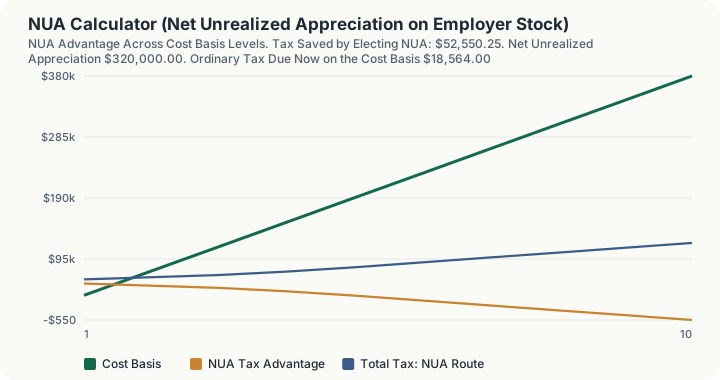
Quick Answer: $400,000 of employer stock carrying an $80,000 plan cost basis, distributed at 57 after separating from service at 57, saves $52,550.25 of federal tax under a Net Unrealized Appreciation election rather than a rollover into an IRA. The NUA route costs $66,564.00 in total tax, 16.64% of market value; the rollover route costs $119,114.25, or 29.78%, assuming $90,000 of other ordinary income in the distribution and sale years and $60,000 in the rollover withdrawal year.
What does this calculator do?
Net Unrealized Appreciation is the election in IRC section 402(e)(4) that lets you take employer stock out of a 401(k) in kind, pay ordinary income tax that year on the plan's cost basis only, and defer the appreciation until you sell the shares: at which point it is taxed as a long-term capital gain, automatically long-term whatever the actual holding period.
The alternative is the thing almost everyone does by default: roll the whole position into an IRA. That is not a neutral act. It converts every dollar in the position, basis and appreciation alike, into future ordinary income.
So the decision turns on one ratio: appreciation to basis. A small basis under a large appreciation makes the election extremely valuable, because you accelerate ordinary tax on very little in exchange for capital-gains treatment on a great deal. A large basis makes it worthless or actively harmful, because you accelerate ordinary tax on a large amount to shelter almost nothing.
This calculator prices both paths on identical facts and reports which is cheaper. It does not assume the election is right, and on a high-basis position it will tell you it is wrong.
How is this calculated?
The engine computes two complete tax paths and differences them.
NUA = Market Value − Plan Cost Basis
NUA Path Tax = T_ord(basis) + 0.10 × basis + T_LTCG(NUA)
Rollover Path Tax = T_ord(entire market value)
Advantage = Rollover Path Tax − NUA Path Tax
Step by step, exactly as the code runs:
Step 1: Separate the position into basis and appreciation. Market value minus the plan's cost basis. The basis is capped at market value, so the appreciation can never be negative.
Step 2: Tax the basis as ordinary income, incrementally. The basis is stacked on top of the distribution year's other ordinary income and taxed at the 2026 brackets after the standard deduction. This is an incremental figure: tax with the basis, minus tax without it. It is not the basis multiplied by an average rate.
Step 3: Apply the 10% additional tax to the basis, and only the basis. The section 72(t) additional tax reaches the cost basis and never touches the net unrealized appreciation. Whether it applies at all is decided by the separation-from-service test: if you left the employer in or after the year you turned 55, the exception removes it.
Step 4: Tax the appreciation as a long-term capital gain at sale. The gain is stacked above the sale year's ordinary taxable income in the 2026 long-term capital gains schedule. The rate you pay therefore depends on how much ordinary income sits underneath the gain.
Step 5: Add the three pieces to get the NUA path total.
Step 6: Price the rollover path. The entire market value is taxed as ordinary income, stacked on the ordinary income you assume in the withdrawal year. The engine taxes the whole balance in a single year.
Step 7: Difference the two. A positive number means the election wins.
Step 8: Find the break-even basis. The engine then re-runs the whole comparison at every cost basis from 0% to 100% of market value in 1% steps, and reports the highest basis at which the election still costs no more than the rollover. On the default inputs that is $376,000, or 94% of market value.
Worked Example
Using the calculator's default inputs: $400,000 of stock, $80,000 basis, $90,000 of other ordinary income in both the distribution and sale years, $60,000 in the rollover withdrawal year, single filer, separated at 57 and distributing at 57.
Step 1: Find the net unrealized appreciation. $400,000 − $80,000 = $320,000
Step 2: Express it as a share of value. $320,000 ÷ $400,000 = 80.0%
Step 3: Ordinary tax on the basis, stacked on $90,000. Taxable income without the basis is $90,000 − $16,100 = $73,900, on which the 2026 single schedule charges $10,970.00. Adding the $80,000 basis gives $153,900 of taxable income and $29,534.00 of tax. $29,534.00 − $10,970.00 = $18,564.00
Step 4: Apply the 10% additional tax to the basis. Separation happened at 57, at or after the age-55 threshold, so the rule-of-55 exception applies. 10% × $80,000 × 0 = $0.00
Step 5: Long-term capital gains tax on the appreciation. Sale-year ordinary taxable income is $73,900, already above the $49,450 top of the 0% band, so the whole gain falls in the 15% band (which runs to $545,500 for a single filer). 15% × $320,000 = $48,000.00
Step 6: Total the NUA path. $18,564.00 + $0.00 + $48,000.00 = $66,564.00
Step 7: Price the rollover path. Ordinary taxable income of $60,000 − $16,100 = $43,900 costs $5,020.00. Adding the full $400,000 gives $443,900 of taxable income and $124,134.25 of tax. $124,134.25 − $5,020.00 = $119,114.25
Step 8: Take the difference. $119,114.25 − $66,564.00 = $52,550.25
Step 9: Compare the effective rates. $66,564.00 ÷ $400,000 = 16.64% for the election, against $119,114.25 ÷ $400,000 = 29.78% for the rollover.
Step 10: Read the break-even. The election still wins at a basis as high as $376,000, which is 94% of market value, because the rollover path is being taxed as a single-year lump.
What does this calculator not account for?
- State income tax. Several states tax capital gains as ordinary income, which erases much of the advantage. None of that is modelled.
- The 3.8% net investment income tax under section 1411, which can apply to the appreciation at sale.
- Spreading the rollover withdrawals across many years. This is the single largest simplification here, and it works against the election. The engine taxes the entire rolled-over balance in one year at one stacked schedule. A retiree drawing an IRA down over twenty years would pay a much lower average ordinary rate, which is exactly why the break-even basis is as high as 94% on these defaults. Treat the break-even as an upper bound.
- Post-distribution appreciation. Only the NUA locked in at distribution is automatically long-term. Growth after the shares leave the plan follows ordinary holding-period rules.
- The lump-sum distribution requirement. The election is only available on a qualifying lump-sum distribution of the entire account balance within one tax year, triggered by a qualifying event. The calculator assumes you have satisfied that; it does not test it.
- Concentration risk. Nothing here prices the risk of holding a single employer's stock.
What mistakes do people make with this?
- Assuming NUA is always the right answer. It is a ratio question. Enter a $380,000 basis on the same $400,000 of stock and the election loses.
- Rolling first and asking later. Once the shares are in an IRA the election is gone permanently. The lump-sum distribution has to happen first.
- Thinking the 10% additional tax applies to the whole distribution. It reaches the cost basis only. On these defaults that would have been at most $8,000, not $40,000.
- Confusing the age at withdrawal with the age at separation. The rule-of-55 exception tests the year you left the employer. Separating at 54 and waiting until 56 does not qualify.
- Forgetting the sale year matters. Selling into a low-income year can drop part of the appreciation into the 0% long-term band. On these defaults, other income of $90,000 puts all of it in the 15% band.
- Ignoring diversification. Deferring the gain means continuing to hold the stock.
Frequently Asked Questions
Does the 10% early withdrawal penalty apply to the NUA?
What cost basis should I enter?
Is the NUA always taxed at long-term rates even if I sell immediately?
At what cost basis does the election stop being worth it?
Can I do a partial NUA election?
Does this include state tax?
Sources
- IRC section 402(e)(4): the statutory net unrealized appreciation election, and the rule that the appreciation is long-term at sale. law.cornell.edu/uscode/text/26/402
- IRS, "Retirement topics - Exceptions to tax on early distributions", irs.gov/retirement-plans/plan-participant-employee/retirement-topics-exceptions-to-tax-on-early-distributions: the separation-from-service exception ("separates from service during or after the year the employee reaches age 55") and the fact that it does not apply to IRAs. Fetched 2026-08-30.
- IRC section 72(t)(1): the 10% additional tax rate. law.cornell.edu/uscode/text/26/72
- IRS Revenue Procedure 2025-32 (Internal Revenue Bulletin 2025-45), irs.gov/pub/irs-drop/rp-25-32.pdf: the 2026 ordinary brackets, the $16,100 single standard deduction, and the 0%/15%/20% long-term capital gains thresholds. Held in
engine/tables/2026/federal-tax.json, verified 2026-08-21.