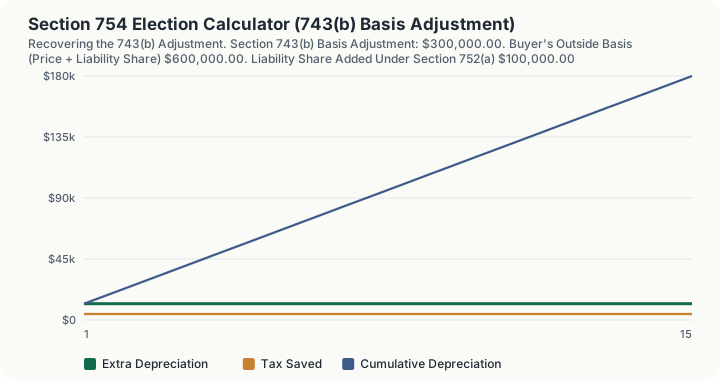
Quick Answer: A buyer paying $500,000 for 25% of a partnership whose assets carry $1,200,000 of adjusted basis against $2,400,000 of fair market value gets a $300,000 step-up under section 743(b). That is exactly the buyer's share of the partnership's built-in gain, which is the whole purpose of the election. With 60% of the adjustment landing on depreciable property recovered over 15 years, it produces $12,000 of extra depreciation a year and $4,440 of annual tax saving at a 37% marginal rate.
What does this calculator do?
When someone buys a partnership interest, they pay fair market value. But the partnership's inside basis in its own assets does not change. Section 743(a) is explicit: no adjustment is made to the basis of partnership property on a sale of an interest unless a section 754 election is in effect.
The consequence for the buyer is severe. They have paid full price for their share of appreciated assets, yet the partnership continues depreciating those assets from their old, lower basis, and on a later sale the buyer is allocated gain that accrued entirely before they arrived. They are taxed twice on the same appreciation: once in the price they paid, once again when the partnership sells.
The section 754 election fixes this. Once made, section 743(b) increases the basis of partnership property by the excess of the transferee's outside basis over their proportionate share of the adjusted basis of partnership property. Critically, the adjustment applies with respect to the transferee partner only: it is a personal basis adjustment that shows up in that partner's allocations, not a revaluation of the partnership's books for everyone.
The election is not free of consequences. It is binding on the partnership for all future transfers unless revoked with IRS consent, it creates real administrative burden, and where a buyer acquires an interest at a discount to their share of inside basis, section 743(b) is a step-down that works against them.
How is this calculated?
743(b) adjustment = (P + ωL) (outside basis) − ωB (share of inside basis)
where $P$ is the price paid, ω the ownership fraction, $L$ total partnership liabilities and $B$ the total adjusted basis of partnership assets.
Step 1: Convert the interest acquired to a fraction. 25% = 0.25
Step 2: Compute the buyer's share of partnership liabilities. $400,000 x 0.25 = $100,000 Section 752(a) treats the assumed liability share as a contribution of money, so it is added to the price.
Step 3: Compute the buyer's outside basis. $500,000 + $100,000 = $600,000
Step 4: Compute the buyer's proportionate share of inside basis. $1,200,000 x 0.25 = $300,000
Step 5: Take the difference. This is the section 743(b) adjustment. $600,000 − $300,000 = $300,000, a step-up
Step 6: Compute the partnership's total built-in gain. $2,400,000 − $1,200,000 = $1,200,000
Step 7: Take the buyer's share of it. $1,200,000 x 0.25 = $300,000 Without the election, section 743(a) leaves inside basis alone and the buyer is taxed on this $300,000 of gain that accrued before they bought in. It matches the adjustment exactly, which is the point.
Step 8: Split the adjustment between depreciable and non-depreciable property. $300,000 x 60% = $180,000 depreciable $300,000 − $180,000 = $120,000 recovered only on a sale
Step 9: Spread the depreciable portion over the recovery period. $180,000 ÷ 15 = $12,000 of extra depreciation a year
Step 10: Value that at the buyer's marginal rate. $12,000 x 37% = $4,440 of tax saved each year
Step 11: Value the whole adjustment at the same rate. $300,000 x 37% = $111,000 This is the undiscounted tax value of the entire adjustment, including the $120,000 portion that will not be recovered until the underlying property is sold.
Step 12: Check the price against economic value. Buyer's share of net asset value: ($2,400,000 − $400,000) x 0.25 = $500,000 Premium over that: $500,000 − $500,000 = $0, the buyer paid exactly asset value with no goodwill premium.
Worked Example
An investor buys a 25% interest in a real estate partnership for $500,000. The partnership's buildings and equipment have been depreciated down to $1,200,000 of tax basis but are worth $2,400,000. There is $400,000 of mortgage debt. The partnership makes a section 754 election.
Step 1: Liability share added under section 752(a). $400,000 x 25% = $100,000
Step 2: Outside basis. $500,000 + $100,000 = $600,000 This is why the adjustment is never simply "price minus book capital": the debt share is part of what the buyer's basis is.
Step 3: Share of inside basis. $1,200,000 x 25% = $300,000
Step 4: The section 743(b) adjustment. $600,000 − $300,000 = $300,000 step-up
Step 5: What the election is worth in the first year. $300,000 x 60% = $180,000 on depreciable property $180,000 ÷ 15 = $12,000 of extra depreciation $12,000 x 37% = $4,440 of tax saved
Step 6: What it is worth across the whole adjustment. $300,000 x 37% = $111,000, undiscounted, with $120,000 of the adjustment waiting for an eventual sale.
Step 7: What happens with no election. Nothing adjusts. The buyer continues to be allocated depreciation from the old $1,200,000 basis and, when the partnership sells, is allocated $300,000 of gain that economically belongs to the seller they bought from.
Now change one input. If the partnership were debt-free, there would be no section 752(a) addition, outside basis would be the $500,000 price alone, and the adjustment would fall from $300,000 to $200,000. And if the buyer had paid only $150,000 for the same interest, a distressed purchase, outside basis would be $250,000 against a $300,000 share of inside basis, producing a $50,000 step-down. The election works against the buyer in that case, and that is exactly why it is not automatic.
Carrying the Adjustment Across the Recovery Period
Step 8: Year two. Extra depreciation $12,000, tax saved $4,440, cumulative depreciation $24,000, adjustment remaining $156,000
Step 9: Year ten. Cumulative depreciation $120,000, adjustment remaining $60,000, and the annual saving in that row is still $4,440
Step 10: Year fifteen, the final row. Cumulative depreciation $180,000, adjustment remaining $0
Fifteen identical rows of $4,440 is what the depreciable slice ever delivers, and it arrives one year at a time. The other $120,000 of the adjustment produces nothing on this schedule at all; it sits as basis in non-depreciable property and only becomes worth anything when the partnership sells. So the $111,000 lifetime figure is not a lump the buyer receives. It is $4,440 a year for fifteen years plus a contingent benefit at an unknown future date, and those two halves are worth very different amounts once discounted.
What does this calculator not account for?
- The share of inside basis is computed as ownership percentage times total asset basis. Treas. Reg. 1.743-1(d) instead builds it from "previously taxed capital" plus the share of liabilities. The two agree for a straightforward partnership with proportionate capital, and diverge where there are special allocations, section 704(c) property, or partners with unequal capital accounts. Those cases are outside what this calculator computes.
- The section 755 allocation across asset classes is not performed. You supply a single depreciable percentage and a single recovery period; the statute requires the adjustment to be allocated among partnership properties by class, and that allocation drives the real timing.
- The lifetime tax value applies one marginal rate to the whole adjustment. The $120,000 non-depreciable portion is realised only on a sale of the underlying property, potentially at capital gains rates and potentially many years away. The figure is undiscounted and is a ceiling, not a present value.
- The mandatory downward adjustment under section 743(d) is not modelled. Where a substantial built-in loss exists immediately after a transfer, a step-down is required even without an election.
- The section 734(b) adjustment on distributions is out of scope, even though the same section 754 election switches it on and it is often the more consequential half of the decision.
- Hot assets and the ordinary income recharacterisation of section 751(a) are ignored, which matters for the seller's tax treatment and for how the adjustment behaves on recovery.
- No depreciation convention is applied. The depreciable portion is spread evenly across the recovery period rather than following MACRS, mid-month or mid-quarter conventions.
- The administrative cost and the binding nature of the election are not priced. Once made, it applies to all subsequent transfers and distributions until revoked with IRS consent.
What mistakes do people make with this?
- Computing the adjustment as price minus capital account. The buyer's liability share is part of outside basis under section 752(a). Omitting it understated the adjustment by $100,000 in the example above.
- Assuming the election is always good. A buyer acquiring at a discount to their share of inside basis gets a step-down, and the partnership is stuck with the election for future transfers too.
- Thinking the adjustment changes the partnership's books for everyone. It applies with respect to the transferee partner only. The other partners' allocations are unaffected, and the partnership must track a separate basis layer for the new partner indefinitely.
- Overvaluing the non-depreciable portion. Adjustment allocated to land, goodwill or non-amortisable intangibles produces nothing until a sale, which may never happen.
- Missing the election deadline. The section 754 election is made on a timely filed partnership return for the year of the transfer. It is not something the buyer can make; the partnership must, and buyers routinely negotiate for it in the purchase agreement for exactly that reason.
- Ignoring the recovery period. The same $300,000 adjustment on a 39-year building returns roughly $4,600 of extra depreciation a year instead of $12,000. The step-up is identical; its usefulness is not.
Frequently Asked Questions
What happens if the partnership does not make a section 754 election?
Who makes the election, the buyer or the partnership?
Why does partnership debt increase the adjustment?
Can the section 743(b) adjustment be negative?
How quickly do I actually get the benefit?
Does the election affect the other partners?
Sources
- 26 U.S.C. 743(a): no adjustment to the basis of partnership property on a sale or exchange of an interest unless a section 754 election is in effect. law.cornell.edu/uscode/text/26/743
- 26 U.S.C. 742 and 26 U.S.C. 1012: the buyer's initial outside basis is cost. law.cornell.edu/uscode/text/26/742
- 26 U.S.C. 752(a): an assumed share of partnership liabilities is treated as a contribution of money and is added to outside basis. law.cornell.edu/uscode/text/26/752
- 26 U.S.C. 755: allocation of the adjustment among partnership properties, which determines whether it is recovered through depreciation or only on a sale. law.cornell.edu/uscode/text/26/755
Also consulted: 26 U.S.C. 743(b): the increase or decrease in the basis of partnership property equal to the difference between the transferee's basis in the interest and their proportionate share of the adjusted basis of partnership property, applied with respect to the transferee partner only; Treas. Reg. 1.743-1(d): the "previously taxed capital" construction of the transferee's share of inside basis, which this calculator approximates as described above.
Statutory text verified 2026-08-30. Section 743 contains no dollar thresholds.