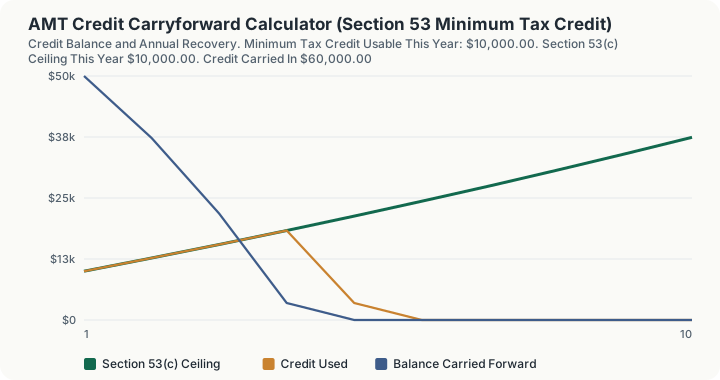
Quick Answer: A $60,000 minimum tax credit meeting $90,000 of regular tax and an $80,000 tentative minimum tax releases $10,000.00 this year, the section 53(c) ceiling for year one. The remaining $50,000.00 carries forward, and with regular tax growing 3% a year and the tentative minimum tax held flat, the whole $60,000 balance is recovered by year five.
What does this calculator do?
The minimum tax credit under 26 U.S.C. 53 exists to solve a timing problem. The alternative minimum tax sometimes charges you tax on income the regular system has not yet recognised, or denies a deduction the regular system has merely deferred. Exercising incentive stock options is the classic case: the bargain element is income for AMT purposes in the year of exercise and income for regular tax purposes only on sale. Without a corrective mechanism you would pay tax twice on the same economic gain. Section 53 is that mechanism. It converts the AMT you paid on those deferral items into a credit that sits on your return indefinitely, waiting for a year in which your regular tax exceeds your tentative minimum tax.
The catch is in section 53(c). The credit cannot simply be claimed. In any given year you may use only so much of it as your regular tax liability, reduced by the credits allowable under subparts A, B, D, E and F, exceeds your tentative minimum tax. If your tentative minimum tax is still at or above your regular tax, the ceiling is zero and nothing is released, no matter how large the balance. Many taxpayers who exercised options in a good year and paid substantial AMT discover that the credit takes many years to come back, and that the pace is set entirely by a gap they only partly control.
This calculator does one thing: it runs that ceiling forward year by year and shows how long the balance takes to clear. It does not compute the AMT itself. Both the tentative minimum tax and any new adjusted net minimum tax are inputs you supply from your own Form 6251.
How is this calculated?
The section 53(c) limitation for a year is
limitation = max(0, (regular tax − other nonrefundable credits) − tentative minimum tax)
and the credit actually used is the lesser of that limitation and the balance on hand:
credit used = min(opening balance, limitation)
Step 1: Reduce regular tax by the other nonrefundable credits. $90,000 - $0 = $90,000.00
This is the first term of the 53(c) ceiling. Credits under subparts A, B, D, E and F come off first, which is why they crowd the minimum tax credit out rather than stacking with it.
Step 2: Subtract the tentative minimum tax to get the ceiling. $90,000.00 - $80,000.00 = $10,000.00
Where this figure is zero or negative it is floored at zero. The gap between regular tax and tentative minimum tax is the only thing that releases the credit.
Step 3: Take the lesser of the ceiling and the balance carried in. min($60,000.00, $10,000.00) = $10,000.00
Step 4: Roll the balance forward. $60,000.00 - $10,000.00 + $0 = $50,000.00
Any new adjusted net minimum tax arising in the year is added at this point, per section 53(b). Section 53 sets no expiry, so whatever remains carries indefinitely.
Step 5: Grow regular tax and repeat. $90,000 x 1.03 = $92,700.00 for year two, with the tentative minimum tax held flat at $80,000 throughout the projection.
Worked Example
Take the defaults and run five years.
Step 1: Year one. Ceiling $90,000 - $80,000 = $10,000.00. Credit used $10,000.00. Balance $50,000.00.
Step 2: Year two. Regular tax $90,000 x 1.03 = $92,700.00. Ceiling $92,700 - $80,000 = $12,700.00. Credit used $12,700.00. Balance $50,000 - $12,700 = $37,300.00.
Step 3: Year three. Regular tax $92,700 x 1.03 = $95,481.00. Ceiling $15,481.00. Balance $37,300 - $15,481 = $21,819.00.
Step 4: Year four. Regular tax $95,481 x 1.03 = $98,345.43. Ceiling $18,345.43. Balance $21,819.00 - $18,345.43 = $3,473.57.
Step 5: Year five. Regular tax $98,345.43 x 1.03 = $101,295.79. Ceiling $21,295.79, far more than the balance, so only $3,473.57 is used and the balance reaches $0.00.
Total recovered over the projection: $60,000.00. Recovery year: year five.
Now change one input. Raise the tentative minimum tax to $95,000 and year one's ceiling becomes $90,000 - $95,000, floored to $0.00. Nothing is released. You are still inside AMT, and the credit sits untouched until the 3% growth in regular tax finally lifts it above $95,000. That single change pushes full recovery out to year nine.
Or leave the tentative minimum tax alone and add $8,000 of other nonrefundable credits. Step 1 becomes $90,000 - $8,000 = $82,000.00, and the ceiling falls to $2,000.00. Other credits do not stack with the minimum tax credit; they consume the same headroom.
What does this calculator not account for?
- It does not compute the AMT. Tentative minimum tax and adjusted net minimum tax are both inputs. Nothing here derives them from alternative minimum taxable income, the exemption amount, or the exemption phase-out.
- It does not split exclusion items from deferral items. Section 53(d)(1)(B) allows a non-corporate taxpayer a credit only for the portion of AMT attributable to timing items. The opening balance you enter is assumed already net of exclusion items, exactly as line 26 of Form 8801 would give it to you.
- It holds the tentative minimum tax flat. In reality the tentative minimum tax moves with your income and with the AMT exemption. Only the regular tax grows in this projection, at the rate you supply.
- It applies no state minimum tax credit rules. Several states run their own AMT and their own credit carryforward with different limitations.
- Corporate AMT is out of scope, including the section 55(b)(2) corporate alternative minimum tax on adjusted financial statement income.
- The 3% growth assumption is yours, not a forecast. Set it to zero for a flat projection if you prefer no assumption at all.
What mistakes do people make with this?
- Believing the credit expires. It does not. Section 53 contains no expiry provision, and the balance carries forward indefinitely. What people usually mean when they say it expired is that they never generated the gap needed to use it.
- Expecting the whole balance back in the first good year. The 53(c) ceiling is a per-year cap. A $60,000 balance with a $10,000 ceiling takes at minimum six years of flat conditions to clear, and the recovery is not a refund: it reduces tax you would otherwise owe.
- Forgetting that other credits come first. Section 53(c) subtracts subparts A, B, D, E and F credits from regular tax before the comparison with tentative minimum tax. A taxpayer with a large foreign tax credit or education credits can find the minimum tax credit ceiling collapses to almost nothing.
- Assuming AMT paid on exclusion items generates a credit. It does not, for individuals. Only deferral items feed the balance, which is why the AMT paid because of a large state tax deduction addback generally produces no credit at all.
- Generating new AMT while trying to recover old AMT. A recurring timing item, such as exercising options every year, adds to the balance at roughly the pace the ceiling releases it, and the balance never falls.
- Confusing the credit with a deduction. The minimum tax credit reduces tax dollar for dollar, but only down to the tentative minimum tax floor, never below it.
Frequently Asked Questions
Does the AMT credit ever expire?
Why is my credit zero this year even though I have a large balance?
Where do I find these numbers on my return?
Does exercising incentive stock options every year help or hurt the recovery?
Is the minimum tax credit refundable?
Sources
- 26 U.S.C. 53, the minimum tax credit: 53(a) allows the credit; 53(b) defines it as a running balance of adjusted net minimum tax imposed for all prior years beginning after 1986 less amounts already allowed; 53(c) caps the annual credit at the excess of regular tax liability reduced by the subpart A, B, D, E and F credits over the tentative minimum tax; 53(d)(1)(B) restricts a non-corporate taxpayer's credit to the timing-item portion. law.cornell.edu/uscode/text/26/53 (read 2026-08-30)
Note on figures: section 53 contains no dollar amounts. Every monetary figure in this calculator comes from your own return, so there is no statutory table to become stale. The 3% growth in regular tax is a projection assumption you control, not a published rate.