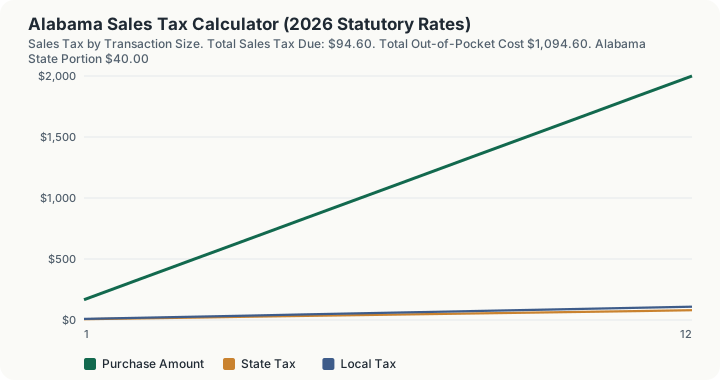
Quick Answer: A $1,000 taxable purchase in Alabama costs $94.60 in combined state and local sales tax, for a total of $1,094.60 out the door.
Where the 9.46% Actually Goes
Alabama's statutory state rate is 4.00% and the statewide average local add-on is 5.46%, for a combined 9.46%. On the $1,000 default the engine returns $94.60 of tax, split $40.00 to the state and $54.60 to counties and municipalities. Alabama is one of the few states where the local component is the larger one: local government takes $14.60 more per $1,000 of taxable spending than Montgomery does.
That split holds at every size the engine was run at. At $50,000 the tax is $4,730.00, of which $2,000.00 is state and $2,730.00 is local. At $100 it is $9.46, of which $4.00 is state and $5.46 is local. The 5.46% figure is a single statewide average, and the calculator has no ZIP code, city, or county input anywhere in its configuration, so no actual Alabama buyer pays exactly this number.
How This Is Calculated
Alabama sets one of the lowest state sales tax rates in the country at 4.00%, and then lets counties and municipalities pile on far more than that. The average local add-on is 5.46%, so local government collects more sales tax on a typical Alabama purchase than the state does. On a $1,000 taxable purchase the combined 9.46% rate produces $94.60 of tax, of which only $40.00 goes to Montgomery and $54.60 stays with the county and city. Alabama is also one of the few states that still taxes groceries, though at a reduced state rate rather than the full 4.00%.
Because the state and local pieces sit on the same base and are simply added together, the arithmetic is a single multiplication against a combined rate:
The calculator works through it in this order:
- Read the purchase price. The full pre-tax amount you enter becomes the taxable base. Negative entries are clamped to zero; nothing else is adjusted.
- No item-level exemption filtering. Alabama's reduced grocery rate and its prescription drug exemption are not modeled: the combined rate is applied uniformly to whatever amount you enter, so enter only the portion of a receipt that is taxed at the general rate.
- Multiply by the state rate and round to the cent. This produces the state portion of the bill as its own rounded figure.
- Multiply by the local surcharge and round to the cent separately. The 5.46% figure is a population-weighted average of Alabama county and municipal rates. A specific city can sit well above or below it, and Alabama's self-administered localities are a large part of why the spread is so wide. If the local toggle is off, this term is zero.
- Add the two rounded pieces together. State tax plus local tax gives the total tax, and adding that to the purchase price gives the amount you actually pay.
Worked Example
For a $1,000 taxable purchase in Alabama:
- Starting purchase price. The buyer rings up a $1,000.00 taxable retail purchase in Alabama, the baseline amount before any tax is applied.
- State portion. Alabama's statutory state sales tax rate of 4.00% applies to the full purchase amount: $1,000.00 × 4.00% = $40.00 owed to the state.
- Local portion. Local municipal, county, and special-district surcharges add an average of 5.46% on top of that: $1,000.00 × 5.46% = $54.60 more.
- Combined tax due. Summing the two pieces, $40.00 in state tax plus $54.60 in local surcharge comes to $94.60 in total sales tax owed on the transaction.
- Total out-of-pocket cost. Adding that $94.60 in tax to the $1,000.00 purchase price brings the buyer's total out-of-pocket cost to $1,094.60.
This example uses Alabama's statewide average local rate of 5.46%; actual combined rates vary by city and county, so a real receipt could show a combined rate above or below the 9.46% average used here.
Walking the Purchase Sweep: There Is No Edge Anywhere
The tier schedule on this page is a straight line, and that is the finding. Alabama's sales tax has no bracket, no exemption threshold, and no cap at any transaction size, so the twelve computed tiers rise in exact proportion: $15.77 of tax at $166.67, $47.30 at $500.00, $94.60 at $1,000.00, $141.90 at $1,500.00, and $189.20 at $2,000.00. Pushed further out, the same line gives $473.00 at $5,000.00, $2,365.00 at $25,000.00 and $4,730.00 at $50,000.00.
The effective rate is identical at both ends of that range. At $100 the tax is $9.46 and at $50,000 it is $4,730.00; both are exactly 9.46% of the base. There is no purchase size at which a different rate begins, which means any advice about "staying under" a figure has nothing to attach to on this page.
The marginal cost of the next $100 is $9.46. The engine returns $94.60 at $1,000.00 and $104.06 at $1,100.00. One dollar more costs nine cents: $94.60 becomes $94.69 at $1,001.00.
The Only Discontinuity: the Local Surcharge Toggle
The single step change this calculator can produce is the Include Average Local / County Surcharge switch, and it is worth pricing at more than one size. On a $1,000.00 purchase, turning local tax off drops the bill from $94.60 to $40.00, and the out-the-door total from $1,094.60 to $1,040.00. On a $50,000.00 purchase it drops from $4,730.00 to $2,000.00, a $2,730.00 swing.
That is a larger absolute change than most bracket edges in this corpus produce, and it is entirely a modelling choice rather than a statutory event: the engine is switching between the 4.00% state rate alone and the 9.46% statewide average. Nothing about a real Alabama transaction toggles that way. A purchase in an Alabama municipality with no local levy genuinely faces 4.00%, and one in a high-rate city faces well above 9.46%, but the calculator cannot tell you which you are in.
Backing the Tax Out of a Receipt Total
The most common real question this page cannot answer directly is the reverse one: a receipt totals $1,000.00 including tax, so what was the shelf price and how much of that was tax? The engine runs in one direction only. It takes a pre-tax amount and adds tax; there is no tax-extraction mode and no gross-to-net input.
The answer can still be produced by running the calculator at candidate pre-tax amounts until the out-the-door total lands on the target. For Alabama that pre-tax amount is $913.58, which the engine prices at $36.54 state tax plus $49.88 local tax, or $86.42 total, for an out-the-door cost of exactly $1,000.00. A cent either side misses: $913.57 totals $999.99 and $913.59 totals $1,000.01.
The wrong method, priced. The frequent error is to take the $1,000.00 tax-inclusive total and multiply it by 9.46%, which the calculator will happily do for you: entered as a pre-tax amount, $1,000.00 returns $94.60 of tax. That is $8.18 more than the $86.42 actually embedded in a $1,000.00 receipt. The correct operation is the tax fraction, r divided by (1 + r), not the rate itself. Expressed against the gross, Alabama's 9.46% combined rate is about 8.64% of a tax-inclusive total, and the two numbers are far enough apart that a bookkeeping system using the headline rate to strip tax from gross receipts will never reconcile. On $100,000 of gross taxable receipts the same error runs to roughly $818.
What This Does Not Account For
- Any specific jurisdiction. The 5.46% local figure is one statewide average. There is no ZIP, city or county input in the configuration, and Alabama's self-administered localities spread widely around that average.
- What you bought. No product taxability classification exists in the engine. Alabama's reduced grocery rate, its prescription drug exemption, clothing, and services are all taxed at the same 9.46% here as a general-merchandise purchase.
- Exemption and resale certificates, direct pay permits, and sales tax holidays. None are modelled; there is no input that could express them.
- Use tax, marketplace facilitator collection, and economic nexus thresholds for sellers. The engine prices a single transaction and knows nothing about who is obliged to remit it.
- Special industry excise taxes such as lodging, rental vehicle, alcohol and tobacco levies, which stack on top of the general rate in practice.
- Cent-level agreement with a register that applies one combined rate. The state and local components are each rounded to the cent before being summed, so the result can differ by a cent from applying 9.46% once. At $999.11 the engine returns $94.51 of tax; applying the combined rate a single time and rounding gives a figure one cent higher.
Common Pitfalls
- Quoting 4.00% as Alabama's sales tax. On $1,000.00 that understates the bill by $54.60, because the local layer here is larger than the state layer.
- Stripping tax from a gross total with the headline rate. $1,000.00 tax-inclusive contains $86.42 of tax, not $94.60.
- Treating 9.46% as a rate anyone is charged. It is a population-weighted average with no jurisdiction behind it.
- Expecting a threshold. The sweep is linear from $0.09 of tax on a $1.00 purchase to $4,730.00 on a $50,000.00 purchase, with no rate change at any point.
Frequently Asked Questions
What is the sales tax rate in Alabama?
How much of an Alabama sales tax bill is local?
How much tax is inside a $1,000 Alabama receipt?
Are groceries taxed in Alabama?
How does use tax differ from sales tax?
Sources
- Alabama Department of Revenue: 2026 Sales and Use Tax Rate Schedules. revenue.alabama.gov
- Streamlined Sales Tax Governing Board (SSTGB): State Taxability Matrix. streamlinedsalestax.org/for-businesses/taxability-matrix