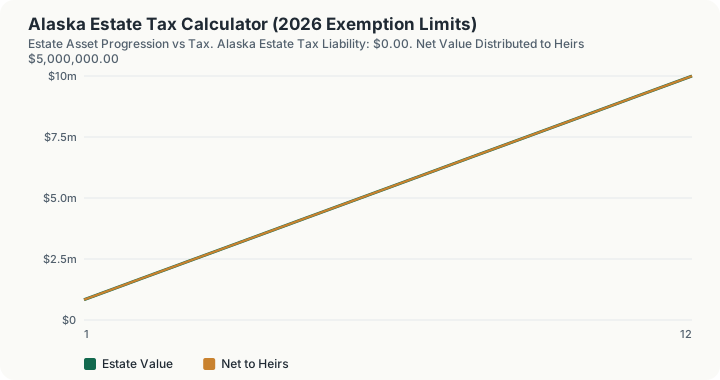
Quick Answer: Alaska has no state-level estate tax, so a $5,000,000 estate owes $0 in Alaska estate tax. Federal exemption rules apply separately.
One Answer at Every Estate Size
The engine's 2026 state estate tax table carries an Alaska record with hasEstateTax set to false, an exemption of $0, and an empty bracket array. The primitive reads that flag and returns before any rate arithmetic runs.
At the default $5,000,000 gross estate the calculator returns $0.00 of Alaska estate tax, an effective rate of 0.00%, an exemption threshold of $0, and $5,000,000.00 distributed to heirs. Move the estate value anywhere within the accepted range and the tax figure does not change. That is the correct Alaska result, not a gap in the tool.
How This Is Calculated
There is no Alaska estate tax entry to clear and no rate schedule to walk. The calculator establishes that rather than computing against a threshold.
- Value the gross estate. Fair market value at the date of death of all real property, business interests, securities, cash, and life insurance proceeds the decedent owned. The figure is taken as typed.
- Subtract allowable deductions. The deductions box is subtracted from the gross and the result floored at zero. The subtraction runs; what it feeds is a state test Alaska cannot fail.
- Look Alaska up in the state estate tax table. The lookup returns
hasEstateTax: false, and the function exits immediately with a tax of $0, an exemption threshold of $0, and a taxable estate above exemption of $0. - Return $0. The net estate passes to beneficiaries with no Alaska reduction at any size.
Worked Example
- Start with the gross estate. A $5,000,000 gross estate: real property, business interests, equities, cash, and life insurance at date-of-death fair market value, before deductions.
- Check Alaska's status in the table. No estate tax, no brackets, so no exemption threshold or rate schedule is loaded.
- Compute the state estate tax due. $0.00.
- Distribute the net estate. The full $5,000,000.00 passes to beneficiaries.
- What this excludes. Alaska's state-level result only. The federal return is separate and is not computed on this page.
Reading a Column of Zeros
Each of these is an independent run of the calculator.
At a $1,000,000 estate. Alaska estate tax = $0.00; net to heirs $1,000,000.00.
At a $9,999,000 estate. Alaska estate tax = $0.00; net to heirs $9,999,000.00.
At a $14,999,000 estate, and again at $15,001,000. Alaska estate tax = $0.00 in both runs. The step between them costs $0.00.
At a $30,000,000 estate. Alaska estate tax = $0.00; net to heirs $30,000,000.00.
At a $50,000,000 estate. Alaska estate tax = $0.00; net to heirs $50,000,000.00.
The marginal cost of the next $1,000,000 of estate value is $0.00 everywhere in that range, and the effective rate reads 0.00% at both ends of it. The reverse question -- what value can pass before Alaska charges -- returns no finite figure, because the code path that would charge is never entered.
This is worth being explicit about because a reader arriving from a state that does tax estates expects the interesting part of the page to be a cliff. There is no cliff here at any value the input accepts, and none of the two inputs can produce one.
Testing the Deduction Box Against the Result
The deductions field is functioning code, so it is fair to ask what it buys an Alaska estate. The calculator answers directly.
On a $5,000,000 gross estate with deductions at $0, the tax is $0.00 and net distributed is $5,000,000.00. At $1,000,000 of deductions the tax is $0.00 and net distributed is $4,000,000.00. At $5,000,000 of deductions the tax is $0.00 and net distributed is $0.
Net distributed moves by the full amount of the deduction. The tax does not move at all, because it was already zero and the deduction is applied before a state test whose answer is fixed. The total Alaska tax saved by claiming $5,000,000 of deductions is $0.00.
The $0 on the Exemption Threshold Line
The secondary output labelled Statutory Exemption Threshold shows $0 here, which reads as "nothing is exempt" and means the reverse.
That field is populated with a real statutory figure only for states the table gives an estate tax. For Alaska the early return assigns $0 as a null placeholder, alongside a hasEstateTax value of false and a taxable-estate-above-exemption of $0. A state that truly taxed from the first dollar would show a threshold of $0 and a large tax figure; here the tax figure beside it is $0.00 at $50,000,000, and that pairing is what identifies the no-tax case.
The Federal Position Is Absent From This Figure
The engine models no federal estate tax. There is no federal exemption anywhere in its 2026 tables, no unified credit, no portability of a deceased spouse's unused exclusion, no add-back of lifetime taxable gifts, and no generation-skipping transfer tax.
A $50,000,000 Alaska estate showing $0.00 on this page therefore has an uncomputed federal position, not a zero death tax bill. The headline answers one jurisdiction and is silent about the one that would produce the larger number.
Alaska also does not appear in the engine's separate 2026 state inheritance tax table, which carries records for five states only: Pennsylvania, Nebraska, Maryland, Kentucky, and New Jersey. Estate tax and inheritance tax are distinct charges with different payers, so a zero in one does not imply a zero in the other, but for Alaska neither table generates a liability.
Situs, Not Domicile
The calculator takes a single jurisdiction. Real property physically located in a state that does levy an estate tax remains taxable by that state on its own schedule, regardless of where the decedent was domiciled, and this page has no input that could represent it. An Alaska resident holding real estate in a taxing state gets $0.00 here and a separate, uncomputed liability there.
What This Does Not Account For
- Federal estate tax under IRC Chapter 11. Not computed; no federal exemption figure exists in the engine's tables.
- Federal generation-skipping transfer tax under IRC Chapter 13. Not computed.
- Out-of-state situs. One jurisdiction per run, with no apportionment.
- Valuation adjustments. Minority-interest and lack-of-marketability discounts on closely held entities are not applied; enter the value your appraisal supports.
- Administration cost. Executor commissions and ancillary probate expenses reach the calculation only through the deductions figure you type, and in Alaska that figure cannot change the tax.
Common Pitfalls
- Treating the $0 exemption threshold as a statutory limit. It is the no-tax sentinel, sitting beside a tax of $0.00 at $50,000,000.
- Crediting deductions with the zero result. With deductions at $0 the answer is $0.00; with deductions at $5,000,000 it is also $0.00.
- Reading the headline as a full death tax bill. No federal component is included in it.
- Assuming a vacation property elsewhere is covered. It is not; the calculator sees only Alaska.
- Waiting for a threshold at a higher value. The sweep runs to $50,000,000 without the answer moving.
Frequently Asked Questions
Does Alaska have a state estate tax?
Does Alaska have an inheritance tax?
Do deductions lower the Alaska estate tax?
Why is the exemption threshold $0?
Is a $0.00 result the whole death tax picture?
Sources
- Alaska Department of Revenue, the official state tax authority for Alaska rates, rules and forms. tax.alaska.gov
Engine table: engine/tables/2026/state-estate-tax.json, Alaska entry: hasEstateTax: false, exemption 0, empty bracket array.
Engine table: engine/tables/2026/state-inheritance-tax.json, listing Pennsylvania, Nebraska, Maryland, Kentucky, and New Jersey only.