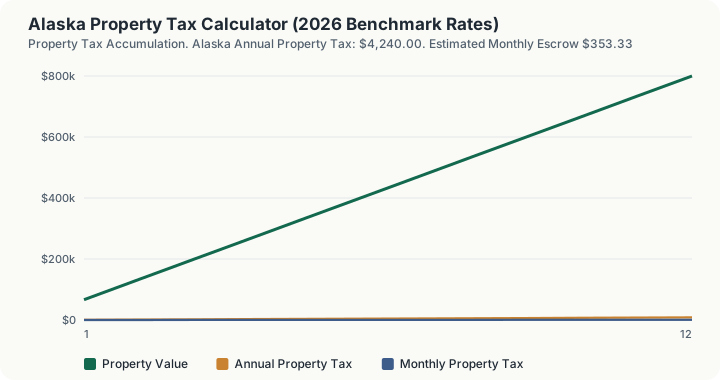
Quick Answer: A $400,000 home in Alaska carries an estimated $4,240.00 in annual property tax at the state's 1.06% effective rate, or about $353.33 a month.
What the 1.06% Rate Is, and What It Is Not
Alaska's 1.06% is an empirical ratio, not a levy. It is median real estate taxes paid divided by median home value, drawn from the U.S. Census Bureau's 2024 1-Year American Community Survey, published in SmartAsset's property tax dataset and cross-checked against WalletHub's 2025 ranking for relative order. That places Alaska #16 of 50, the highest effective rate of any state in this calculator's low-tax neighbours and above the national median.
The figure carries an Alaska-specific distortion worth naming. Most of Alaska's land area sits in the Unorganized Borough, where no borough government exists and no general property tax is levied at all. The median that produces 1.06% is dominated by the municipalities that do tax property, principally Anchorage, the Fairbanks North Star Borough, the Matanuska-Susitna Borough and Juneau. A homeowner outside an organized borough may owe nothing, and this calculator has no way to express that: it will still return $4,240.00 on a $400,000 value.
The rate is flat, so the whole output surface is a straight line. $200,000 returns $2,120.00. $300,000 returns $3,180.00. $500,000 returns $5,300.00. $750,000 returns $7,950.00. $1,000,000 returns $10,600.00.
How This Is Calculated
Two operations, in this order.
- Read the value box as typed. No conversion of any kind is applied to it. The engine does not derive an assessed value, does not apply a ratio and does not look up a borough.
- Subtract the exemption, floored at zero. The subtraction is a plain dollar amount.
max(0, ...)prevents a negative taxable figure. - Multiply by the single 1.06% rate. The same rate applies at every value; there is no band, threshold or cap in the code.
- Divide by twelve for the escrow line. $4,240.00 a year is $353.33 a month.
For background only, and explicitly not what the engine does: Alaska statute requires municipalities to assess property at full and true value, and each borough or city then sets its own mill rate against that. This calculator reproduces none of that machinery.
Worked Example
The baseline: a $400,000 Alaska home with no exemption.
- Value. $400,000.00, used as entered.
- Exemption. $0.00, leaving a taxable figure of $400,000.00.
- Annual tax. $4,240.00.
- Monthly escrow. $353.33.
With the calculator's $25,000 exemption scenario applied, the same home returns $3,975.00 a year and $331.25 a month.
Walking the One Discontinuity: the Exemption Floor
A flat rate has no bracket edge, and the sweep table below the result shows exactly that: an unbroken line from $706.67 of annual tax at a $66,666.67 value through $4,240.00 at $400,000 to $8,480.00 at $800,000. Nothing steps anywhere.
The only edge in the code is the zero floor on the exemption. On a $150,000 property, each figure a separate run:
Exemption $100,000. Taxable $50,000, annual tax $530.00, monthly $44.17.
Exemption $150,000, equal to the value. Annual tax $0.00.
Exemption $200,000, exceeding the value. Annual tax $0.00. The excess is discarded rather than carried, refunded or applied elsewhere.
What Exemption Dollars Buy, and the Cost of the Next $1,000
Alaska's mandatory residential exemption for qualifying senior citizens and disabled veterans is the largest in this calculator's six states, and its effect here is easy to price. A $400,000 home with $150,000 entered returns $2,650.00 a year against $4,240.00 with nothing entered, a saving of $1,590.00. The smaller amounts scale in proportion: $25,000 of exemption takes the bill to $3,975.00, $50,000 takes it to $3,710.00, and the input's $200,000 maximum takes it to $2,120.00.
On the value side, $400,000 returns $4,240.00 and $401,000 returns $4,250.60. Each additional $1,000 of value costs $10.60 a year. Ten thousand dollars costs $106.00, moving the bill to $4,346.00 and the escrow line from $353.33 to $362.17 a month. Alaska's rate is nearly three times Alabama's, and the per-thousand figure is where that shows up most plainly.
The Reverse Question: How Much Value Sits Under a Given Bill
Reading the sweep backwards, $200,000 of value produces $2,120.00 of annual tax and $500,000 produces $5,300.00, so a $5,000 annual budget is exhausted somewhere just under half a million dollars of value. A $750,000 home reaches $7,950.00 a year, which is $662.50 a month of escrow on its own.
For an exemption-shaped version of the question: to hold a $400,000 home's annual bill under $3,000 the exemption has to reach $150,000, which returns $2,650.00. At $50,000 of exemption the bill is still $3,710.00. The relationship is linear at $10.60 per $1,000 in both directions, because the rate never changes.
Right Value Against Wrong Value, Priced
The mistake this input contract invites is entering a value that has already had an exemption taken out of it, and then entering the exemption again.
Correct. Full value $400,000 with the $150,000 exemption in the exemption box returns $2,650.00 a year.
Double counted. The already-reduced $250,000 figure in the value box with $150,000 still in the exemption box returns $1,060.00.
The second run understates the bill by $1,590.00, exactly the value of the exemption applied twice. The engine cannot detect this: it has no idea whether the number you typed is gross or net, and it will subtract whatever is in the exemption box regardless. Entering $250,000 with no exemption returns $2,650.00, the same as the correct run, which is a useful check that the two boxes are doing one job between them and not two.
What This Does Not Account For
- The exemption field is a flat dollar subtraction with no eligibility test. Whatever you type is removed from the base before the 1.06% rate is applied, and the engine treats a general homestead, a senior freeze and a disabled-veteran exemption as the same number. A $25,000 entry returns $3,975.00 on a $400,000 home, $50,000 returns $3,710.00 and $100,000 returns $3,180.00; no step of that sweep asks whether the amount is one you actually qualify for, and no per-programme cap is enforced beyond the field's own maximum.
- The Unorganized Borough. Large parts of Alaska levy no general property tax. This calculator still returns a positive figure for any positive value, and for those areas that figure is simply wrong in kind, not just in degree.
- Borough and city mill rates. Anchorage, Fairbanks North Star, Matanuska-Susitna and Juneau all set different mill rates. None is looked up; one statewide ratio is used for all.
- Eligibility for the residential exemption. The exemption box is an unconditional dollar subtraction. The engine does not test age, veteran status, occupancy or filing deadlines.
- Service area levies. Road, fire and limited service area assessments layered on within organized boroughs are not modelled.
- Any passage of time. No reassessment, no appreciation and no year selection. Every number here is a single static valuation.
Common Pitfalls
- Entering a net-of-exemption value and the exemption together. Priced above at $1,590.00 of understatement on the default home.
- Reading the schedule as a forecast. All twelve rows price a different property at today's rate, not this property in a later year. Row 12 sits at $800,000 of value and returns $8,480.00 with no exemption entered; there is no appreciation, reassessment or levy growth anywhere in the code path.
- Treating 1.06% as a mill rate. It is a median-over-median ratio; no Alaska borough levies 1.06% of market value as such.
- Assuming a rate break at higher values. There is none. $1,000,000 returns $10,600.00, the same 1.06% that a $200,000 home pays on its $2,120.00.
- Budgeting $353.33 as a full escrow payment. It is one twelfth of the annual tax alone, with no insurance and no lender cushion.
Frequently Asked Questions
How high are property taxes in Alaska?
Does this work for homes outside an organized borough?
What is Alaska's senior and veteran exemption worth here?
What does each extra $1,000 of value cost?
Should I enter market value or my borough's assessed value?
Sources
- U.S. Census Bureau: 2024 1-Year American Community Survey, median real estate taxes paid over median home value. census.gov/programs-surveys/acs
- Alaska Department of Revenue, the official state tax authority for Alaska rates, rules and forms. tax.alaska.gov
Also consulted: Alaska Department of Commerce, Community and Economic Development: full and true value assessment requirement and the mandatory residential exemption, cited as background only.