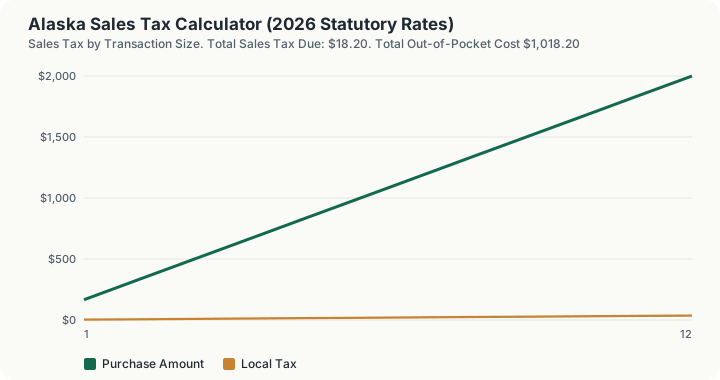
Quick Answer: A $1,000 purchase in Alaska incurs $0.00 in state sales tax, since Alaska is one of the five NOMAD states and levies no statewide general sales tax, but at the 1.82% statewide average local rate the same purchase still carries $18.20 in local sales tax for a total of $1,018.20. In a community that levies nothing, the tax really is $0.00.
A Zero State Rate That Still Returns a Tax Bill
Alaska's state sales tax rate in this engine is 0.00%, and the state portion the calculator reports is $0.00 at every purchase size it was run at: $0.00 on $1.00, $0.00 on $1,000.00, $0.00 on $50,000.00. Every cent of tax this page produces is the average local rate, 1.82%, contributed by boroughs and municipalities. That is the whole structure of the Alaska page, and it makes the local surcharge toggle unusually consequential here: it is not a modifier on the tax, it is the tax.
More than 100 Alaska cities and boroughs (Juneau, Sitka, Kodiak, Nome and Wrangell among them) levy their own sales taxes, while Anchorage and Fairbanks do not. The 1.82% the engine uses is a population-weighted blend of all of them, including the ones charging nothing. There is no city, borough or ZIP input in the configuration, so the calculator cannot distinguish a Juneau purchase from an Anchorage one.
How This Is Calculated
Alaska has no state sales tax at all, but it is not a tax-free state at the register. There is no statewide rate to apply, and yet boroughs and municipalities levy their own sales taxes that are very real. The population-weighted average of those local rates is 1.82%, which is why a $1,000 purchase in this calculator returns $18.20 of tax rather than zero. Every cent of it is local; the state portion is $0.00 by construction.
The general form is the same as any other state, with the state term simply set to zero:
Here is what the calculator does with your inputs:
- Take the entered amount as the base. No adjustments are made to the price before tax is computed; a negative entry is clamped to zero.
- No item-level exemption filtering. Alaskan localities set their own exemptions, their own caps on the taxable portion of a single sale, and in several cases their own seasonal rates. None of that is modeled, so the entered amount is treated as fully taxable.
- Multiply by the state statutory rate and round to the cent. For Alaska that rate is zero, so this term is $0.00 at every purchase amount.
- Multiply by the local rate and round to the cent separately. The entire 1.82% is municipal and borough tax. Turning off the local surcharge toggle sets this term to zero as well, which is the correct answer for an Anchorage or Fairbanks purchase and the wrong one in the communities that do levy.
- Sum and total. The state and local amounts are added to give total tax, and the total is added back to the price to give the out-of-pocket cost.
Worked Example
For a $1,000 retail purchase in Alaska:
- Starting purchase price. The buyer rings up a $1,000.00 taxable retail purchase in Alaska, the baseline amount before any tax consideration.
- State statutory rate applied. Alaska is one of the five NOMAD states, so its state sales tax rate is 0.00%: $1,000.00 × 0.00% = $0.00 in state tax owed.
- No state tax due. Because the statutory rate is zero, the state sales tax line item is $0.00 regardless of the purchase amount, whether it is $10 or $10,000.
- Local surcharge applied. With the local surcharge switch on, the calculator applies Alaska's 1.82% statewide average local rate: $1,000.00 × 1.82% = $18.20 in local sales tax.
- Total out-of-pocket cost. Adding the local tax to the purchase price gives $1,000.00 + $18.20 = $1,018.20 out the door.
The $18.20 figure is an average, not a rate any single Alaska community charges. Turn the local surcharge off and the tax falls to $0.00 on a $1,000.00 purchase, which is the correct answer in an unincorporated area or a city that levies no sales tax.
The Toggle Is the Entire Calculator
On most state pages the local surcharge switch trims a bill. Here it removes it. At $1,000.00 the tax goes from $18.20 to $0.00 and the out-the-door cost from $1,018.20 to $1,000.00. At $50,000.00 it goes from $910.00 to $0.00, and the total cost from $50,910.00 to $50,000.00 flat. There is no other input on this page that can change the answer's structure, only its scale.
That $910.00 swing at $50,000.00 is the closest thing Alaska has to a threshold, and it is a modelling switch rather than a statutory one. Neither setting describes a real transaction: 1.82% is charged by no community, and 0.00% is right only where no local levy exists. Alaska's local rates run to roughly 7.5% in some places, and the engine has no way to express any of them.
Twelve Tiers, One Straight Line
There is no bracket, exemption cliff or cap anywhere in Alaska's sweep. The twelve computed tiers rise in exact proportion: $3.03 of tax at $166.67, $9.10 at $500.00, $18.20 at $1,000.00, $27.30 at $1,500.00 and $36.40 at $2,000.00. Beyond the table the line continues unbroken to $91.00 at $5,000.00, $455.00 at $25,000.00 and $910.00 at $50,000.00.
The effective rate is the same at both extremes: $1.82 on a $100.00 purchase and $910.00 on a $50,000.00 purchase are both exactly 1.82%. Each additional $100 of purchase price costs $1.82, which is why $1,000.00 returns $18.20 and $1,100.00 returns $20.02. One additional dollar costs two cents: $18.20 becomes $18.22 at $1,001.00. On a $1.00 purchase the tax rounds to $0.02.
From a Register Total Back to the Shelf Price
The calculator runs one way only. It takes a pre-tax price and adds tax; it has no gross-to-net mode and no way to accept a tax-inclusive figure. So the natural question, "my receipt says $1,000.00, what was the pre-tax price," has to be answered by searching the forward direction.
For Alaska the answer is a pre-tax price of $982.13, which the engine prices at $0.00 of state tax and $17.87 of local tax, for an out-the-door total of exactly $1,000.00. A cent lower, $982.12, totals $999.99.
Right method against wrong method. The standard error is to multiply the tax-inclusive $1,000.00 by 1.82%. Entered as a pre-tax amount, $1,000.00 returns $18.20 of tax, but only $17.87 is actually embedded in a $1,000.00 Alaska receipt. The overstatement is $0.33 per $1,000.00 of gross, and it scales: roughly $33 on $100,000 of gross taxable receipts. The correct operation is the tax fraction, r divided by (1 + r). Against a tax-inclusive total, Alaska's 1.82% average works out to about 1.79%, and confusing the two is precisely the error. The gap is small in Alaska only because the rate is small; in a Juneau-rate community the same mistake is several times larger.
What This Does Not Account For
- Alaska has no statewide sales tax whatsoever. Every dollar this calculator returns is an average of borough and municipal rates, and many Alaska localities levy none at all.
- Any specific borough or city. There is no ZIP, city or borough input in the configuration. The 1.82% average sits between a genuine 0.00% in Anchorage and Fairbanks and roughly 7.5% at the high end.
- Local single-sale caps. Several Alaska communities tax only the first few thousand dollars of a single transaction. The engine applies its rate to the entire amount entered, so the $910.00 it reports on $50,000.00 would be far too high in a capped jurisdiction.
- Seasonal rates. Some Alaska municipalities change their rate between summer and winter. The engine holds one rate.
- What you bought. No product taxability logic exists. Groceries, prescription drugs, clothing and services all receive the same 1.82% here.
- Exemption certificates, resale exemptions and sales tax holidays. None are modelled.
- Use tax, marketplace facilitator rules and seller nexus thresholds. The engine prices one transaction and computes no filing obligation.
Common Pitfalls
- Reading "no sales tax state" as "no tax at the register." The engine returns $18.20 on a $1,000.00 purchase, all of it local.
- Reading $18.20 as a bill anyone receives. It is a statewide average; the correct figure is $0.00 in a non-levying community and several times $18.20 in a high-rate one.
- Stripping tax from a gross total at 1.82%. A $1,000.00 tax-inclusive total contains $17.87 of tax, not $18.20.
- Assuming a large purchase is taxed proportionally. The engine says $910.00 on $50,000.00, but local single-sale caps mean many Alaska jurisdictions would charge a small fraction of that.
Frequently Asked Questions
What is the sales tax rate in Alaska?
Why does this calculator show tax for a state with no sales tax?
How do I get the answer for Anchorage?
How much tax is inside a $1,000 Alaska receipt?
How does use tax differ from sales tax?
Sources
- Alaska Department of Revenue: 2026 Sales and Use Tax Rate Schedules. tax.alaska.gov
- Streamlined Sales Tax Governing Board (SSTGB): State Taxability Matrix. streamlinedsalestax.org/for-businesses/taxability-matrix