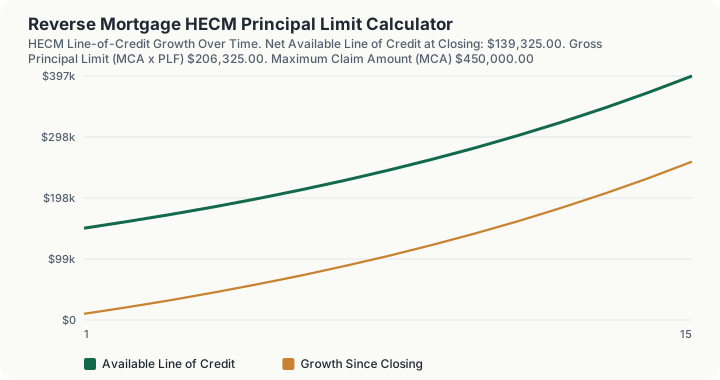
Quick Answer: A HECM principal limit equals the lesser of appraised value or the 2026 national lending limit of $1,249,125, times a Principal Limit Factor that rises with age and falls as the expected rate rises. On the baseline, a 72-year-old with a $450,000 home at a 6.5% expected rate has a $206,325.00 gross limit, leaving $139,325.00 at closing after mortgage payoff, MIP and costs.
Overview
A Home Equity Conversion Mortgage, commonly called a HECM or reverse mortgage, lets a homeowner age 62 or older convert home equity into cash without a monthly mortgage payment. The loan is repaid when the last surviving borrower sells the home, moves out permanently, or passes away. The amount you can actually borrow is not simply a percentage of home value picked at random. It is governed by a specific formula published by the Department of Housing and Urban Development (HUD), which insures nearly all reverse mortgages in the United States through the Federal Housing Administration.
The core number in that formula is the Principal Limit Factor, or PLF. HUD publishes a lookup table that assigns a PLF to every combination of borrower age and "expected interest rate." Older borrowers receive a higher PLF because actuarially they are expected to occupy the home, and therefore accrue interest on the loan, for fewer years. A lower expected rate also raises the PLF, because the balance grows more slowly, leaving more room under the home's value before the loan could exceed it. This calculator models that relationship and applies it to your inputs so you can see how much of your home's value could realistically become a HECM line of credit, lump sum, or monthly payment.
How This Is Calculated
The calculator follows four steps that mirror how a HECM originator actually sizes a loan.
Step 1: Determine the Maximum Claim Amount (MCA). This is the lesser of your home's appraised value or the nationwide FHA HECM lending limit, which is $1,249,125 for 2026. The limit applies uniformly across the continental United States as well as Alaska, Hawaii, Guam, and the U.S. Virgin Islands.
Step 2: Look up the Principal Limit Factor. HUD's actual PLF table is a two-dimensional grid: one axis is the youngest borrower's age in whole years, the other is the expected interest rate in eighth-of-a-percent increments. This calculator does not have access to that exact published spreadsheet, so it uses a transparent, documented approximation instead of guessing at real HUD numbers. The approximation starts from a PLF of 50% at age 70 with a 5.0% expected rate, then adds 0.55 percentage points of PLF for every year of age above 70, and subtracts 3.5 percentage points for every 1.0% the expected rate sits above 5.0%. The result is clamped between 10% and 75%, which is the realistic range real HUD tables occupy. This is an estimate, not the official figure a lender will quote you.
Step 3: Compute the Gross Principal Limit. Multiply the Maximum Claim Amount by the Principal Limit Factor.
Step 4: Subtract mandatory obligations. Before you receive any net proceeds, HECM proceeds must first pay off any existing mortgage or lien on the property, fund the upfront Mortgage Insurance Premium (a statutory 2.0% of the Maximum Claim Amount under HUD Mortgagee Letter 2017-12), and cover closing costs such as origination fees, title work, appraisal, and required counseling. What remains is your net principal limit, the amount available at closing as a lump sum, line of credit, or the basis for monthly payments.
If you choose the line-of-credit option and do not draw the full amount, the unused portion grows over time. That growth rate equals the expected interest rate plus the ongoing annual MIP rate of 0.50%, compounded monthly. This calculator projects that growth for 15 years so you can see how a credit line left untouched can expand.
Worked Example
Consider a 72-year-old borrower with a home appraised at $450,000, an expected interest rate of 6.5%, an existing mortgage balance of $50,000 that must be paid off, and closing costs of $8,000.
- Maximum Claim Amount: the home value of $450,000 is below the 2026 limit of $1,249,125, so the MCA equals $450,000.
- Principal Limit Factor: 0.50 + (72 - 70) x 0.0055 - (6.5 - 5) x 0.035 = 0.50 + 0.011 - 0.0525 = 0.4585, or 45.85%.
- Gross Principal Limit: $450,000 x 0.4585 = $206,325.00.
- Upfront MIP: $450,000 x 2.0% = $9,000.00.
- Mandatory Obligations: $50,000 (existing lien) + $9,000 (MIP) + $8,000 (closing costs) = $67,000.00.
- Net Principal Limit at Closing: $206,325.00 - $67,000.00 = $139,325.00.
That $139,325 is the amount this borrower could access as a lump sum, set up as a line of credit, or convert into a stream of monthly payments. If left as an untouched line of credit growing at 6.5% + 0.50% = 7.0% annually, it would grow to $279,996.07 after 10 years purely from the unused-credit growth feature, before any additional draws.
Carrying the Line of Credit Forward
- End of year one: the untouched line stands at $149,396.82, up $10,071.82 on the $139,325.00 available at closing.
- End of year two: $160,196.72, cumulative growth $20,871.72. Year two added $10,799.90, more than year one, because the growth accrues on the enlarged line.
- End of year ten: $279,996.07, cumulative growth $140,671.07. The line has slightly more than doubled.
- End of year fifteen: $396,929.50, cumulative growth $257,604.50.
The growth rate is the expected rate plus the 0.50% annual mortgage insurance premium, compounded monthly on the unused balance. A borrower who takes the $139,325 as a lump sum at closing has $139,325; a borrower who leaves it alone for fifteen years has a line worth $396,929.50 against a home that may not have appreciated nearly as fast. That asymmetry, not the opening figure, is the reason the line-of-credit option is usually the one that gets recommended.
What This Does Not Account For
This calculator has real, disclosed limitations you should understand before relying on it.
- The Principal Limit Factor is an approximation, not the official HUD table. HUD's actual PLF is a published lookup table with values at every age and every eighth of a percent of expected rate. This calculator's PLF formula tracks the same general shape (higher for older borrowers, lower for higher rates) but will not match your lender's quoted PLF to the decimal. Always get an exact PLF from a HUD-approved HECM counselor or lender before making a decision.
- It does not model HECM for Purchase transactions, where a reverse mortgage is combined with a down payment to buy a new home.
- It does not model the HECM Financial Assessment, which evaluates a borrower's residual income and credit history and can require a Life Expectancy Set-Aside for property taxes and insurance in some cases, reducing available proceeds further.
- It assumes a fixed expected rate for the life of the loan. Adjustable-rate HECMs have expected rates that can change the actual accrual rate over time, though the PLF itself is locked at closing based on the expected rate in effect then.
- It does not include servicing fees, per diem interest between closing and first draw, or state-specific recording taxes, all of which can modestly change net proceeds at the margin.
Common Pitfalls
- Confusing the expected rate with the note rate. The expected rate used to size the loan is not the rate that actually accrues on your balance day to day; the two can differ, especially on adjustable-rate HECMs.
- Assuming the PLF is a flat percentage of home value regardless of age. Two borrowers with identical homes but a 15-year age gap can have PLFs that differ by 8 percentage points or more.
- Forgetting that upfront MIP is calculated on the Maximum Claim Amount, not on the amount actually borrowed. Even a borrower who draws a small amount pays MIP based on the capped claim amount.
- Ignoring that a HECM line of credit that grows unused is not the same as a savings account earning interest for you. It represents growth in the amount you are entitled to borrow, and the entire balance including that growth must eventually be repaid from the home's value or the borrower's estate.
- Treating this or any online estimator as a loan offer. Only a HUD-approved lender using the current published PLF table can quote an actual, binding principal limit.
Frequently Asked Questions
What is the minimum age to qualify for a HECM reverse mortgage?
Why does a higher expected interest rate reduce how much I can borrow?
Is the Principal Limit Factor the same everywhere in the country?
Can I owe more than my home is worth with a reverse mortgage?
Does an unused HECM line of credit really grow every year?
Sources
- Consumer Financial Protection Bureau, Reverse mortgage loans. consumerfinance.gov/consumer-tools/reverse-mortgages
Also consulted: U.S. Department of Housing and Urban Development, "HUD's FHA Announces 2026 Loan Limits," HUD.gov news release, confirming the 2026 nationwide HECM Maximum Claim Amount of $1,249,125; HUD Mortgagee Letter 2017-12, HECM Financial Assessment and Property Charge Guide, establishing the 2.0% upfront MIP and the 0.50% annual MIP rate used in line-of-credit growth; National Reverse Mortgage Lenders Association (NRMLA), coverage of the 2026 HECM loan limit increase; HUD Handbook 4000.1, Home Equity Conversion Mortgage program requirements, for eligibility, non-recourse structure, and Financial Assessment overview.