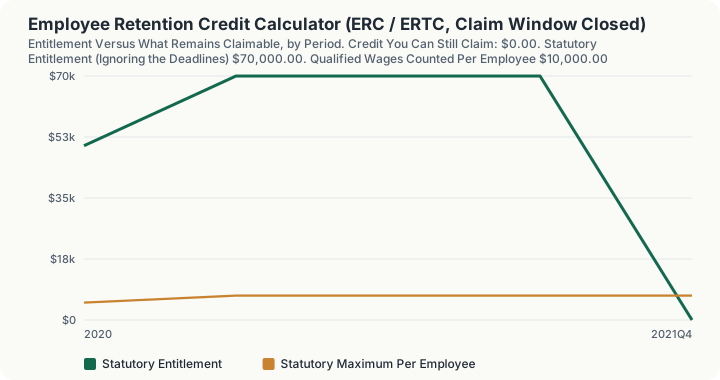
Quick Answer: The ERC claim window is closed. On the default inputs this calculator returns $0.00 of claimable credit, and it will return $0.00 for every period unless a claim was already filed in time. Ten employees with $12,000 of qualified wages each in Q2 2021 would have carried a $70,000.00 entitlement, but the Form 941-X limitations period for that quarter closed on 15 April 2025.
What does this calculator do?
Read the paragraph above before anything else on this page. The employee retention credit was a genuine and substantial pandemic-era payroll tax credit, and it is now unavailable to anyone who did not already claim it. Every filing deadline has passed:
- 2020 quarters. The period of limitations for a Form 941-X correcting 2020 employment tax expired for most employers on 15 April 2024.
- 2021 quarters. The same period expired for most employers on 15 April 2025.
- Q3 and Q4 2021, additionally and independently. Section 70605(d) of Public Law 119-21, enacted 4 July 2025, provides that no credit under section 3134 shall be allowed and no refund with respect to any such credit shall be made after the date of enactment unless a claim was filed on or before 31 January 2024. That reaches back and disallows claims that were perfectly timely when they were made. A Q3 2021 claim filed on 1 March 2024 was inside the Form 941-X window on the day it was filed and is barred today.
There is a separate limit worth knowing even though it is now academic: section 3134(n), as amended by section 80604 of the Infrastructure Investment and Jobs Act, ended the credit for wages paid after 30 September 2021 for every employer except a recovery startup business. Q4 2021 therefore exists as an ERC quarter only for recovery startups.
So why does this calculator exist? Because a live question remains for employers who already received an ERC refund and are now under examination, or who are being asked to substantiate a claim. They need to know what the statutory entitlement actually was for the quarter in question. This page reports that entitlement separately from the collectable amount, and it never conflates them.
The ERC attracted an industry of contingency-fee promoters. The IRS opened a moratorium on new claims in September 2023, ran a voluntary disclosure programme and a withdrawal process, and has issued tens of thousands of disallowance letters. A calculator that produces a large number and lets the reader assume it is money waiting for them is not a neutral tool, which is why the headline here is the gated figure and the entitlement sits below it.
How is this calculated?
The credit itself is straightforward. The gate is the part that matters.
entitlement = min(qualified wages per employee, cap) × rate × employees
claimable = entitlement, if the filing gate is passed; 0, otherwise
Step 1: Apply the statutory wage cap for the period. Q2 2021 caps qualified wages at $10,000 per employee for the quarter. min($12,000, $10,000) = $10,000.00 Wages above the cap, ignored: $12,000 - $10,000 = $2,000.00
For 2020 the cap is also $10,000 per employee, but for the whole year, not per quarter. That single difference is why 2021 was worth so much more.
Step 2: Apply the credit rate. $10,000.00 x 70% = $7,000.00 per employee
The rate is 50% for 2020 and 70% for every 2021 quarter.
Step 3: Multiply by headcount. $7,000.00 x 10 = $70,000.00 statutory entitlement
Step 4: Test the gross receipts decline. 1 - ($600,000 / $1,000,000) = 40.0% decline The 2021 test requires quarter receipts below 80% of the same 2019 quarter, that is a decline of more than 20%. A 40.0% decline clears it. (The 2020 test was far harder: receipts below 50% of the 2019 quarter.)
Step 5: Check the large employer test. 20 average full-time employees in 2019 is below the 500-employee threshold that applies for 2021, so wages for time actually worked can count. Above that threshold, only wages paid for time not worked qualify. For 2020 the threshold was 100.
Step 6: Apply the filing gate. This is the step that decides the answer. Filing posture: not filed. Period of limitations for Q2 2021: 15 April 2025, in the past. Claimable credit: $0.00
Step 7: Compute the section 280C(a) offset on the entitlement. An employer claiming the ERC must reduce its wage deduction by the full credit in the year the wages were paid. Deduction given up: $70,000.00 At a 21% marginal rate: $70,000 x 0.21 = $14,700.00 of extra income tax Entitlement net of that cost: $70,000 - $14,700 = $55,300.00
A dollar of ERC was never a dollar. This is the offset promoters routinely omitted from their fee calculations.
Worked Example
A restaurant group with ten employees. Q2 2021 receipts were $600,000 against $1,000,000 in Q2 2019. Each employee was paid $12,000 of qualified wages in the quarter. The business had 20 full-time employees in 2019. No ERC claim was ever filed.
Step 1: Eligibility. Receipts fell 40.0%, comfortably past the 20% decline the 2021 test requires. Eligible on the gross receipts ground.
Step 2: Wage cap. min($12,000, $10,000) = $10,000.00 counted per employee. $2,000 per employee is simply ignored.
Step 3: Credit per employee. $10,000 x 70% = $7,000.00
Step 4: Total entitlement. $7,000 x 10 = $70,000.00
Step 5: The deadline. The Form 941-X period of limitations for a Q2 2021 quarter closed on 15 April 2025.
Step 6: The claim. None was filed. Claimable credit: $0.00.
The $70,000 was real. It is also unrecoverable. The gap between step 4 and step 6 is the entire point of this page.
Now vary the filing posture and watch the gate behave.
Filed before 15 April 2025. Q2 2021 is not a section 3134 quarter, so only the Form 941-X window applies. The claim stands and the credit is $70,000.00. Note that a timely, allowable claim is not the same as a correct one: the IRS is examining ERC claims and has extended the assessment period for these quarters.
Q3 2021, filed February 2024. Inside the Form 941-X window on the day it was filed, and disallowed anyway. Q3 2021 is a section 3134 quarter, and Public Law 119-21 section 70605(d) requires the claim to have been filed on or before 31 January 2024. Claimable: $0.00. This is the retroactive trap that caught employers who filed in good faith.
The same wages in 2020, filed before 15 April 2024. The 2020 cap is $10,000 for the entire year at a 50% rate, so the credit is $5,000.00 per employee for all of 2020, against $7,000 for a single quarter of 2021.
Recovery startup, Q4 2021. The only category of employer with any Q4 2021 credit at all, because section 3134(n) as amended by IIJA section 80604 ended the credit for everyone else after 30 September 2021. A recovery startup's credit is separately capped at $50,000 for the quarter under section 3134(b)(1)(B).
Across every period combined, the statutory maximum was $26,000 per employee: $5,000 for all of 2020, plus $7,000 for each of Q1, Q2 and Q3 2021. That is the figure the promoters advertised, and reaching it required qualifying in four separate periods.
Carrying The Entitlement Across Every Period
The per-employee ceiling above is the headline figure, but the business-level accumulation is what the promoters were quoting.
Step 7: Q1 2021 plus Q2 2021. $70,000.00 + $70,000.00 = $140,000.00 of statutory entitlement for these ten employees
Step 8: Add Q3 2021. $140,000.00 + $70,000.00 = $210,000.00
Step 9: Add the whole of 2020, which is capped at $5,000 per employee. $210,000.00 + $50,000.00 = $260,000.00
Step 10: Add Q4 2021. $260,000.00 + $0.00 = $260,000.00. The credit ended for ordinary employers after 30 September 2021, so the fourth quarter adds nothing.
Step 11: Now the same accumulation of what can still be claimed. $0.00 + $0.00 + $0.00 + $0.00 + $0.00 = $0.00
Two running totals over the same five periods: $260,000 of entitlement, and nothing at all recoverable. The entitlement column never stopped being true, and every deadline against it has passed. That divergence is what any 2026 offer to file for you is quietly betting you will not compute.
What does this calculator not account for?
- Aggregation. The rules of section 3134(e) and sections 52(a)-(b) and 414(m)-(o) treat a controlled group as one employer for the headcount and gross receipts tests. This calculator models one employer exactly as you describe it.
- Coordination with other relief. The same wages cannot be counted for the ERC and for PPP loan forgiveness, the section 45S paid family leave credit, the section 51 work opportunity credit, or the FFCRA leave credits. Wages entered here are assumed already free of all of those. Double-counting is one of the most common reasons a claim was disallowed.
- Qualified health plan expenses. Amounts allocable to qualified wages are included in "qualified wages" and would raise the per-employee figure. Include them in your wage input if you want them counted.
- The related-individual exclusion. Section 3134(e)(5) and section 51(i)(1) exclude wages paid to majority owners and certain relatives. The IRS addressed this in Notice 2021-49. It is not applied here.
- Governmental employers and the separate section 3111(e) and (f) rules.
- Uniform wages across employees. Every employee is assumed to have the same qualified wages.
- The partial suspension test in any detail. The calculator takes a yes or no for government-order suspension. A general reduction in business is not a suspension, and the IRS has disallowed large numbers of claims resting on supply-chain arguments alone.
- State-level credits, interest on refunds, and any penalties or accuracy-related additions on a disallowed claim.
- Individual extensions of the period of limitations. The deadlines used here are the ordinary ones. An employer who signed a Form SS-10 consent has a different date, and this calculator does not model that.
What mistakes do people make with this?
- Believing there is still time to file. There is not. Every deadline is in the past, and for Q3 and Q4 2021 Congress additionally cut the window back to 31 January 2024 retroactively in July 2025. If someone in 2026 offers to file an ERC claim on a contingency fee, they are proposing to file a claim the law disallows.
- Confusing the 2020 and 2021 caps. The 2020 cap is $10,000 of qualified wages per employee for the entire year, at 50%, giving a maximum of $5,000 per employee for all of 2020. The 2021 cap is $10,000 per employee per quarter at 70%, giving $7,000 per employee per quarter. Applying the 2021 structure to 2020 inflates the number roughly fourfold.
- Assuming "$26,000 per employee" applied to anyone. That figure required qualifying separately in 2020 and in each of Q1, Q2 and Q3 2021. Very few employers met all four tests, and the number was used as a marketing headline far more often than it was earned.
- Treating a timely claim as a correct claim. The IRS is actively examining ERC claims for these quarters and has extended the assessment period. Being inside the filing window says nothing about whether the eligibility ground holds up.
- Forgetting section 280C(a). The wage deduction must be reduced by the full credit in the year the wages were paid, which generally required amending that year's income tax return. At a 21% rate a $70,000 credit costs $14,700 in extra income tax, leaving $55,300.
- Claiming on supply-chain disruption alone. A partial suspension requires a government order that limited commerce, travel or group meetings and had more than a nominal effect on your operations. Difficulty obtaining supplies, without such an order affecting your supplier in a qualifying way, has been a frequent basis for disallowance.
- Counting PPP-forgiven wages twice. The single most common substantive error in the claims that were filed.
Frequently Asked Questions
Can I still claim the ERC in 2026?
A company is telling me I qualify for tens of thousands of dollars. Should I engage them?
I already received an ERC refund and I am now under examination. What does this calculator tell me?
Why did Congress bar claims that were timely when they were filed?
Was the ERC really worth its face value?
Sources
- IRS, "Employee Retention Credit: 2020 vs 2021 Comparison Chart" (fetched and read 2026-08-30). Source of the 50% rate and $10,000 per employee for the year cap for 2020 with a $5,000 per employee maximum; the 70% rate and $10,000 per employee per calendar quarter cap for 2021 with a $7,000 per employee per quarter maximum; the gross receipts tests (below 50% of the same 2019 quarter for 2020, below 80% for 2021); and the large employer thresholds of more than 100 average 2019 full-time employees for 2020 and more than 500 for 2021. irs.gov/newsroom/employee-retention-credit-2020-vs-2021-comparison-chart
- 26 U.S.C. 3134 (read 2026-08-30). 3134(a) and (b)(1): 70% of qualified wages, $10,000 per employee per calendar quarter. 3134(c)(5) and (b)(1)(B): recovery startup business definition, a trade or business begun after 15 February 2020 with average annual gross receipts not exceeding $1,000,000, and the $50,000 per quarter cap. 3134(n): applicability, as amended by section 80604 of the Infrastructure Investment and Jobs Act (Public Law 117-58, 15 November 2021), which pulled the end date back to wages paid before 1 October 2021 for all employers other than recovery startups. law.cornell.edu/uscode/text/26/3134
- IRS, Instructions for Form 941-X (read 2026-08-30). The 15 April 2024 and 15 April 2025 periods of limitations for 2020 and 2021 quarters respectively. irs.gov/instructions/i941x
- 26 U.S.C. 280C(a). The wage deduction disallowance equal to the credit. law.cornell.edu/uscode/text/26/280C
Also consulted: Public Law 119-21, section 70605(d) (enacted 4 July 2025). The section 3134 claim disallowance: no credit allowed and no refund made after enactment unless a claim was filed on or before 31 January 2024; CARES Act section 2301, as amended by section 207 of the Taxpayer Certainty and Disaster Tax Relief Act of 2020. The governing provision for 2020 and for the first half of 2021.
The marginal income tax rate used for the 280C offset is a user input defaulting to 21%. Nothing in this calculator verifies it against a bracket table; supply your own combined rate.