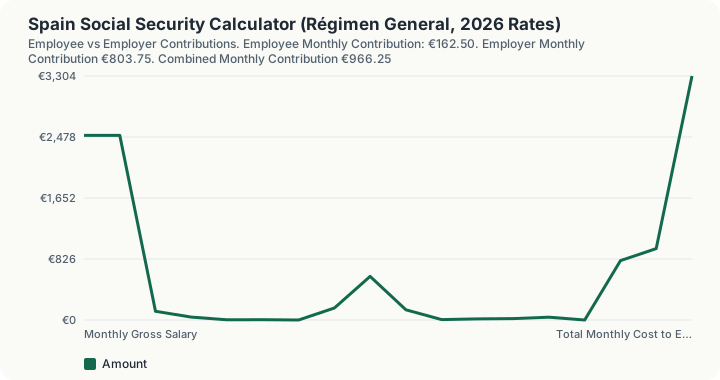
Quick Answer: A €2,500 monthly gross salary in grupo de cotización 1, on an indefinite contract with a 1.5% AT/EP tariff, costs the employee €162.50 a month and the employer €803.75, for a combined €966.25 reaching the Tesorería General. The total monthly cost of the hire is €3,303.75, and pay after social security (before IRPF withholding) is €2,337.50. That is an employee effective rate of 6.50%, an employer rate of 32.15%, and a combined 38.65% of gross pay.
What does this calculator do?
Spanish payroll cost is dominated by the part that never appears on a payslip. In the default case the employee sees €162.50 deducted while the employer pays €803.75, roughly five times as much, into the same system. Understanding Spanish employment cost means looking at both sides.
Contributions in the Régimen General are charged on a contribution base, not directly on salary. The base is your gross pay clamped into the statutory band for your grupo de cotización, the category set by professional qualification and the job actually performed. Earn below your group's floor and you still contribute on the floor. Earn above the tope máximo of €5,101.20 a month and ordinary contributions stop there.
Since the introduction of the cotización adicional de solidaridad, however, that ceiling is no longer a true ceiling. Pay above the tope máximo attracts a progressive additional charge in three bands, so the marginal contribution rate for a high earner falls sharply but does not fall to zero.
One rate on this page is not statutory and cannot be. The AT/EP premium for accident and occupational-illness cover is set by the employer's CNAE activity code under the tarifa de primas, with no single national figure. It is a required input, and the 1.5% default is a placeholder.
How is this calculated?
Contribution = min(max(S, B_min), B_max) (contribution base) × r
Every rate below is from Orden PJC/297/2026.
Step 1: Look up the grupo de cotización band. Grupo 1, Ingenieros y Licenciados / alta dirección: floor €1,989.30, ceiling €5,101.20
Step 2: Clamp gross salary into that band to get the contribution base. €2,500 sits between the floor and the ceiling, so the base is the actual salary: €2,500.00
Step 3: Employee contingencias comunes at 4.70%. €2,500 x 4.70% = €117.50
Step 4: Employee desempleo at 1.55% (indefinite contract). €2,500 x 1.55% = €38.75
Step 5: Employee formación profesional at 0.10%. €2,500 x 0.10% = €2.50
Step 6: Employee MEI at 0.15%. €2,500 x 0.15% = €3.75
Step 7: Employee solidarity contribution. Pay is below the €5,101.20 tope máximo, so €0.00
Step 8: Total the employee side. €117.50 + €38.75 + €2.50 + €3.75 = €162.50
Step 9: Employer contingencias comunes at 23.60%. €2,500 x 23.60% = €590.00
Step 10: Employer desempleo at 5.50% (indefinite contract). €2,500 x 5.50% = €137.50
Step 11: Employer FOGASA at 0.20%. €2,500 x 0.20% = €5.00
Step 12: Employer formación profesional at 0.60%. €2,500 x 0.60% = €15.00
Step 13: Employer MEI at 0.75%. €2,500 x 0.75% = €18.75
Step 14: Employer AT/EP at your own tariff rate. €2,500 x 1.50% = €37.50 This rate is yours to supply. There is no national figure.
Step 15: Total the employer side. €590.00 + €137.50 + €5.00 + €15.00 + €18.75 + €37.50 = €803.75
Step 16: Combine. €162.50 + €803.75 = €966.25 a month
Step 17: Compute the true cost of employment. €2,500.00 + €803.75 = €3,303.75 a month
Step 18: Compute pay after social security. €2,500.00 − €162.50 = €2,337.50 IRPF withholding is a separate deduction and is not applied here.
Step 19: Annualise at twelve months. Employee €1,950.00, employer €9,645.00, combined €11,595.00
Worked Example
A Madrid software company hires an engineer on an indefinite contract at €2,500 a month gross. The engineer falls in grupo 1. The company's CNAE activity carries a 1.5% AT/EP tariff.
Step 1: The contribution base. €2,500 is inside the grupo 1 band of €1,989.30 to €5,101.20, so the base is €2,500.00
Step 2: What the engineer pays. 4.70% + 1.55% + 0.10% + 0.15% = 6.50% of the base: €162.50 a month
Step 3: What the company pays. 23.60% + 5.50% + 0.20% + 0.60% + 0.75% + 1.50% = 32.15% of the base: €803.75 a month
Step 4: The full cost of the hire. €2,500.00 + €803.75 = €3,303.75 a month, or €39,645.00 a year, against a €30,000 headline salary
Step 5: What reaches the Tesorería. €966.25 a month, €11,595.00 a year, of which the engineer contributed €1,950.00 and the company €9,645.00.
Three variations are instructive. On a temporary contract the desempleo rates rise to 6.70% employer and 1.60% employee, deliberately making precarious contracts more expensive on both sides. At €8,000 a month, ordinary contributions freeze at the €5,101.20 tope máximo but the solidarity contribution keeps charging on the €2,898.80 of excess, in bands of 1.15%, 1.25% and 1.46% total. And at €1,200 a month in grupo 1, the base is raised to the €1,989.30 floor, so contributions are computed on €1,989.30 and the effective rate on actual pay exceeds the headline 6.50%.
What does this calculator not account for?
- IRPF withholding is not applied. This page models social security contributions only. The retención on Spanish payroll is a separate and usually larger deduction, and "salary after employee contributions" is not take-home pay.
- The AT/EP rate is an unverified placeholder. The premium comes from the tarifa de primas in DA 61ª LGSS and is set by CNAE activity code, with office work near the bottom of the scale and construction and mining near the top. The individual CNAE percentages were not read when this module was built and are not encoded anywhere in it. The 1.5% default is not a statutory figure and you must substitute your own.
- Desempleo, FOGASA and formación profesional are legally computed on the AT/EP base, not the contingencias comunes base. The AT/EP base includes overtime. This calculator takes a single monthly remuneration figure and applies one base to every concept, which is exact whenever there is no overtime and understates the charge when there is.
- No bonificaciones or reducciones are applied. Spain operates numerous hiring incentives that reduce employer contributions for particular groups and contract types; none is modelled.
- Pagas extraordinarias are not modelled. Where extra payments are prorated across the year the monthly base rises accordingly, and where they are paid separately the treatment differs.
- Groups 8 to 11 are quoted on a daily basis in the Orden (€47.48 and €170.04 per day). Multiplied by thirty they match groups 4 to 7 exactly, and the calculator uses those monthly equivalents.
- Only the Régimen General for employees is covered. The RETA cuota for self-employed workers is a different regime entirely and is handled by a separate calculator.
- No special regimes, no part-time proration rules, and no mid-month starts or leavers are handled.
What mistakes do people make with this?
- Budgeting from the gross salary. Employer contributions add 32.15% at these figures. A €30,000 salary costs a Spanish employer roughly €39,645 before any other benefit.
- Believing the tope máximo caps everything. It caps ordinary contributions. The solidarity contribution charges progressively on remuneration above it, so a high earner's marginal rate drops but never reaches zero.
- Assuming a low salary means low contributions. If your pay is below your grupo's floor you contribute on the floor. In grupo 1 that floor is €1,989.30, so a €1,200 salary is charged as though it were €1,989.30.
- Using the 2025 tope máximo. The €4,909.50 figure widely circulating online is the 2025 value. For 2026 it is €5,101.20.
- Confusing the grupo de cotización with a job title. It is set by professional qualification and the work actually performed, and it determines only the floor and ceiling of the base, not the rates.
- Assuming every temporary contract carries the higher unemployment rate. Several types (formación en alternancia, formativo para práctica profesional, relevo, sustitución or interinidad, and any contract with a worker with 33% or greater disability) are charged at the cheaper indefinite rate.
- Treating pay after social security as net pay. IRPF has not been deducted.
Frequently Asked Questions
How much does an employee actually cost in Spain?
What is the AT/EP rate and why must I supply it?
What is the maximum contribution base for 2026?
How does the solidarity contribution work?
Why do temporary contracts cost more?
What happens if I earn less than my group's minimum base?
Is IRPF included in these figures?
Sources
- Orden PJC/297/2026, de 30 de marzo, por la que se desarrollan las normas legales de cotización a la Seguridad Social, desempleo, protección por cese de actividad, Fondo de Garantía Salarial y formación profesional para el ejercicio 2026. BOE núm. 79 of 31/03/2026, BOE-A-2026-7296. Read from the official BOE PDF on 2026-08-31. boe.es/boe/dias/2026/03/31/pdfs/BOE-A-2026-7296.pdf
Also consulted: art. 2.1: tope máximo of €5,101.20 per month from 01/01/2026; art. 3: monthly minimum and maximum bases by grupo de cotización; art. 4.a): contingencias comunes at 28.30% total, 23.60% employer and 4.70% employee; art. 4.b): AT/EP from the tarifa de primas, employer only; art. 16: MEI at 0.90% total, 0.75% employer and 0.15% employee, confirmed unchanged for 2026; art. 17.1: the cotización adicional de solidaridad bands on remuneration above the tope máximo; art. 33.1: the base difference for desempleo, FOGASA and formación profesional, disclosed above; art. 33.2.a): desempleo at 7.05% for indefinite and 8.30% for temporary contracts; art. 33.2.b): FOGASA at 0.20%, employer only; art. 33.2.c): formación profesional at 0.70% total; Real Decreto-ley 3/2026, de 3 de febrero: art. 3, which sets the 2026 tope máximo, and DF primera, which introduces the tarifa de primas at DA 61ª LGSS; Real Decreto Legislativo 8/2015 (LGSS): art. 127 bis and DT 43ª for the MEI, art. 19 bis and DT 42ª for the solidarity contribution, DA 61ª for the AT/EP tariff.
Every rate comes from the BOE Orden itself, the legal instrument that the Seguridad Social's own pages restate. The AT/EP percentage depends on your company's CNAE activity code in the tarifa de primas, so it is an input rather than a figure this page supplies.