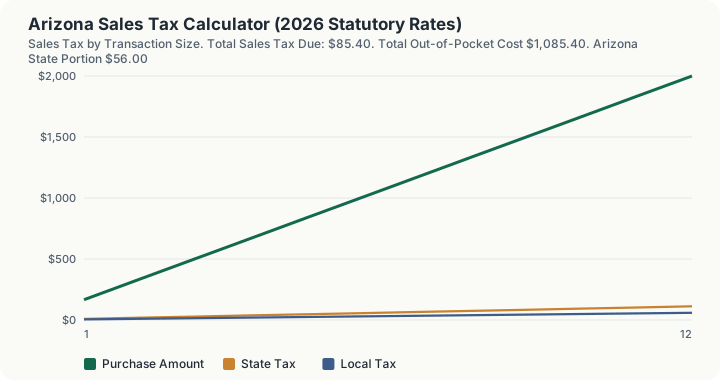
Quick Answer: A $1,000 taxable purchase in Arizona costs $85.40 in combined state and local sales tax, for a total of $1,085.40 out the door.
The 5.60% Floor and the 2.94% Layer, Priced
Arizona's state rate is 5.60% and the statewide average local add-on is 2.94%, for a combined 8.54%. On the $1,000.00 default the engine returns $85.40 of tax, split $56.00 to the state and $29.40 to cities and counties. Arizona is one of the few high-local states where the state share is still the larger one: the state takes $26.60 more per $1,000.00 of taxable spending than local government does.
That ratio is fixed at every size the engine was run at. At $50,000.00 the tax is $4,270.00, of which $2,800.00 is state and $1,470.00 local. At $100.00 it is $8.54, of which $5.60 is state and $2.94 local. The 2.94% figure is a single statewide average blending county excise taxes with city TPT rates, and there is no ZIP code, city or address input anywhere in this calculator's configuration.
Arizona Doesn't Have a Sales Tax: It Has a Transaction Privilege Tax
Arizona is one of the few states with no true general sales tax on the books. What everyone calls "Arizona sales tax" is legally the Transaction Privilege Tax (TPT), imposed under A.R.S. Title 42, Chapter 5. The distinction is not semantic:
- The tax is on the seller, not the buyer. A conventional sales tax is a tax on the purchaser that the retailer merely collects and remits as an agent of the state. TPT is levied on the vendor for the privilege of doing business in Arizona, measured by gross receipts. The legal liability is the seller's; passing it through as a separate line on the receipt is permitted, but it is a business decision, not a statutory collection duty.
- Sellers must be licensed, not merely registered. Because TPT is a privilege tax on business activity, anyone engaging in a taxable business activity in Arizona needs a TPT license from the Arizona Department of Revenue (with per-location licensing and annual renewal), rather than the simpler seller's permit some states use.
- Liability doesn't disappear if you fail to charge the customer. If a seller under-collects or forgets to add TPT, the state still assesses the seller for the tax on those gross receipts. Under a true sales tax the state's claim runs primarily against the buyer; under TPT it runs against the business.
- The tax is split into business classifications. There is no single "sales tax" rate. TPT is imposed under roughly 16 separate classifications (retail, restaurant and bar, contracting/prime contracting, commercial lease, personal property rental, transient lodging, amusement, and so on), each with its own rate and its own deductions. Two businesses on the same street can owe different rates on the same dollar of revenue.
- Cities levy their own TPT under the Model City Tax Code. Arizona's municipal-level tax is governed by the Model City Tax Code (MCTC), a uniform statutory framework adopted by the state's incorporated cities and towns. Cities choose rates and a limited menu of options within it, so municipal TPT can reach activities the state does not tax (residential rental has historically been the classic example) and can define a classification differently from the state. Since 2015 the Department of Revenue administers and collects both state and city TPT through a single return and the AZTaxes.gov portal, including for the "non-program" cities that once collected their own.
- Use tax is the true buyer-side tax. Because TPT falls on the seller, Arizona's complementary use tax is what actually reaches the purchaser on out-of-state purchases where no Arizona TPT was paid.
This calculator applies the combined state plus average local rate to a purchase price, which mirrors what a retail-classification receipt looks like. It does not select among TPT classifications, and a contractor, landlord, or lodging operator should not use the retail figure as their rate.
How This Is Calculated
What Arizona calls a sales tax is technically a transaction privilege tax: the legal liability sits on the seller for the privilege of doing business, not on the buyer, even though the charge is passed through at the register in the usual way. The state rate is 5.60% and the average local add-on is 2.94%, giving a combined 8.54% and $85.40 on a $1,000 purchase. Arizona also has a large number of cities that write their own TPT rules and rate schedules, so two addresses a few miles apart can be taxed differently on the same item.
Once the applicable city and county rates are folded into a single combined rate, the computation is one multiplication:
The steps the calculator runs are:
- Establish the taxable base. The calculator uses the pre-tax price exactly as entered.
- No item-level exemption filtering. Arizona exempts most groceries from the state rate while many cities still tax them, and prescription drugs are exempt. None of that is applied here, so enter only amounts taxed at the general rate.
- Apply the state rate to the base. That gives the state share of the tax.
- Apply the local surcharge. The 2.94% average blends county excise taxes with city TPT rates. Cities that administer their own tax are the main source of variation around that average.
- Combine into a total. State and local tax are added, then the combined tax is added to the purchase price for the final transaction amount.
Worked Example
For a $1,000 taxable purchase in Arizona:
- Starting purchase price. The buyer rings up a $1,000.00 taxable retail purchase in Arizona, the baseline amount before any tax is applied.
- State portion. Arizona's statutory state sales tax rate of 5.60% applies to the full purchase amount: $1,000.00 × 5.60% = $56.00 owed to the state.
- Local portion. Local municipal, county, and special-district surcharges add an average of 2.94% on top of that: $1,000.00 × 2.94% = $29.40 more.
- Combined tax due. Summing the two pieces, $56.00 in state tax plus $29.40 in local surcharge comes to $85.40 in total sales tax owed on the transaction.
- Total out-of-pocket cost. Adding that $85.40 in tax to the $1,000.00 purchase price brings the buyer's total out-of-pocket cost to $1,085.40.
This example uses Arizona's statewide average local rate of 2.94%; actual combined rates vary by city and county, so a real receipt could show a combined rate above or below the 8.54% average used here.
Twelve Tiers With No Edge in Them
Arizona's TPT has no bracket, no exemption cliff and no cap at any transaction size on the retail classification, so the tier schedule is a straight line and that is worth stating plainly rather than hunting for a threshold that does not exist. The computed tiers run $14.23 of tax at $166.67, $42.70 at $500.00, $85.40 at $1,000.00, $128.10 at $1,500.00 and $170.80 at $2,000.00. Extended past the table the same line gives $427.00 at $5,000.00, $2,135.00 at $25,000.00 and $4,270.00 at $50,000.00.
The effective rate does not move across four orders of magnitude. At $100.00 the tax is $8.54 and at $50,000.00 it is $4,270.00; both are exactly 8.54% of the base. Each additional $100 of purchase price costs $8.54, which is why $1,000.00 returns $85.40 and $1,100.00 returns $93.94. One further dollar costs nine cents: $85.40 becomes $85.49 at $1,001.00. A $1.00 purchase rounds to $0.09.
The Local Toggle Is the Only Step Change
The one discontinuity this calculator can produce is the average local surcharge switch. At $1,000.00, turning it off drops the tax from $85.40 to $56.00 and the out-the-door cost from $1,085.40 to $1,056.00. At $50,000.00 it drops from $4,270.00 to $2,800.00, a $1,470.00 swing.
Neither position describes a specific Arizona transaction. With the switch on, the engine is applying a statewide blend that no single address is charged; with it off, it reports the bare state rate, which is only correct in the rare case of a purchase facing no city or county TPT at all. Because Arizona cities set rates under the Model City Tax Code independently, two addresses a few miles apart can be several points apart, and nothing in the engine can distinguish them.
Reading an Arizona Receipt Backwards
The question this page cannot answer directly is the reverse one: a receipt totals $1,000.00 including TPT, so what was the pre-tax price and how much of it was tax? The engine runs net to gross only. It accepts a pre-tax amount and adds tax; there is no extraction mode and no tax-inclusive input.
The figure can still be recovered by running the forward calculation at candidate pre-tax amounts. For Arizona that amount is $921.32, which the engine prices at $51.59 of state tax and $27.09 of local tax, or $78.68 total, for an out-the-door cost of exactly $1,000.00. A cent lower, $921.31, lands at $999.99.
The wrong method, priced. The common error is to multiply the $1,000.00 tax-inclusive total by 8.54%. Entered as a pre-tax amount, $1,000.00 returns $85.40 of tax, but only $78.68 is embedded in a $1,000.00 receipt. The overstatement is $6.72 per $1,000.00 of gross, roughly $672 across $100,000 of gross receipts. The correct operation is the tax fraction, r divided by (1 + r), not the headline rate: against a tax-inclusive total, Arizona's 8.54% combined rate is about 7.87%. Those are two different numbers and treating them as one is the whole error. For a TPT filer the distinction is not cosmetic, because the tax is measured on the vendor's gross receipts, which is exactly the figure people are most tempted to multiply by the rate.
What This Does Not Account For
- TPT classifications. The engine applies one retail-style combined rate. It does not select among the roughly 16 business classifications, so a contractor, commercial landlord, lodging operator or personal property lessor should not use the $85.40 figure as their tax on $1,000.00 of gross receipts.
- Any specific jurisdiction. The 2.94% local figure is a statewide average. There is no city, county or ZIP input, and Model City Tax Code rates vary widely around it.
- What you bought. No product taxability classification exists in the engine. Arizona's food-for-home-consumption exemption and its prescription drug exemption are not applied; groceries entered here are taxed at the full 8.54%.
- Exemption and resale certificates, direct pay permits, and sales tax holidays. None are modelled; no input could express them.
- Use tax, marketplace facilitator collection, and economic nexus thresholds. The engine prices a single transaction and computes no registration, licensing or filing obligation.
- Special industry excise taxes such as lodging, rental vehicle, alcohol and tobacco levies, which stack on top of the general rate in practice.
- Cent-level agreement with a register that applies one combined rate. The state and local components are each rounded to the cent before being summed. At $999.01 the engine returns $85.31 of tax; applying 8.54% once to the same base and rounding gives a figure one cent higher.
Common Pitfalls
- Quoting 5.60% as the Arizona rate. On $1,000.00 that understates the bill by $29.40, and on $50,000.00 by $1,470.00.
- Stripping tax from gross receipts at the headline rate. A $1,000.00 tax-inclusive total contains $78.68 of TPT, not $85.40.
- Treating 8.54% as a rate charged at a specific address. It is a population-weighted average with no jurisdiction behind it.
- Using the retail figure for a non-retail classification. TPT rates and deductions differ by classification, and this page computes only the retail-style combined rate.
- Expecting a threshold. The sweep is linear from $0.09 of tax on $1.00 to $4,270.00 on $50,000.00, with no rate change at any point.
Frequently Asked Questions
What is the sales tax rate in Arizona?
Are groceries taxed in Arizona?
How does use tax differ from sales tax?
Are digital goods and SaaS taxable in Arizona?
Sources
- Arizona Department of Revenue: 2026 Sales and Use Tax Rate Schedules. azdor.gov
- Streamlined Sales Tax Governing Board (SSTGB): State Taxability Matrix. streamlinedsalestax.org/for-businesses/taxability-matrix
- A.R.S. Title 42, Chapter 5: Transaction Privilege and Affiliated Excise Taxes (TPT classifications and the seller-side incidence of the tax). azleg.gov/arstitle
Also consulted: Model City Tax Code (modelcitytaxcode.az.gov): Uniform framework for municipal TPT, administered and collected by ADOR; Arizona HB 2061 (56th Leg., 1st Reg. Sess., 2023): Prohibits municipal TPT on food for home consumption; ADOR Transaction Privilege Tax Ruling TPR 24-1: Economic nexus measured by retail-classification gross proceeds; treatment of non-retail classifications; ADP, LLC v. Arizona Dep't of Revenue, 247 Ariz. 36 (App. 2019): Hosted software access taxable as a rental of tangible personal property.