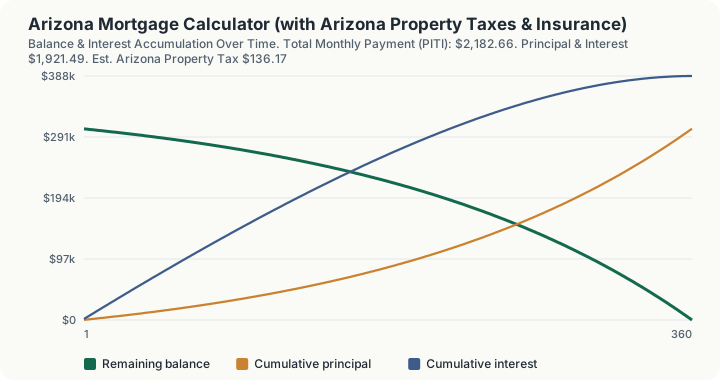
Quick Answer: A $380,000 Arizona home with 20% down, a 30-year fixed loan at 6.5% APR, this calculator's 0.43% property tax assumption, and a $125/month insurance estimate produces a total monthly payment (PITI) of $2,182.66.
What This Calculator Is Actually Modelling
Three inputs go in: price, down payment percentage, and APR. Everything else is fixed in code. The term is hardcoded at 360 months, so there is no 15-year option and no adjustable-rate path. The property tax rate is hardcoded at 0.43% in this calculator's own configuration rather than read from a rate table, and it is applied to the purchase price rather than to any separately assessed value. Homeowners insurance is a flat $125 a month at every price. Those three constants shape the result more than any input does.
On the defaults the engine returns a $304,000.00 loan principal, $1,921.49 of monthly principal and interest, $136.17 of monthly property tax, $125.00 of insurance, and a total PITI of $2,182.66, with $387,732.82 of interest paid across the full 360 payments.
Arizona's real property tax mechanism is more layered than this. County assessors maintain a Limited Property Value that is capped in how fast it can rise and is usually below the purchase price in year one, and combined primary and secondary rates from county, city, school and special districts are applied to it. None of that appears in the code; 0.43% of the purchase price is the whole of the tax model.
How This Is Calculated
- Down payment and loan principal. Loan Principal = Home Price x (1 - Down Payment %). At the defaults, $380,000 x 80% = $304,000.
- Principal and interest. The principal amortizes over exactly 360 periods at the monthly rate (APR / 12):
The 360 is fixed in the call; no term input exists, and the extra-payment parameter is passed as zero.
- Property tax estimate. Monthly Property Tax = Home Price x 0.43% / 12. The 0.43% is a constant in this calculator's configuration and the base is the purchase price.
- Insurance estimate. A flat $125.00 a month, unchanged by price, location or coverage.
- PITI total. Monthly PITI = Principal & Interest + Property Tax + $125.00. No PMI term is added at any down payment level.
Worked Example
Using the calculator's baseline inputs:
- Home Purchase Price: $380,000
- Down Payment: 20% ($76,000)
- Interest Rate (APR): 6.5%
Step by step: - Loan principal: $380,000 x 80% = $304,000.00 - Monthly principal & interest: $1,921.49 - Monthly property tax: $136.17 - Monthly insurance estimate: $125.00 - Total monthly payment (PITI): $2,182.66 - Total interest paid over 360 payments: $387,732.82
The Down Payment Walk, and the PMI That Is Missing From It
Every figure below is a separate run at $380,000 and 6.5%.
0% down. Principal $380,000.00, P&I $2,401.86, PITI $2,663.03, lifetime interest $484,667.97.
3.5% down. Principal $366,700.00, P&I $2,317.79, PITI $2,578.96.
5% down. Principal $361,000.00, P&I $2,281.77, PITI $2,542.94, lifetime interest $460,432.24.
10% down. Principal $342,000.00, P&I $2,161.67, PITI $2,422.84.
20% down. Principal $304,000.00, P&I $1,921.49, PITI $2,182.66.
25% down. Principal $285,000.00, P&I $1,801.39, PITI $2,062.56.
The single most misleading number in that list is $2,542.94. A conventional Arizona loan at 5% down is financed at 95% loan-to-value and will carry private mortgage insurance, and this calculator adds none: the PITI it reports at 5% down is the same three components it reports at 25% down. Moving from 20% to 5% down costs $360.28 a month in this model, and a real borrower's gap is larger than that by the whole PMI premium. Moving from 20% down to nothing down costs $480.37 a month here, on the same understated basis.
The Marginal Cost of an Eighth of a Point
Rate steps in 0.125% increments in this input, and each step is worth a specific amount. At $380,000 with 20% down:
6.375% APR. P&I $1,896.56, PITI $2,157.73, lifetime interest $378,763.14.
6.5% APR. P&I $1,921.49, PITI $2,182.66, lifetime interest $387,732.82.
6.625% APR. P&I $1,946.55, PITI $2,207.72, lifetime interest $396,756.31.
One eighth of a point costs $25.06 a month and $9,021.08 in interest across the 360 payments. A full point costs considerably more than eight times as much at the tails: 6.5% to 7.5% moves P&I from $1,921.49 to $2,125.61, a difference of $204.12 a month, and lifetime interest from $387,732.82 to $461,220.45. Dropping to 5.5% instead returns P&I of $1,726.08, PITI of $1,987.25, and $317,388.26 of lifetime interest.
The Reverse Question: What Price Holds the Payment
Holding 20% down and 6.5%, a $340,000 purchase produces PITI of $1,966.06 and a $380,000 purchase produces $2,182.66, so a $2,000 monthly ceiling is crossed between those two runs. A $300,000 purchase comes in at $1,749.46. A buyer targeting $2,400 can reach $420,000, which returns $2,399.25. At $500,000 the figure is $2,832.44, and at $750,000 it is $4,186.16.
Quoting P&I When You Meant PITI
This is the error that breaks budgets, and it is a computed figure on this page. A lender quoting the loan alone reports $1,921.49. The housing payment this calculator models is $2,182.66. The gap is $261.17 a month, or $3,134.04 a year, entirely made up of the tax and insurance components a borrower still has to fund through escrow.
The same comparison at other prices: at $300,000 the P&I is $1,516.96 against PITI of $1,749.46; at $750,000 it is $3,792.41 against $4,186.16.
The Flat Insurance Constant, Priced
The $125 is the same at every price, which is easy to verify by running the calculator twice. At $300,000 the tax component is $107.50 and insurance is $125.00, so the placeholder is the larger of the two escrow items. At $750,000 the tax component is $268.75 and insurance is still $125.00. A $750,000 Arizona home insured for $125 a month is not a realistic assumption, and every PITI figure on this page inherits that error unchanged as price rises.
What This Does Not Account For
- Private mortgage insurance. Not modelled at any loan-to-value. The 0% and 5% down figures above are understated by the full premium.
- The flat insurance constant. $125.00 a month at $300,000 and at $750,000 alike, as shown above.
- The fixed 360-month term. No 15-year, 20-year or ARM option exists, and the extra-payment parameter is passed as zero, so prepayment cannot be modelled.
- The hardcoded 0.43% tax rate. It lives in this calculator's configuration rather than in a state rate table, and it is applied to the purchase price.
- Limited Property Value. A first-year LPV is typically below the purchase price and rises on a capped schedule, so real Arizona tax bills diverge from a flat percentage of price.
- County and district rate variation. Maricopa, Pima, Pinal and Yavapai combined rates differ, sometimes by more than double, and none is looked up.
- HOA dues, closing costs, points and escrow reserves. None appears in the PITI figure.
Common Pitfalls
- Budgeting the $1,921.49 P&I figure. The modelled housing payment is $2,182.66, a difference of $261.17 a month.
- Trusting a low-down-payment PITI. The $2,542.94 shown at 5% down carries no PMI line.
- Assuming insurance scales with price. It does not move from $125.00 between a $300,000 and a $750,000 run.
- Reading 0.43% as a county rate. It is a hardcoded planning constant applied to the purchase price, not a primary or secondary district rate.
- Comparing a 30-year result against a 15-year quote. This calculator has no 15-year path; every figure is 360 payments.
Frequently Asked Questions
Why does this calculator use 0.43% instead of my county's actual property tax rate?
Is PMI included in the monthly payment shown?
Does the insurance estimate change with home price?
What does an eighth of a point cost?
Can I model a 15-year loan or extra payments?
Sources
- Arizona Department of Revenue: Property Tax Division, Limited Property Value guidance, cited as background only. azdor.gov
- Consumer Financial Protection Bureau (CFPB): mortgage disclosure and PMI requirements under Regulation Z. ecfr.gov/current/title-12/chapter-X/part-1026
Also consulted: Arizona county assessor offices (Maricopa County Assessor, Pima County Assessor): parcel-level rate and LPV lookups; Arizona Department of Insurance and Financial Institutions: homeowners insurance market data.