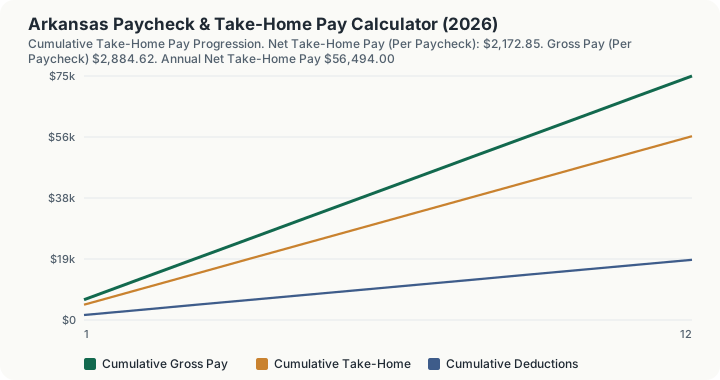
Quick Answer: A $75,000 annual salary in Arkansas, paid bi-weekly and filing single, takes home about $2,172.85 per paycheck ($56,494.00 per year) after federal tax, FICA, and Arkansas state withholding.
How This Is Calculated
Arkansas is graduated on paper and close to flat in practice for a full-time wage. The schedule opens with a 0% band and works up through 2%, 3% and 3.4% steps that are all exhausted by $26,400 of taxable income, so most of a working salary is taxed at the top 3.9% rate. That top rate is low enough that the state line on an Arkansas stub is usually smaller than the pre-tax benefit line next to it. The arithmetic behind it:
Each paycheck is built in four steps:
- FICA Payroll Tax Computation: Assessed on the full gross salary, before any pre-tax deduction is subtracted. - Social Security (OASDI): 6.20% withheld on wages up to the 2026 statutory wage base ($184,500). - Medicare (HI): 1.45% withheld on all gross earnings (no wage cap), plus 0.90% Additional Medicare Tax on earnings exceeding $200,000 (single) or $250,000 (married filing jointly).
- Federal Income Tax Withholding: Evaluated using 2026 progressive federal tax brackets (10%, 12%, 22%, 24%, 32%, 35%, 37%) on gross salary less the pre-tax deduction, after applying standard deduction thresholds ($16,100 single / $32,200 married joint).
- Arkansas State Income Tax Withholding: The same reduced wage figure is stacked through the Arkansas indexed bracket array -- 0% to $5,599, then 2.00% from $5,600, 3.00% from $11,200, 3.40% from $16,000 and 3.90% from $26,400. No state standard deduction and no state personal tax credit are applied at this step.
- Pay Period Proration: Annual net compensation is divided across the designated pay frequency (26 bi-weekly, 24 semi-monthly, 12 monthly, or 52 weekly pay periods).
Worked Example
Consider an employee in Arkansas earning $75,000 annually, paid bi-weekly (26 paychecks per year), filing single, with $3,500 in annual pre-tax 401(k) contributions.
- Gross pay per paycheck. $75,000 ÷ 26 pay periods = $2,884.62 before any withholding.
- Pre-tax deduction. The $3,500 annual 401(k) contribution reduces each paycheck by $134.62 and also shrinks the wages used to calculate federal and state income tax; FICA is still assessed on the full gross amount.
- FICA payroll taxes. Social Security withholds 6.2% of gross pay and Medicare withholds 1.45%, for $220.67 per paycheck.
- Federal income tax withholding. Applying the 2026 federal schedule to the reduced taxable wage withholds $265.38 per paycheck.
- Arkansas state tax withholding. The Arkansas bracket array applied to the same reduced wage withholds $91.10 per paycheck.
- Net take-home pay. $2,884.62 gross, minus $134.62 pre-tax, minus $220.67 FICA, minus $265.38 federal tax, minus $91.10 state tax leaves $2,172.85 per paycheck, or about $56,494.00 per year, an effective total tax rate of 20.01%.
Carrying The Year Forward
Arkansas reaches its 3.9% top rate at $26,400 of taxable income, which on a $75,000 salary is passed before the end of the fifth month, so for most of the year the state line is accruing at its maximum rate and never changes again.
Step 7 -- Two months of cumulative pay. The schedule's first row shows $6,250.00 of cumulative gross against $4,707.83 of cumulative take-home. Row two doubles both: $12,500.00 gross, $9,415.67 take-home, with $3,084.33 accumulated on the deduction side.
Step 8 -- The full year. By month twelve the schedule reaches $75,000.00 of cumulative gross and $56,494.00 of cumulative take-home, adding $4,707.83 every month without variation.
Step 9 -- What the year actually withheld. The cumulative deduction column closes at $18,506.00. That column carries the $3,500 pre-tax 401(k) contribution alongside the tax, so tax alone is $18,506.00 - $3,500 = $15,006.00, an effective total tax rate of 20.01% on $75,000.00 of gross pay.
Step 10 -- Why the monthly increment never changes. Watch the increments and they never change. The reason is structural: annual FICA is calculated first, with Social Security stopping at $184,500 and Additional Medicare beginning at $200,000 for a single filer, and only the annual total is prorated across the twelve rows. A live payroll system would show the paycheck grow in the month the wage base is hit. This one cannot, and at $75,000 there is nothing to show -- the wage base is $109,500 away.
Walking The Salary Axis Instead Of The Calendar
The twelve rows are a straight-line proration, so every real edge on this page lives on the salary axis. Arkansas has four bracket edges of its own, at $5,600, $11,200, $16,000 and $26,400 of taxable income, but with the default $3,500 pre-tax deduction those correspond to gross salaries of $9,100, $14,700, $19,500 and $29,900. All four sit at or below the bottom of any realistic full-time sweep: at $30,000 of salary the state line is already $23.60 per check and already in the 3.90% band. From there to $428.60 per check at $300,000 the Arkansas line is a straight ramp with no step in it. The edges that matter to an Arkansas wage earner are federal.
The federal edge that lands at $70,000 of gross salary
With $3,500 of pre-tax deductions and the $16,100 single standard deduction, the federal 12% band runs out at exactly $70,000 of gross.
At $69,000 of salary. Take-home is $2,015.65 per bi-weekly check, federal withholding $218.46, state $82.10. Annual net is $52,407.00.
At $70,000, at the boundary. Take-home is $2,045.06 per check, federal withholding $223.08, state $83.60. Annual net is $53,171.50, so that thousand added $764.50 to the year.
At $71,000, past it. Take-home is $2,070.62 per check, federal withholding $231.54, state $85.10. Annual net is $53,836.00, and the identical thousand now adds only $664.50.
The step costs $100.00 of annual take-home. Arkansas contributed $39.00 to each of those two thousands and nothing to the difference, since 3.9% applies on both sides.
The Social Security wage base at $184,500
At $184,000 of salary, annual net take-home is $127,750.50, FICA $541.38 per check.
At $185,000, annual net is $128,426.00, FICA $543.13. That thousand was worth $675.50.
At $186,000, wholly above the base, annual net is $129,132.50 and FICA per check is $543.69. That thousand was worth $706.50, $31.00 more than the one below it, because Social Security's 6.2% has stopped and only 1.45% Medicare remains.
The schedule shows none of it. At $186,000 the twelve rows still climb by one identical increment, because FICA was resolved annually before the division by twelve.
The marginal cost of the next $1,000
Annual net take-home is $55,829.50 at $74,000 of salary, $56,494.00 at $75,000 and $57,158.50 at $76,000. Each additional $1,000 of salary is worth $664.50 of annual take-home in Arkansas, and costs $335.50 in tax. The Arkansas share of that cost is $39.00, unchanged at any salary above about $30,000 because the top band never ends.
Running the calculator backwards
Sweeping the salary axis in $500 steps at the default settings, $107,500 is the first salary at which the bi-weekly check reaches $3,000, paying $3,003.47 against $2,990.69 at $107,000. And $141,000 is the first salary whose annual net take-home clears $100,000, at $100,037.00 against $99,714.75 at $140,500.
The pre-tax dollar, priced
At $3,500 of pre-tax deductions, annual net take-home is $56,494.00, state withholding $91.10 per check.
At $10,000, annual net take-home is $51,527.50, state withholding $81.35 per check.
Contributions rose by $6,500.00 while spendable take-home fell by only $4,966.50. The $1,533.50 gap is tax that was never withheld, and the whole $10,000 is still the employee's money. Of that saving, the Arkansas portion is $253.50, the state's 3.9% on the extra $6,500.
The Total Effective Tax Rate output falls from 20.01% to 17.96% across that same change, because the contribution is stripped out of the ratio's numerator, while the Cumulative Deductions column rises because it treats the contribution as a deduction. Two outputs on one page, measuring two different things.
Common Pitfalls
Multiplying the paycheck by 26. Twenty-six times $2,172.85 is $56,494.10, ten cents over the engine's $56,494.00. Choose monthly instead and $4,707.83 twelve times gives $56,493.96. The annual figure is computed first; the paycheck is derived from it. Annual net is $56,494.00 on every frequency -- weekly $1,086.42, bi-weekly $2,172.85, semi-monthly $2,353.92, monthly $4,707.83.
Reading Cumulative Deductions as tax. The column closes at $18,506.00 against $15,006.00 of actual tax. Quoted as tax it reads 24.67% of $75,000 where the correct figure is 20.01%, overstating the burden by 4.66 percentage points.
Expecting this state figure to match an Arkansas paystub. It will not, for two documented reasons set out below: the engine applies no state standard deduction, and it uses a marginal stack where Arkansas DFA uses a band-midpoint table with a phased-out adjustment.
What This Does Not Account For
- No state standard deduction and no state personal tax credit. Arkansas taxable income is taken as gross less the pre-tax box, nothing more. The state line here is therefore an upper bound on real Arkansas withholding.
- Marginal stack, not the DFA table. Arkansas DFA computes tax from the midpoint of each $100 band and subtracts a fixed per-bracket adjustment. The stacked calculation used here agrees to within about four cents at each bracket floor but can differ from the published table by roughly two dollars because of that midpoint rule.
- No adjustment phase-out above roughly $94,700. DFA phases the bracket adjustment down in $10 steps, so its own rule for $100,001 and over is $3,809 plus 3.9% of the excess over $100,000. The stack used here gives $3,480 at that point, so this engine understates Arkansas tax on high incomes by up to about $330. That is a real gap and is not corrected anywhere on this page.
- Bracket vintage. The array is the tax year 2025 indexed schedule. DFA has not published a 2026 bracket table, so 2025 is the current schedule.
- No local wage taxes, no W-4 detail. No dependents, multiple-jobs checkbox, extra per-period withholding or other-income entry. Filing status is single or married filing jointly, and Arkansas uses one bracket array for both.
- One pre-tax box, no post-tax box. 401(k), HSA and FSA share a single annual field with no employer match and no per-plan limit. Roth contributions, garnishments and post-tax premiums are absent.
- FICA is annual, then prorated. The twelve rows never show the wage-base step at any salary, for the reason given in Step 10.
- Two definitions on one page. The effective rate output excludes the pre-tax deduction; the Cumulative Deductions column includes it.
Frequently Asked Questions
Does Arkansas have a state income tax on paychecks?
At what income does Arkansas reach its top rate?
What does the next $1,000 of salary actually add?
What is the Social Security wage cap for 2026?
Sources
- Internal Revenue Service (IRS): Publication 15 (Circular E) and Publication 15-T (2026). irs.gov/publications/p15
- Social Security Administration (SSA): 2026 Social Security Wage Base Limit. ssa.gov
- Arkansas Department of Finance and Administration: State of Arkansas Indexed Tax Brackets, Tax Year 2025. dfa.arkansas.gov