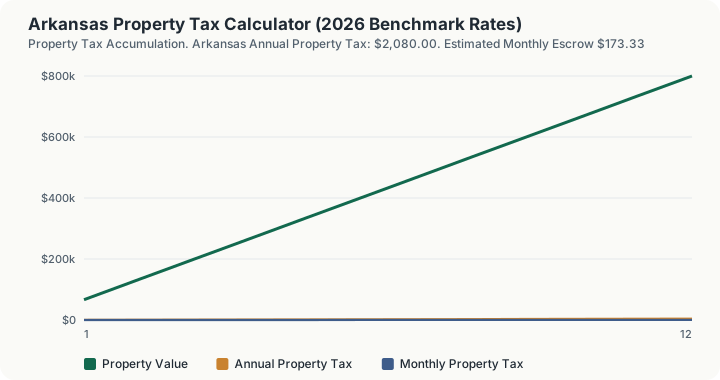
Quick Answer: A $400,000 home in Arkansas carries an estimated $2,080.00 in annual property tax at the state's 0.52% effective rate, or about $173.33 a month.
The Provenance of the 0.52%
No Arkansas authority levies 0.52% of market value. The figure is an observed ratio: median real estate taxes paid over median home value, sourced from the U.S. Census Bureau's 2024 1-Year American Community Survey, published in SmartAsset's property tax dataset and cross-checked against WalletHub's 2025 ranking for relative order. It puts Arkansas at #39 of 50.
What that ratio has absorbed matters in Arkansas more than in most states. Constitutional Amendment 79 sets assessed value at 20% of appraised value, caps annual homestead assessment growth, and grants a flat-dollar Homestead Property Tax Credit that reduces the bill after millage is applied. All three effects, plus every county and school district millage in the state, are already inside the 0.52%. None of them appears as a step in this calculator.
The rate is constant across value, so the results form a proportional line: $200,000 returns $1,040.00, $300,000 returns $1,560.00, $500,000 returns $2,600.00, $750,000 returns $3,900.00, and $1,000,000 returns $5,200.00.
How This Is Calculated
- Use the value box as typed. The engine applies no ratio, no cap and no county lookup to it. Amendment 79's 20% assessment step is not performed here.
- Subtract the exemption, with a zero floor. A flat dollar subtraction;
max(0, ...)stops the taxable figure going negative. - Multiply by 0.52%. One statewide rate at every value. There is no band, threshold or ceiling in the code.
- Divide by twelve. $2,080.00 a year is $173.33 a month. That division is the whole escrow model.
Worked Example
Baseline: a $400,000 Arkansas home with no exemption entered.
- Value. $400,000.00, used as given.
- Exemption. $0.00, leaving $400,000.00 taxable.
- Annual tax. $2,080.00.
- Monthly escrow. $173.33.
With the built-in $25,000 exemption scenario the same home returns $1,950.00 a year and $162.50 a month.
Testing the Sweep for an Edge, and Finding One Place Only
The sweep table beneath the result runs from $346.67 of annual tax at a $66,666.67 value through $2,080.00 at $400,000 to $4,160.00 at $800,000. It is a straight line. A flat rate cannot produce a bracket, so there is no threshold anywhere in the value dimension to walk.
The exemption floor is the exception, and it is a real cliff in the sense that the output stops responding entirely. On a $150,000 property:
Exemption $100,000. Taxable $50,000, annual tax $260.00, monthly $21.67.
Exemption $150,000, matching the value exactly. Annual tax $0.00.
Exemption $200,000, $50,000 more than the property is worth. Annual tax $0.00. The extra exemption buys nothing and is not carried forward.
What a Dollar of Exemption and a Dollar of Value Each Cost
Every $1,000 of exemption removes $5.20 of annual tax, at any value above the exemption. So $25,000 takes a $400,000 home from $2,080.00 to $1,950.00, a saving of $130.00 a year. $50,000 takes it to $1,820.00. The $200,000 maximum the input accepts takes it to $1,040.00.
Value costs the same $5.20 per thousand in the other direction. $400,000 returns $2,080.00 and $401,000 returns $2,085.20. Ten thousand dollars of extra value costs $52.00 a year, moving the bill to $2,132.00 and the escrow line from $173.33 to $177.67 a month. Across a realistic Arkansas price range, stepping from $200,000 to $400,000 doubles the annual figure from $1,040.00 to $2,080.00, with no relief at either end.
Working Backwards From a Budget
A homeowner holding annual property tax under $2,000 can carry a $300,000 home at $1,560.00 or a $400,000 home at $2,080.00; the ceiling falls between those two runs. At $500,000 the figure is $2,600.00, at $750,000 it is $3,900.00, and a million-dollar Arkansas property reaches $5,200.00 a year, which is $433.33 a month of escrow before any insurance is added.
Asked about exemptions: to bring a $400,000 home down to the $1,040.00 a $200,000 home pays, you would need $200,000 of exemption, the input's maximum. The Homestead Property Tax Credit in Arkansas statute works differently from that box, as a flat credit against the finished bill rather than a reduction of value, and nothing in this engine reproduces it.
Right Base Against Wrong Base, Priced
Arkansas is the state where this error is most tempting, because Amendment 79's 20% assessment ratio is explicit on every county notice. A $400,000 appraised home shows an assessed value of $80,000, and $80,000 looks like the number a property tax calculator wants.
Full value entered. $400,000 returns $2,080.00 a year.
Amendment 79 assessed value entered instead. $80,000 returns $416.00 a year.
The understatement is $1,664.00, a factor of five. The 0.52% is the ratio of taxes actually paid to market value, so the 20% assessment ratio is already inside it. Applying it again discounts the same value twice over. The engine performs no assessment-ratio conversion, cannot distinguish an appraised value from an assessed one, and will report the smaller number without complaint.
What This Does Not Account For
- The exemption field is a flat dollar subtraction with no eligibility test. Whatever you type is removed from the base before the 0.52% rate is applied, and the engine treats a general homestead, a senior freeze and a disabled-veteran exemption as the same number. A $25,000 entry returns $1,950.00 on a $400,000 home, $50,000 returns $1,820.00 and $100,000 returns $1,560.00; no step of that sweep asks whether the amount is one you actually qualify for, and no per-programme cap is enforced beyond the field's own maximum.
- The Homestead Property Tax Credit. A flat annual dollar credit under Amendment 79 applied after millage. This engine has no credit mechanism at all; the exemption box reduces value instead, which is not the same operation.
- The 20% assessment ratio and the homestead growth cap. Both are Arkansas statute and neither is performed here.
- County and district millage. Arkansas has 75 counties and hundreds of school districts, each with its own millage. One statewide ratio stands in for all of them.
- Classification. No residential-versus-commercial or agricultural distinction exists in the engine.
- Time. No year input, no appreciation, no reassessment cycle. Every figure is one static valuation.
Common Pitfalls
- Entering the 20% assessed value. Priced above at $416.00 against a correct $2,080.00.
- Expecting the Homestead Credit to appear. It does not exist in this engine in any form.
- Reading the schedule as a forecast. Every row prices a different property at today's rate, not this property in a later year. Row 12 sits at $800,000 of value and returns $4,160.00 with the exemption field at zero; there is no appreciation, reassessment or levy growth in the code path.
- Looking for a rate break at higher values. There is none: $5,200.00 on a million-dollar home is the same 0.52% that produces $1,040.00 at $200,000.
- Treating $173.33 as an escrow payment. It is one twelfth of the property tax alone, with no insurance and no cushion.
Frequently Asked Questions
How high are property taxes in Arkansas?
Should I enter appraised value or assessed value?
Is the Homestead Property Tax Credit included?
What does each additional $1,000 of value cost?
Can the tax reach zero?
Sources
- U.S. Census Bureau: 2024 1-Year American Community Survey, median real estate taxes paid over median home value. census.gov/programs-surveys/acs
- Arkansas Department of Finance and Administration, the official state tax authority for Arkansas rates, rules and forms. dfa.arkansas.gov
Also consulted: Arkansas Assessment Coordination Division: Amendment 79 assessment ratio and Homestead Property Tax Credit, cited as background only and not applied by this engine.