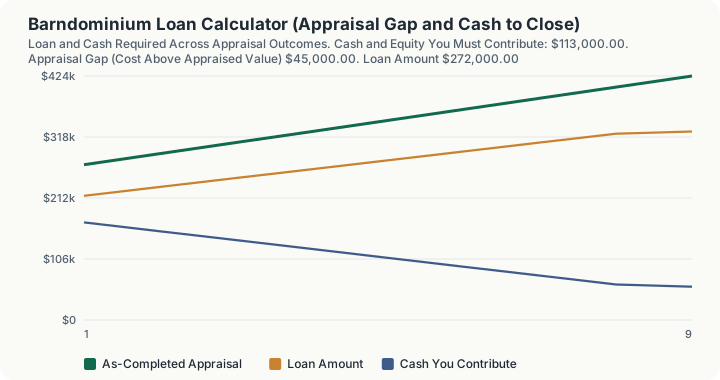
Quick Answer: A $385,000 barndominium budget that appraises at $340,000 as completed demands $113,000 of cash and equity at closing. The loan is $272,000, capped by the 80% LTV on appraised value rather than by the 85% loan-to-cost ceiling, and $45,000 of that contribution exists purely because the building costs more than it appraises for.
What does this calculator do?
A barndominium is a post-frame or steel building finished as a dwelling. The financing problem it creates has nothing to do with the interest rate and everything to do with the appraisal.
An appraiser sets value from comparable sales. In most counties there are no barndominium comparables, so the appraiser reaches for conventional stick-built houses, and the number that comes back commonly lands below what the project cost to build. The lender sizes the loan off the appraisal. You fund the difference in cash. That difference is invisible if you look only at a payment, and it is the reason these projects stall at the closing table rather than during construction.
This page treats the loan amount as an output, not an input. Two independent ceilings apply at once, the smaller one binds, and everything above it is yours to produce. Knowing which ceiling binds tells you which conversation to have: if value binds, you argue the appraisal or find more comparables; if cost binds, you argue the loan-to-cost limit. They are different negotiations with different people.
This is a different question from a construction loan calculator, which prices interest on progressive draws and assumes the loan amount is already known.
How is this calculated?
L = min(V × LTV_max, C × LTC_max, C)
cash required = C − L
where $C$ is total project cost, $V$ is the as-completed appraised value, and the loan is additionally never allowed to exceed 100% of cost.
Step 1: Total the project cost. $65,000 + $135,000 + $185,000 = $385,000
Step 2: Find the ceiling set by appraised value. $340,000 x 80% = $272,000
Step 3: Find the ceiling set by project cost. $385,000 x 85% = $327,250
Step 4: Take the lower of the two. $272,000 is less than $327,250, so the loan is $272,000 and the binding constraint is appraised value (max LTV)
Step 5: Everything above the loan is your contribution. $385,000 - $272,000 = $113,000 of cash and equity required at closing
Step 6: Measure the appraisal gap separately. $385,000 - $340,000 = $45,000, the amount your budget exceeds what the finished building is worth
Step 7: Credit the land you already own. $113,000 - $65,000 = $48,000 of cash needed beyond the land
Step 8: Express the contribution as a share of the budget. $113,000 / $385,000 = 29.35% of the budget
Step 9: Check the effective loan-to-value. $272,000 / $340,000 = 80.00%, confirming the LTV ceiling is exactly binding
Step 10: Price the payment on the loan that survived. $272,000 at 7.25% / 12 over 360 months = $1,855.52 a month
Step 11: Add the non-financing carry to get the annual cost of ownership. ($1,855.52 x 12) + $4,800 = $22,266.24 + $4,800 = $27,066.24 a year
Worked Example
The decision this page exists to inform is what happens when the appraisal moves. Everything else on the project is fixed by the time you find out.
Step 1: Suppose the appraisal comes back at cost, $385,000. $385,000 x 80% = $308,000 value ceiling
Step 2: Compare against the unchanged cost ceiling. $385,000 x 85% = $327,250
Step 3: Now the value ceiling still binds, but less severely. The loan is $308,000, and your contribution falls to $385,000 - $308,000 = $77,000
Step 4: Price the swing. $113,000 - $77,000 = $36,000 less cash, from an appraisal $45,000 higher
Step 5: Now suppose the appraisal comes back at $285,000, $100,000 under cost. $285,000 x 80% = $228,000 of loan
Step 6: Your contribution. $385,000 - $228,000 = $157,000
Step 7: Against the land you own. $157,000 - $65,000 = $92,000 of cash on top of the land
So a $100,000 appraisal shortfall costs you $80,000 of cash, not $100,000, because the LTV cap means every dollar of appraised value only ever carried 80 cents of loan. The relationship is linear at 0.8 dollars of loan per dollar of appraisal, right up until the cost ceiling takes over at an appraisal of $409,062.50, above which more value buys you nothing at all.
The table on the page runs exactly this sweep, from 70% of cost upward in 5% steps, reporting the loan, the cash and the payment at each appraisal outcome. Read it before you order the appraisal, not after.
What does this calculator not account for?
- Interest during construction. The engine prices the permanent loan only. A construction-to-permanent facility accrues interest on drawn balances throughout the build, and that interest is real money not shown here.
- Whether any lender will finance the project at all. Many will not touch non-conforming construction regardless of the arithmetic. The engine assumes a willing portfolio lender.
- Budget overruns. Owner-built projects routinely exceed the interior finish budget, and every dollar of overrun is a dollar of cash, because the loan is already capped.
- Closing costs, permits, septic, well and site work unless you have included them in the three cost inputs yourself.
- Whether the land is genuinely free and clear. The land equity credit assumes you own it outright. A land loan against it reduces the credit dollar for dollar.
- Draw schedules, inspections and retainage, all of which affect when you need the cash rather than how much.
- Property tax reassessment after completion. The annual tax and insurance figure is a single input you supply and does not change over the term.
What mistakes do people make with this?
- Budgeting the down payment as a percentage. The cash requirement here is 29.35% of budget, not the 20% the LTV cap might suggest, because the appraisal gap sits on top of the ordinary down payment.
- Assuming the shell is the expensive part. At the defaults the interior finish is $185,000 against $135,000 for shell and slab. The part that makes it a barndominium is the cheaper half.
- Negotiating the rate when value is the binding constraint. No rate concession reduces a $45,000 appraisal gap by a single dollar. If value binds, the appraisal is the only thing worth arguing about.
- Assuming owned land removes the cash problem. It removes $65,000 of it here. There is still $48,000 to write a cheque for.
- Insuring it like a house. Metal buildings can rate very differently. Get the quote before closing.
- Building without comparables. If no barndominium in your county has sold recently, the appraisal will be built from stick-built houses, and the gap is close to guaranteed.
Frequently Asked Questions
Why does my barndominium appraise for less than it costs to build?
Can I use land I already own as my down payment?
Which limit is capping my loan, the LTV or the loan-to-cost?
What LTV will a lender give me on a barndominium?
Is it cheaper to build the shell now and finish the interior later?
Why is my rate higher than a normal mortgage?
Sources
- USDA Rural Development. rd.usda.gov
- Consumer Financial Protection Bureau, Buying a house. consumerfinance.gov/owning-a-home
Also consulted: No public authority publishes loan-to-value caps, loan-to-cost caps, or interest rates for owner-built or non-conforming construction. These are lender credit policy and vary by institution, so the engine treats all three as user inputs rather than sourced constants; The as-completed appraised value is likewise an input: it is the output of an individual appraisal on your specific property and comparables, not a published figure; The payment, interest and balance figures come from a standard monthly amortisation schedule on the loan amount the two ceilings permit.