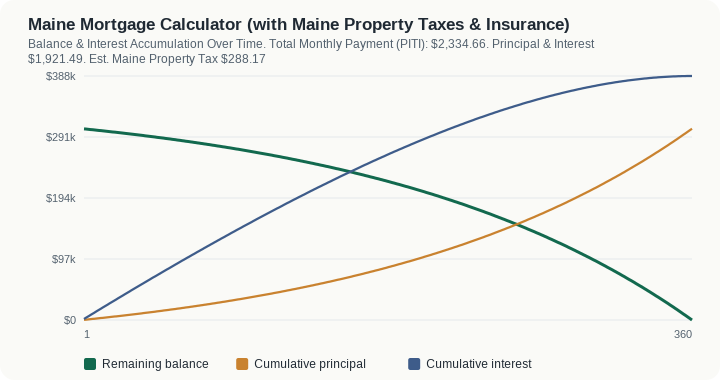
Quick Answer: A Maine buyer paying $380,000 with 20% down at 6.5% fixed lands at about $2,305.49 a month here: $1,921.49 goes to the loan, $288.17 to property tax at Maine's 0.91% effective rate, and $95.83 to homeowners insurance.
Where Maine Lands
Run the shared defaults through every state and Maine comes out 26th of 50 on the monthly total, with no other state producing exactly $2,305.49. Its tax line runs just $7.03 a month above what you would get from 0.89%, the plain unweighted average of all fifty state ratios, while its insurance line is one of the lightest in the country, which is what drops it into the lower half. Georgia is the next state up the list, only $2.66 higher; Missouri, at 0.79%, sits $1.41 below.
Maine touches only one other state, and that border is where the comparison bites. New Hampshire's 1.46% turns the identical purchase into $2,492.15 a month. That gap, $186.66 monthly or $2,239.92 a year, is pure escrow: $174.16 of tax and $12.50 of insurance, so a family weighing Kittery against Portsmouth, or Fryeburg against Conway, sees it on every statement. Income tax on either side of the Piscataqua is a separate question this page leaves alone.
The 0.91% comes from Census figures for Maine: median real estate taxes paid over median owner-occupied value, 2024.
How is this calculated?
At the defaults the Maine figure is built in four lines:
- $380,000 minus a $76,000 down payment leaves a $304,000 loan.
- That loan, amortized over 360 months at 6.5% with interest rounded to the cent each month, costs $1,921.49.
- $380,000 times 0.91% is $3,458 a year of tax; the monthly line is $288.17. The price is the base, so a bigger down payment never touches it.
- Insurance is $95.83 a month. In the NAIC's report on 2023 policies, a Maine HO-3 homeowner paid $1,150 on average, $587 less than the $1,737 countrywide mean and 43rd of the 50 states. The figure averages every coverage level across the state, so it is a benchmark rather than a quote, and the engine leaves it unchanged whatever the price.
$1,921.49 plus $288.17 plus $95.83 gives $2,305.49. No mortgage insurance is added at any down payment, so a low-down Maine loan reads lighter here than a lender will quote it.
Worked Example
A $250,000 house in Lewiston or Waterville
Borrowing $200,000 at 6.5% means $1,264.14 of principal and interest. Add $189.58 of tax and the $95.83 insurance line: $1,549.55. At this price insurance is 6.18% of the bill and tax 12.23%.
Maine's median home, $341,900
Census puts the typical owner-occupied Maine home at $341,900. A 20% down payment leaves $273,520 to borrow, which costs $1,728.83 a month; tax adds $259.27 and insurance $95.83 for a total of $2,083.93. Over thirty years that loan accrues $348,861.52 of interest, slightly more than the price of the house itself.
A $600,000 place near Portland or on the midcoast
A $480,000 loan runs $3,033.93 a month. Tax is $455.00, insurance $95.83, total $3,584.76. Here the tax share climbs to 12.69% while the fixed insurance line shrinks to 2.67%.
On the default house the loan is 83.34% of the payment, tax 12.50% and insurance 4.16%. Monthly tax passes the $95.83 insurance line once a price reaches $126,369, which covers almost everything for sale in southern and coastal Maine.
Down Payment and Rate in Maine
Holding the $380,000 price, thinner down payments move only the loan line, because tax is figured on the price:
| Down payment | Loan | Monthly total |
|---|---|---|
| 0% | $380,000 | $2,785.86 |
| 5% | $361,000 | $2,665.77 |
| 10% | $342,000 | $2,545.67 |
| 20% | $304,000 | $2,305.49 |
Dropping from 20% to 5% down adds $360.28 a month before any mortgage insurance, which the engine does not price. A half point either side of 6.5% is worth about $100: 6% gives $2,206.63 and 7% gives $2,406.52.
If the house costs 25% more, $475,000, still with 20% down, the loan becomes $380,000 and the total $2,857.90. Tax on that pricier house is $360.21 a month. Across thirty years the default house pays $103,741 of tax on this calculator's flat basis, a figure that never rises because the engine freezes the price.
Maine Taxes That Sit Outside the Payment
Bills come from each town at its own mil rate, with ownership status set on April 1 and due dates voted locally, so a summer closing usually means a prorated bill still in the seller's name. Newcomers also wait a year for the homestead exemption. The Maine property tax calculator handles exemptions and abatement; this page applies neither.
The deed tax is split down the middle between seller and buyer by statute. At $2.20 per $500 of value, a buyer's half on the default house works out to $836.00 from the statutory rate, cash due at closing rather than part of the loan. The Maine real estate transfer tax calculator covers the higher tier above $1 million.
Foreclosure Runs Through the Courts
Title 14, section 6321 provides for foreclosure by civil action in the Superior Court or District Court where the property sits. After judgment, section 6322 gives the borrower a redemption period of 90 days on mortgages executed on or after October 1, 1975. Section 6321-A sets up a foreclosure mediation program. This affects risk and timelines rather than the monthly figure, and the calculator does not model default in any form.
What does this calculator not account for?
- Your town's mil rate. Cape Elizabeth and a rural Aroostook town will not both match 0.91%.
- The homestead exemption, in the first year or later.
- The buyer's half of the deed tax and other closing costs.
- Mortgage insurance, at any down payment.
- Your own insurance quote. The $95.83 is a statewide 2023 average, so it ignores your county, coastal wind, flood zone, construction and the age of an old farmhouse, along with your deductible, claims history and coverage amount.
What mistakes do people make with this?
- Assuming the exemption arrives with the keys. It takes a year of Maine ownership and an April 1 residence.
- Trusting 0.91% in a high mil rate town. Ask the town office for the assessment and current rate; the servicer's escrow analysis will follow those, not this page.
- Forgetting that a cheaper price helps twice. A $25,000 lower price cuts both the loan and the tax line, while extra cash down only shrinks the loan.
- Leaving the deed tax out of closing cash. $836.00 on the default house is small next to the down payment, but it is not financed.
Frequently Asked Questions
What property tax rate does this Maine mortgage calculator use?
What does a mortgage payment in Maine look like at the state median price?
How much does each half point of rate change the Maine payment?
How does Maine compare with New Hampshire on this calculator?
Is Maine a judicial foreclosure state?
Sources
- U.S. Census Bureau, 2024 ACS 1-year estimates for Maine, tables B25103 and B25077. data.census.gov/table/ACSDT1Y2024.B25103
- Maine Revenue Services, Real Estate Transfer Tax. maine.gov/revenue/taxes/property-tax/transfer-tax
- Maine Legislature, Title 36, Section 502. legislature.maine.gov/statutes/36/title36sec502.html
- Maine Legislature, Title 36, Section 505. legislature.maine.gov/statutes/36/title36sec505.html
- Maine Legislature, Title 14, Section 6321. legislature.maine.gov/statutes/14/title14sec6321.html
- Maine Legislature, Title 14, Section 6321-A. legislature.maine.gov/statutes/14/title14sec6321-A.html
- Maine Legislature, Title 14, Section 6322. legislature.maine.gov/statutes/14/title14sec6322.html
- NAIC, Homeowners Insurance Report, data for 2023 (Table 4, HO-3 average premium, Maine). content.naic.org/sites/default/files/publication-hmr-zu-homeowners-report.pdf