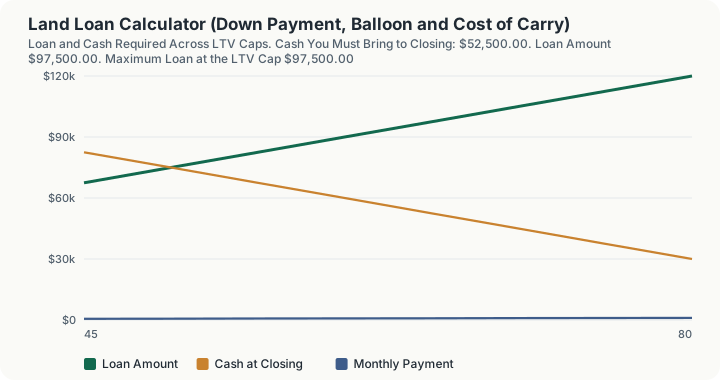
Quick Answer: A $150,000 parcel financed at a 65% maximum LTV needs $52,500 of cash at closing, 35.00% of the price. The loan is $97,500 at 8.5% amortised over 20 years, the payment is $846.13, tax, insurance and upkeep push the annual holding cost to $12,353.56, and at the balloon in month 60 you still owe $85,924 after repaying only $11,576 of principal.
What does this calculator do?
The question a land loan raises is not whether you can afford the payment. It is whether you can afford to hold an asset that earns nothing.
Three structural facts make raw land different from a house, and all three point the same direction:
The LTV cap is low. Lenders cap land far below what they would lend on a dwelling, because there is no house to foreclose on and no secondary market to sell the loan into. A 65% cap means 35% of the price is cash, before you have spent a dollar on the build.
The loan balloons long before it amortises. A payment sized on a 20-year schedule with the balance due in year 5 means you repay almost no principal. At the defaults, 11.9% of the loan is retired by the balloon date.
The carry is pure outflow. Vacant land is taxed, insured and maintained, and produces nothing to offset any of it. Over a five-year hold that adds up quietly.
This calculator prices all three together. It is deliberately not a payment calculator: the figure it leads with is the cash you must produce, and the figure it exists to make visible is what the whole hold costs you before you ever break ground.
How is this calculated?
L = min(V × LTV_max, C); cash = C − L
where $C$ is the purchase price and $V$ is the appraised value. The payment is a standard monthly amortisation payment over the amortisation period, and the balloon is the scheduled balance at the balloon month, taken from that schedule rather than re-derived.
Step 1: Apply the LTV cap to the appraised value. $150,000 x 65% = $97,500
Step 2: Check it against the price, since no lender lends above cost. $97,500 is below $150,000, so the loan is $97,500 and the binding constraint is appraised value (max LTV)
Step 3: The cash you must produce is the rest of the price. $150,000 - $97,500 = $52,500
Step 4: Express it as a share of the price. $52,500 / $150,000 = 35.00% of the price
Step 5: Confirm the effective loan-to-value. $97,500 / $150,000 = 65.00%
Step 6: Size the payment on the amortisation period, not the balloon period. $97,500 at 8.5% / 12 over 240 months = $846.13 a month
Step 7: Read the scheduled balance at the balloon month. After 60 payments the balance is $85,924, due in a single instalment
Step 8: Find how little principal that represents. $97,500 - $85,924 = $11,576 of principal repaid, which is 11.9% of the loan
Step 9: Total the payments made before the balloon. $846.13 x 60 = $50,767.80
Step 10: Of which interest is. $39,191.67
Step 11: Add the non-financing carry over the same period. $2,200 a year x 5 years = $11,000
Step 12: Total cash out of pocket to the balloon, excluding the balloon itself. $52,500 + $50,767.80 + $11,000 = $114,267.80
Step 13: The annual cost of simply holding the land. ($846.13 x 12) + $2,200 = $10,153.56 + $2,200 = $12,353.56 a year
Worked Example
The input worth shopping hardest is the LTV cap, because it moves your cash requirement dollar for dollar and lenders differ on it more than they differ on rate.
Step 1: A remote unimproved parcel at a 50% cap. $150,000 x 50% = $75,000 of loan
Step 2: The cash that leaves. $150,000 - $75,000 = $75,000 at closing
Step 3: An improved recorded lot with utilities, at an 80% cap. $150,000 x 80% = $120,000 of loan
Step 4: The cash that leaves. $150,000 - $120,000 = $30,000 at closing
Step 5: The spread across those two lenders. $75,000 - $30,000 = $45,000 of cash, on an identical $150,000 parcel
Thirty percentage points of LTV is worth $45,000 here. Half a point of rate on the default $97,500 loan is worth about $30 a month, or $1,800 across the five-year hold. The ranking is not close, and yet the rate is what most buyers negotiate.
Now the second half of the decision, which is what a longer hold does.
Step 6: Extend the balloon from 5 years to 10. The payment is unchanged at $846.13, because it is sized on the 20-year schedule.
Step 7: But the carry doubles. $2,200 x 10 = $22,000 of tax, insurance and upkeep
Step 8: And ten years of payments. $846.13 x 120 = $101,535.60
Step 9: Total cash out of pocket over ten years. $52,500 + $101,535.60 + $22,000 = $176,035.60, against a parcel that has produced nothing
That is the number to weigh against what the land is worth to you. The page reports it directly, along with the balloon balance still outstanding at the end of it.
What does this calculator not account for?
- The balloon payment itself. The total cash outlay figure deliberately excludes it, because at the balloon you refinance, build, or sell rather than write a cheque for $85,924. What the engine does not do is model any of those three exits.
- Whether you can refinance at all. A balloon assumes a lender exists in year 5 on terms you can accept. That is not guaranteed, and it is the principal risk in a land loan.
- Appreciation. No land value growth is projected. The calculation is entirely about outflow.
- Perc tests, surveys, easements, road access and utility extension. All are real costs of making land buildable and none are inputs.
- Closing costs, title work and origination fees.
- Rollover into a construction loan. Many buyers intend to refinance the land into construction financing. The engine prices the land loan in isolation.
- Tax treatment. Interest on vacant land held for investment and property tax on it may be deductible or capitalisable depending on your circumstances. Nothing here is after-tax.
- Owner or seller financing, which is often the only route on remote acreage and prices completely differently.
What mistakes do people make with this?
- Budgeting a 20% down payment. Land is not a house. At a 65% cap the cash requirement is 35%, and on raw acreage a 50% cap is common.
- Assuming the payment is the cost. The payment is $846.13. The annual holding cost is $12,353.56, because tax, insurance and upkeep run alongside it and nothing offsets them.
- Missing that the balloon is not the end of the amortisation. The payment is sized on 240 months and the loan matures at 60. You will still owe 88.1% of what you borrowed.
- Shopping rate instead of LTV. Thirty points of LTV is worth $45,000 of cash here. A half point of rate is worth $1,800 over the same period.
- Forgetting the appraisal can come in low. The loan is sized off the appraised value, not your price, so any shortfall lands entirely on your closing cash on top of the ordinary down payment.
- Planning to hold "a few years" without pricing it. Five years of carry and payments is $61,767.80 on this parcel, before the balloon.
Frequently Asked Questions
How much down payment do I need for raw land?
Why do land loans have balloon payments?
What happens when the balloon comes due?
Why is the interest rate on land higher than on a mortgage?
What does it actually cost me to hold this land for five years?
Does an improved lot really borrow that much more?
Sources
- USDA Rural Development. rd.usda.gov
Also consulted: No public authority sets a loan-to-value cap, an interest rate, or a balloon term for land. All three are lender credit policy, vary by parcel type and institution, and the engine treats every one as a user input rather than a sourced constant; Your annual property tax figure comes from your county assessor, who publishes the millage rate and the assessed value for your parcel; The payment, the balance at the balloon and the interest paid come from a standard monthly amortisation schedule on the loan the LTV cap permits, with the balloon balance read from that schedule rather than re-derived.