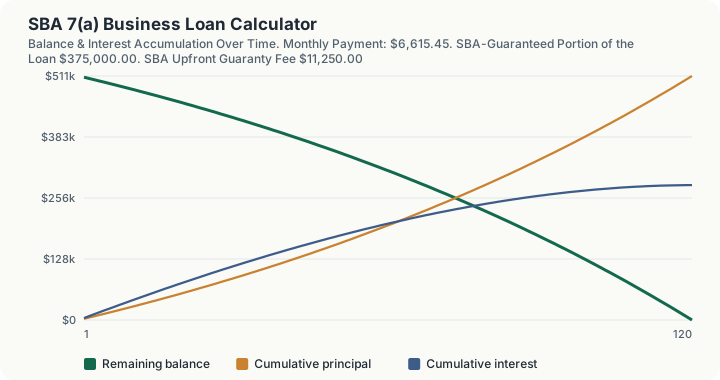
Quick Answer: A $500,000 SBA 7(a) loan carries a 75% SBA guarantee ($375,000 guaranteed), a $11,250 upfront guaranty fee financed into the loan, and at Prime (6.75%) plus a 2.75% lender spread over 10 years, a monthly payment of about $6,615.45.
Overview
An SBA 7(a) loan is not a loan from the Small Business Administration. It's a conventional loan made by a bank, credit union, or fintech lender, where the SBA agrees to guarantee a large portion of the balance if the borrower defaults. That guarantee is what lets lenders extend credit to small businesses that wouldn't otherwise qualify for financing on those terms, and it's also why the loan carries a fee that doesn't exist on an ordinary bank loan: the SBA guaranty fee, charged not on the full loan amount but specifically on the portion the SBA is guaranteeing.
Most 7(a) loans carry a variable interest rate tied to the Wall Street Journal Prime Rate, plus a spread the lender adds on top, subject to SBA-imposed caps that get tighter as the loan size and term increase. This calculator models both halves of the real cost structure: the ongoing interest rate built from Prime plus your spread, and the one-time guaranty fee, calculated correctly using the SBA's actual tiered fee schedule and applied to the guaranteed portion of the loan, not the total loan amount, which is a distinction many simplified calculators get wrong.
How This Is Calculated
Step 1: Determine the guarantee percentage. Loans of $150,000 or less carry an 85% SBA guarantee. Loans above $150,000 carry a 75% guarantee. This percentage protects the lender, not the borrower directly, but it is the basis for the fee calculation in the next step.
Step 2: Apply the correct guaranty fee tier to the guaranteed portion. For FY2026, standard 7(a) loans with maturities over 12 months use this schedule:
- Loans $150,000 or less: 2% of the guaranteed portion.
- Loans $150,001 to $700,000: 3% of the guaranteed portion.
- Loans $700,001 to $5,000,000: 3.5% of the guaranteed portion up to $1,000,000 guaranteed, plus 3.75% on any guaranteed amount above $1,000,000.
Step 3: Finance or pay the fee. Most borrowers roll the guaranty fee into the loan balance rather than paying it in cash at closing. This calculator lets you choose either way; financing it increases your amortized balance and therefore your monthly payment, while paying in cash keeps the amortized balance at the raw loan amount but requires more cash upfront.
Step 4: Set the interest rate. Most 7(a) loans are variable, calculated as the WSJ Prime Rate plus a lender spread. SBA caps the maximum allowable spread; for loans over $50,000 with a maturity of 7 years or more, the current cap is Prime plus 2.75%.
Step 5: Amortize. The financed loan amount is run through the standard amortization formula over the chosen term to produce the monthly payment and the full payment schedule.
Worked Example
Take a $500,000 7(a) loan, Prime at 6.75%, a 2.75% lender spread, a 10-year term, with the guaranty fee financed.
- Guarantee percentage: loan exceeds $150,000, so the guarantee is 75%.
- Guaranteed portion: $500,000 × 75% = $375,000.
- Fee tier: $500,000 falls in the $150,001-$700,000 tier, so the fee rate is 3% of the guaranteed portion.
- Guaranty fee: $375,000 × 3% = $11,250.
- Financed loan amount: $500,000 + $11,250 = $511,250.
- Interest rate: 6.75% + 2.75% = 9.5%.
- Monthly payment (120 months): applying the standard amortization formula to $511,250 at 9.5% over 120 months gives $6,615.45.
Compare that to a smaller $100,000 loan: it stays under the $150,000 threshold, so it gets the more generous 85% guarantee and the lower 2% fee tier. Guaranteed portion is $85,000, fee is $1,700, financed amount is $101,700, and the monthly payment at the same rate and term drops to $1,315.97. A $2,000,000 loan illustrates the top tier: guaranteed portion of $1,500,000 splits across both brackets, producing a fee of $35,000 (on the first $1,000,000 guaranteed) plus $18,750 (on the remaining $500,000 guaranteed) for a total of $53,750.
What This Does Not Account For
This calculator models principal, interest, and the SBA upfront guaranty fee. It does not include the lender's own closing costs, packaging fees, or third-party costs like appraisals and environmental reports, which are separate from the SBA guaranty fee and vary by lender and loan type. It does not model the SBA's ongoing annual servicing fee, which is charged to the lender (not typically passed directly to the borrower as a separate line item, though it can be reflected in pricing). It assumes a level interest rate for the full term; because most 7(a) loans are variable and repriced periodically against Prime, your actual rate and payment will shift as Prime moves. It does not distinguish between the many 7(a) sub-programs, such as SBA Express, Export Express, or the manufacturer-specific fee waivers, which carry their own fee schedules and guarantee percentages different from the standard 7(a) figures used here. It also does not model prepayment penalties, which can apply to loans with maturities of 15 years or more if prepaid heavily within the first three years.
Common Pitfalls
Borrowers often assume the guaranty fee applies to the full loan amount, when it's actually calculated only on the SBA-guaranteed portion, which is why two loans of the same size but different guarantee percentages produce different fee totals. It's also common to shop lenders purely on the stated spread over Prime without confirming that spread against SBA's own maximum allowable caps, which vary by loan size and term. A lender quoting a spread above the legal cap for that loan's characteristics is either miscalculating or including additional costs elsewhere. Some borrowers budget as if the fee is a small, forgettable line item, when on a large loan it can run into the tens of thousands of dollars, meaningfully changing the total amount financed. And because most 7(a) loans carry variable rates, borrowers sometimes anchor on the rate quoted at closing and are caught off guard when Prime moves and their payment adjusts at the next reset date.
Frequently Asked Questions
Does the SBA actually lend me the money?
Why is the guaranty fee based on the guaranteed portion instead of the full loan?
Can I avoid the guaranty fee entirely?
Is the interest rate always Prime plus a spread?
How often does my payment change on a variable-rate SBA loan?
Sources
- U.S. Small Business Administration, 7(a) Loan Program.
- SBA FY2026 7(a) & 504 Loan Fee Notice, effective October 1, 2025, summarized by NAGGL (National Association of Government Guaranteed Lenders). sba.gov
- WSJ Prime Rate, August 2026 (Federal Reserve upper target range plus 3.00 percentage points). federalreserve.gov