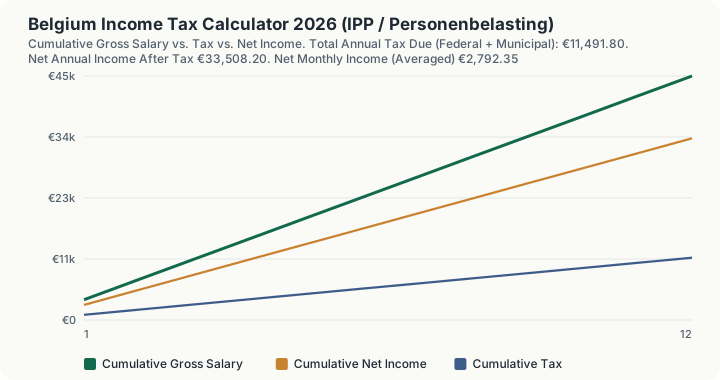
Quick Answer: A Belgian resident earning €45,000.00 in annual gross taxable salary (after social security) owes an estimated €11,491.80 in total personal income tax for 2026 -- €10,740.00 in federal tax (impôt des personnes physiques) plus €751.80 in municipal surcharge at the national-average 7% rate -- leaving €33,508.20 in net annual income, or about €2,792.35 per month.
Overview
This calculator estimates Belgian personal income tax -- impôt des personnes physiques (IPP) in French, personenbelasting in Dutch -- for income year 2026 (the tax year currently accruing, assessed and filed in 2027 as assessment year / exercice d'imposition 2027). It covers Belgium's national federal tax specifically, applied uniformly whether you live in the Flemish Region, the Walloon Region, or the Brussels-Capital Region; only the municipal surcharge on top of it varies by where you live.
Belgian income tax has a structure that trips up a lot of people who are used to a simpler "subtract a standard deduction, then apply brackets" system. Two mechanics make it distinctive:
- The forfait professionnel (flat-rate professional expense deduction). Before your salary is taxed at all, 30% of it is deducted automatically, up to a cap (€6,070 for income year 2026), to account for job-related costs -- unless you have documented actual expenses larger than that, most salaried employees never touch this and it's applied automatically.
- The quotité exemptée d'impôt (tax-free allowance) is not a deduction -- it's a credit. Unlike many countries where the tax-free amount is subtracted from taxable income before brackets apply, Belgium computes tax on your full taxable income first, then converts your tax-free allowance into a flat tax reduction equal to 25% of that allowance (the lowest bracket rate). For 2026 the base allowance is €11,180, worth a €2,795.00 reduction to anyone below the top bracket.
On top of the federal result, every one of Belgium's roughly 581 communes levies its own surcharge -- from 0% to 9% of the federal tax due, averaging about 7% nationally. This calculator defaults to that 7% average and lets you override it with your own commune's exact rate.
How This Is Calculated
- Forfait professionnel (flat-rate deduction). 30% of gross taxable salary, capped at €6,070 for income year 2026.
- Net taxable income.
- Gross tax before reduction, via the 2026 progressive bracket schedule:
| Bracket | Rate |
|---|---|
| €0-€16,720 | 25% |
| €16,720-€29,510 | 40% |
| €29,510-€51,070 | 45% |
| Above €51,070 | 50% |
- Quotité exemptée reduction. The €11,180 base allowance converts to a tax reduction at the 25% rate, capped so it can never take tax below zero.
- Federal tax after reduction, then the municipal surcharge (your rate, default 7%):
Worked Example
Using the calculator's default inputs -- €45,000.00 gross taxable salary, 7% communal surcharge:
- Forfait: min(€45,000 × 30%, €6,070) = €6,070.00.
- Net taxable income: €45,000 − €6,070 = €38,930.00.
- Gross tax across brackets: €16,720 × 25% + €12,790 × 40% + €9,420 × 45% = €4,180.00 + €5,116.00 + €4,239.00 = €13,535.00.
- Quotité exemptée reduction: €11,180 × 25% = €2,795.00.
- Federal tax: €13,535.00 − €2,795.00 = €10,740.00.
- Municipal surcharge: €10,740.00 × 7% = €751.80.
- Total tax due: €11,491.80, for net income of €33,508.20 (€2,792.35/month).
The Same Figures Spread Across the Year
Belgian payroll withholds monthly, so the annual computation above is best read as twelve identical slices.
Step 1 -- Month 1. Cumulative gross €3,750.00, cumulative tax €957.65, cumulative net €2,792.35
Step 2 -- Month 2. Cumulative gross €7,500.00, cumulative tax €1,915.30, cumulative net €5,584.70
Step 3 -- Month 12. Cumulative gross €45,000.00, cumulative tax €11,491.80, cumulative net €33,508.20
By the end of June the employee has already handed over €5,745.90, more than half of a full year's take-home month. Spreading the total this way is what makes the 25.54% effective rate concrete: every fourth month of work in the year goes to federal tax and the communal surcharge before anything else is deducted. The schedule apportions the annual result evenly and does not model the progressive withholding scales that make real Belgian payslips vary month to month.
What This Does Not Account For
- Dependent children, marital status, and the quotient conjugal. A higher quotité exemptée applies for dependent children, a disabled taxpayer, or certain other family situations, and a single-income married/legally-cohabiting household can split income between spouses (quotient conjugal) to lower the marginal rate. This calculator models a single taxpayer with no dependents only; public sources gave genuinely conflicting figures for the exact 2026 per-child supplement, so rather than guess, it is left out entirely -- check the SPF Finances tax simulator for your exact family situation.
- Investment income, rental income, and self-employment income. This calculator models salaried employment income only, not the separate (and differently taxed) rules for dividends, interest, rental income, or self-employed professional profits.
- Actual professional expenses. If your real job-related costs exceed the 30%/€6,070 flat-rate forfait, you can deduct actual documented expenses instead -- this calculator always applies the flat-rate forfait.
- Tax credits beyond the quotité exemptée, such as the long-term savings tax reduction (pension savings, mortgage-related reductions -- see the companion Belgium Pension & Mortgage Bonus Logement Calculator), service voucher (titres-services) reductions, or charitable-gift reductions.
- Special social security regimes (self-employed RSVZ/INASTI contributions, statutory civil servants) -- this assumes a standard private-sector salaried employee already net of ONSS/RSZ contributions.
Common Pitfalls
- Entering gross salary before social security instead of after. This calculator expects your salary already net of Belgian social security contributions (ONSS/RSZ), which is how the forfait professionnel and tax brackets are meant to apply -- entering pre-social-security gross pay will overstate your tax.
- Assuming the tax-free allowance works like a deduction. Because Belgium converts the quotité exemptée into a flat 25% tax reduction rather than subtracting it from taxable income, its cash value is always capped at 25% of the allowance amount regardless of your marginal bracket -- it is worth exactly the same in absolute euros to a 25%-bracket taxpayer and a 50%-bracket taxpayer.
- Forgetting the municipal surcharge varies by where you live, not where you work. The commune that taxes you is your domicile (residence) on 1 January of the assessment year, not your employer's location.
- Ignoring that this reform-era tax-free allowance is still rising. A federal reform law passed 9-10 July 2026 progressively raises the quotité exemptée from €11,180 toward €14,450 by assessment year 2030 and €15,600 by 2031 -- the exact allowance you'll see for later income years will keep increasing.
Frequently Asked Questions
Why is my actual tax bill different from this estimate?
Is the 30% forfait professionnel always the better choice?
Does this include the municipal surcharge automatically?
What's changing with the 2026-2029 tax reform?
Does this calculator file my tax return for me?
Sources
- Belgian Federal Public Service Finance, the official authority for the national tax authority this calculator relates to. finance.belgium.be
Also consulted: SPF Finances / FOD Financiën (fin.belgium.be): "Tax rates," income tax year 2026 (assessment year 2027) -- official bracket thresholds (€16,720 / €29,510 / €51,070) and quotité exemptée (€11,180); PwC Worldwide Tax Summaries, Belgium -- Individual, Taxes on Personal Income: municipal surcharge range (0%-9%, average 7%); MyFid and Accountable.eu (Belgian accounting-practice publishers): quotité exemptée 25%-tax-reduction mechanism and worked numeric example, cross-verified against two independent sources; Test-Achats and MyFid: forfait professionnel rate (30%) and cap for income year 2025 (€5,930); the €6,070 cap applied here for income year 2026 is a single-sourced, indexation-consistent estimate and carries medium confidence -- confirm against your own tax simulation before relying on it precisely; OECCBB (Ordre des Experts-Comptables): synthesis of the "Loi du 10 juillet 2026 portant réforme de l'impôt des personnes physiques," confirming the reform's phased quotité exemptée increases through assessment years 2027-2031.