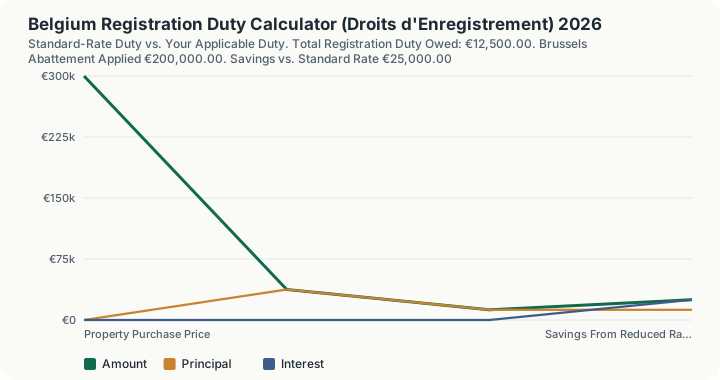
Quick Answer: Buying a €300,000.00 property as your sole/only own home in the Brussels-Capital Region incurs an estimated €12,500.00 in registration duty (droits d'enregistrement) for 2026 -- thanks to the region's €200,000 tax-free abattement, that's €25,000.00 less than the €37,500.00 a non-qualifying buyer would owe at the standard 12.5% rate.
Overview
Droits d'enregistrement (French) / registratierechten (Dutch) is the tax owed when you buy real estate in Belgium, collected by the notary at the signing of the deed and paid over to the tax authorities. Unlike précompte immobilier (an annual property tax), this is a one-time cost paid at purchase, and it is large enough -- typically in the range of a few percent up to 12.5% of the purchase price -- that it's one of the biggest single closing costs most Belgian home buyers face.
Crucially, each region built a completely different mechanism to reduce this cost for people buying their sole, main home, rather than a second residence or an investment property:
- Brussels-Capital Region uses a tax-free abattement: the first €200,000 of the purchase price is exempt from duty entirely (worth up to €25,000 in savings) -- but only if the total price does not exceed €600,000. Cross that line by even €1, and the entire €200,000 abattement disappears; there is no partial or phased-out version.
- Wallonia instead cuts the rate itself, from a 12.5% standard rate down to 3% for a qualifying sole/main home, with no separate abattement layered on top.
- Flanders also cuts the rate, from 12% down to 2% for what it calls the "enige eigen woning" (sole/own home) -- the largest proportional cut of the three regions, though as of 1 January 2026 the conditions to qualify were meaningfully tightened.
All three regions require the buyer to be a natural person acquiring full ownership and intending the property as their actual main residence, established within a set window after signing.
How This Is Calculated
Brussels applies the standard 12.5% rate to the purchase price minus the abattement (if eligible):
Wallonia and Flanders apply either the standard or reduced rate directly to the full price:
| Region | Standard Rate | Reduced (Sole/Main Home) Rate |
|---|---|---|
| Brussels-Capital | 12.5% | 12.5% on price minus EUR 200,000 abattement (price ≤ EUR 600,000) |
| Wallonia | 12.5% | 3% |
| Flanders | 12% | 2% |
Worked Example
A first-time buyer purchases an apartment in Brussels for EUR 300,000 and will live in it as their sole and only home. The headline rate is alarming; the abattement is what makes the deal work.
Step 1 -- Check the abattement cap. EUR 300,000 is at or below the EUR 600,000 ceiling, so the abattement is available in full
Step 2 -- The abattement. = EUR 200,000 deducted from the taxable base
Step 3 -- The taxable base. EUR 300,000 - EUR 200,000 = EUR 100,000
Step 4 -- The duty rate. Brussels standard registration duty = 12.50%
Step 5 -- Duty payable. EUR 100,000 x 12.50% = EUR 12,500.00
What the Same Purchase Costs Without the Reduction
Step 6 -- Duty on the full price at the standard rate. EUR 300,000 x 12.50% = EUR 37,500.00
Step 7 -- The value of qualifying. EUR 37,500.00 - EUR 12,500.00 = EUR 25,000.00 saved
Note that the rate never changes: Brussels grants relief by shrinking the base, not by discounting the percentage. The consequence is that the abattement is worth exactly EUR 25,000 to every qualifying buyer, whether the property costs EUR 250,000 or EUR 600,000, so it matters proportionally far more at the bottom of the market. Cross the EUR 600,000 cap by a single euro and the whole EUR 25,000 disappears at once, which is a hard cliff rather than a taper and is worth knowing before agreeing a price near that line.
What This Does Not Account For
- Notary fees, mortgage registration fees, and other closing costs. Registration duty is typically the largest single closing cost but not the only one -- see the companion Home Closing Costs Calculator conventions for a fuller breakdown methodology.
- Portability/carry-over of previously paid duty ("meeneembaarheid"/report des droits) in some regions, which can credit duty already paid on a prior home toward a new purchase in the same region under specific conditions -- not modeled here.
- Wallonia's "tax credit" mechanism for VAT-liable new construction, and Flanders'/Brussels' distinct rules for buying a building lot versus an existing home.
- Split acquisitions (usufruct/bare ownership), company co-purchases, or joint purchases with a non-qualifying party -- Flanders explicitly excluded these from its reduced rate starting 1 January 2026; this calculator models a straightforward full-ownership natural-person purchase only.
- Region-specific energy-renovation-linked enhancements, such as Brussels' extended abattement (up to €250,000, plus €25,000 per additional class) for buyers committing to a two-class-or-greater energy performance (PEB/EPC) upgrade.
Common Pitfalls
- Assuming the Brussels abattement phases out gradually near €600,000. It does not -- it is a hard cliff. A property at €599,000 and one at €601,000 can differ by over €25,000 in duty despite a €2,000 difference in price.
- Missing Flanders' 2026 rule tightening. Since 1 January 2026, the 2% Flemish rate requires uninterrupted domicile registration at the property for at least one full year (previously, simply registering within three years was enough), full ownership only (no usufruct/bare-ownership splits), and purchase by natural persons only (no co-purchase with a company).
- Forgetting Wallonia's ownership condition. The 3% rate requires you own no other residential property -- unless you commit to selling an existing one within three years -- on top of the residency-establishment and minimum-occupancy conditions.
- Confusing the reduced RATE (Wallonia, Flanders) with an abattement (Brussels). They produce very different savings curves: a rate cut saves proportionally more on a higher-priced home, while Brussels' fixed-euro abattement saves the same €25,000 for any home priced from €200,000 up to the €600,000 cap, then zero above it.
- Using the price before or after notary fees inconsistently. Registration duty is calculated on the purchase price (or a higher officially-assessed value if applicable), not on the price plus notary fees.
Frequently Asked Questions
Which region's system is cheapest for a typical first-home buyer?
What happens if I don't actually move in within the required window?
Can I combine the reduced rate/abattement with a mortgage-related tax benefit?
Does this calculator handle building lots or new construction differently?
Does this calculator file anything with a notary or the tax authorities?
Sources
- Belgian Federal Public Service Finance, the official authority for the national tax authority this calculator relates to. finance.belgium.be
Also consulted: SPF Finances / FOD Financiën (fin.belgium.be/en/private-individuals/property/buying-selling/registration-duty): official confirmation of the Brussels 12.5% standard rate and the EUR 200,000 abattement (up to EUR 600,000 price cap, up to EUR 25,000 savings), and Wallonia's 12.5% standard rate with 3% reduced rate for a sole/main residence; Notaire.be (Fednot, the Royal Federation of Belgian Notaries): official confirmation of Wallonia's registration duty rates and the sole/main-home eligibility conditions; Pim.be (Belgian tax/estate-planning publisher): cross-region comparison confirming Flanders' 12% standard / 2% reduced rate structure; Andersen Belgium and Compta-Fiscal.be: confirmation of the three conditions tightened for Flanders' 2% "enige eigen woning" rate effective 1 January 2026 (continuous 1-year domicile registration, full-ownership-only, natural-persons-only); Immo-Checker.be: worked-example confirmation of the Brussels abattement's hard-cliff mechanic at the EUR 600,000 threshold.