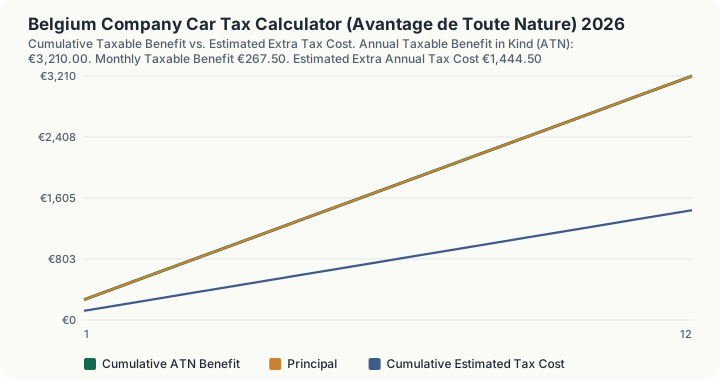
Quick Answer: A diesel company car with a €35,000.00 catalog value, 110 g/km CO2 emissions, and 6 months since first registration generates an estimated €3,210.00 annual taxable benefit in kind (avantage de toute nature) for 2026 -- adding roughly €1,444.50 in extra personal income tax per year at a 45% marginal rate, or about €267.50 a month in taxable benefit.
Overview
If your employer gives you a company car you're also allowed to use privately, Belgium taxes that private use as an avantage de toute nature (ATN) -- a "benefit in kind" -- added to your taxable salary, in French, or voordeel van alle aard (VAA) in Dutch. You don't pay this in cash directly; it simply increases the income your employer reports for you, which then gets taxed at your normal personal income tax bracket (see the companion Belgium Income Tax Calculator).
The formula is deliberately built around CO2 emissions, not fuel cost or horsepower: a car that emits less CO2 than the year's official "reference" emissions figure gets taxed at a lower rate, and a dirtier car gets taxed at a higher one, within a 4%-18% band. On top of that, the vehicle's catalog value (its original list price when new, not what your employer actually paid or what it's now worth) shrinks in steps as the car ages, and the whole result is floored at a statutory minimum so a very cheap, very clean older car can't be taxed at close to zero.
Because the reference CO2 figures are set by Royal Decree each year and typically get stricter over time, the same unchanged car generally becomes slightly more expensive to keep as a company car year over year, even with zero changes to the car itself.
How This Is Calculated
- Age percentage (based on months since first registration):
| Age | Percentage of Catalog Value |
|---|---|
| 0-12 months | 100% |
| 13-24 months | 94% |
| 25-36 months | 88% |
| 37-48 months | 82% |
| 49-60 months | 76% |
| 61+ months | 70% |
- CO2 percentage (non-electric vehicles):
For 2026, the reference CO2 is 58 g/km for diesel and 70 g/km for petrol/LPG/CNG. Electric vehicles get a flat 4% regardless of the (zero) emissions figure.
- Raw annual benefit:
- Statutory minimum floor. For income year 2026, the annual benefit can never be assessed below €1,650.00 (rising to €1,690.00 for income year 2027), regardless of how the formula computes.
Worked Example
Using the calculator's default inputs -- €35,000.00 catalog value, diesel, 110 g/km CO2, 6 months old:
- Age percentage (0-12 months): 100%.
- CO2 percentage: 5.5% + (110 − 58) × 0.1% = 5.5% + 5.2% = 10.7%.
- Raw benefit: €35,000 × 6/7 × 100% × 10.7% = €30,000 × 10.7% = €3,210.00.
- €3,210.00 exceeds the €1,650.00 minimum, so it stands as the final annual ATN.
- At an illustrative 45% marginal tax rate, this adds roughly €1,444.50 a year in real extra tax (€120.38/month) -- on top of, not instead of, tax on your regular salary.
The Benefit Accruing Month by Month
The ATN is an annual figure, but it is reported and taxed through payroll, so it reaches you in twelfths.
Step 1 -- Month 1. Cumulative ATN benefit €267.50, cumulative estimated tax cost €120.38
Step 2 -- Month 2. Cumulative benefit €535.00, cumulative tax cost €240.76
Step 3 -- Month 12. Cumulative benefit €3,210.00, cumulative tax cost €1,444.56
A full year of the company car adds €3,210.00 to taxable income and roughly €1,444.56 of tax at the illustrative 45% rate, which is about €120 a month of real cash out of net pay. Judge the car against that number rather than against the catalog value: the question is whether €120 a month is a fair price for the vehicle, insurance, maintenance and fuel card the employer is carrying.
The month-by-month tax column rounds each month to the cent before adding, so twelve months sum to €1,444.56 while the annual figure computed in one step is €1,444.50. The six-cent gap is rounding, not a difference in method.
What This Does Not Account For
- Employee contribution toward private use. If you personally pay your employer a monthly contribution for the private use of the car (a common arrangement), that contribution reduces the taxable ATN euro-for-euro (down to zero, but never below). This calculator computes the full, uncontributed benefit.
- Fuel/charging card private-use benefit. A separate, smaller benefit-in-kind rule can apply if your employer also covers fuel or EV charging costs for private mileage -- not modeled here.
- Employer corporate tax deductibility (limitation on deductible car costs). Employers face a separate CO2-based deduction-limitation scale for the cost of providing the car itself; this calculator addresses only the EMPLOYEE's personal taxable benefit.
- The special solidarity contribution employers owe to social security (CO2-based) on company cars -- a distinct employer-side cost, not part of the employee's ATN.
- Non-WLTP or missing CO2 figures. If a vehicle has no valid WLTP CO2 certificate, the tax administration applies substitute default emissions figures, which are not replicated here.
Common Pitfalls
- Using the price your employer actually paid instead of catalog value. The catalog value is the manufacturer's official list price including options and VAT when new -- fleet or bulk purchase discounts your employer negotiated do not reduce it for ATN purposes.
- Forgetting the reference CO2 figures change (and generally tighten) every year. A car with an unchanged CO2 rating typically sees its CO2% creep upward year after year as the reference figure it's measured against gets stricter.
- Assuming a very old, cheap, low-emission car will be taxed near zero. The €1,650 statutory annual minimum (2026) puts a floor under every company car with a private-use benefit, however the formula computes.
- Missing that electric vehicles are not zero-tax. Electric company cars still generate a taxable benefit -- a flat 4% of 6/7 of the age-adjusted catalog value -- just at the lowest end of the CO2% band.
- Ignoring the marginal-rate framing. The ATN itself isn't a tax bill -- it's added to taxable income and taxed at whatever bracket that additional income falls into, which is why this calculator's "extra tax cost" is only an approximation using your marginal rate, not a guarantee.
Frequently Asked Questions
Does the age percentage ever reset, e.g., after a lease renewal?
Is a plug-in hybrid treated as electric or as its combustion fuel type?
Can I reduce my ATN by paying my employer for private use?
Why did my ATN go up even though I didn't change cars?
Does this calculator file anything with tax authorities?
Sources
- Belgian Federal Public Service Finance, the official authority for the national tax authority this calculator relates to. finance.belgium.be
Also consulted: SPF Finances / FOD Financiën (fin.belgium.be): "Voitures de société" -- official base formula (catalog value × 6/7 × age% × CO2%), age-percentage schedule, the 4%/18% CO2% floor/cap, and the EUR 1,650 (2026) / EUR 1,690 (2027) statutory minimum annual benefit; Partena Professional infoflash, "Company cars: reference CO2 emissions 2026 have been published" -- confirms the 2026 reference CO2 values (diesel 58 g/km, petrol/LPG/CNG 70 g/km) per the Royal Decree of 17 December 2025, and that these are a reduction from the 2025 values (59/71 g/km).