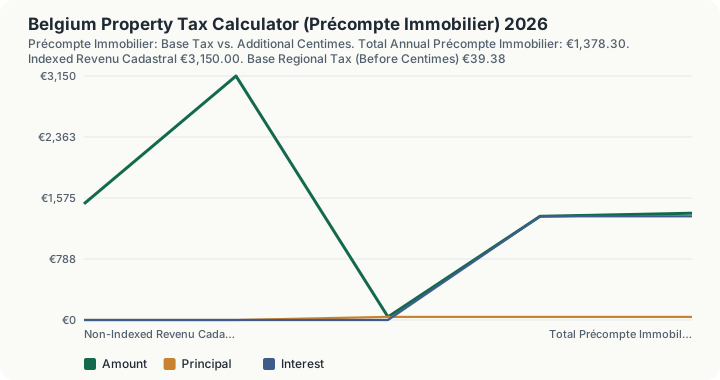
Quick Answer: A Brussels property with a non-indexed cadastral income (revenu cadastral) of €1,500.00 and a combined communal/agglomeration multiplier of 3,400 "additional centimes" owes an estimated €1,378.30 in annual précompte immobilier for 2026 -- €39.38 in base regional tax on the indexed cadastral income, plus €1,338.92 added by the local multiplier.
Overview
Précompte immobilier (French) / onroerende voorheffing (Dutch) is Belgium's annual property tax, owed by whoever owns real estate on 1 January of the tax year -- owner-occupiers, landlords, and second-home owners alike. Unlike many countries' property taxes, it isn't based on your home's market value. It's based on the revenu cadastral (RC), an administratively-assigned notional rental value fixed decades ago (Belgium's last general cadastral revaluation dates to 1975 for most of the country), which is then adjusted upward each year by an official indexation coefficient to keep pace with inflation.
This calculator works region by region, because each of Belgium's three regions -- Brussels-Capital, Wallonia, and Flanders -- sets its own base précompte immobilier rate, and the actual bill you receive is the product of three layers stacked together:
- A regional base rate applied to your indexed cadastral income (1.25% in both Brussels and Wallonia; a notably higher 3.97% in Flanders).
- Provincial additional centimes (Wallonia only -- Brussels has no province layer, and Flanders' provincial layer is minimal to nonexistent in practice).
- Communal additional centimes -- and, in Brussels, an additional "agglomeration" layer -- set independently by each of Belgium's roughly 581 municipalities, which is where most of the real variation between two otherwise-identical properties comes from.
Flanders' headline rate looks over 3x higher than Brussels' or Wallonia's, but this is commonly offset in practice by lower average provincial/communal multipliers there -- the two effects can land in a similar ballpark for a similar property, though this varies hugely commune by commune.
How This Is Calculated
Belgium taxes property on cadastral income, a notional annual rental value fixed in 1975, rather than on what the property is worth or earns today. That old figure is indexed, taxed at a regional rate, and then multiplied several times over by local surcharges, so the headline regional rate understates the bill by a wide margin. Three steps get you there:
- Index the cadastral income.
- Apply the regional base rate to get the base regional tax:
| Region | Regional Base Rate |
|---|---|
| Brussels-Capital | 1.25% |
| Wallonia | 1.25% |
| Flanders | 3.97% |
- Apply the combined communal + provincial (+ Brussels agglomeration) "additional centimes" multiplier. This is expressed as a number like 3,400, meaning the base regional tax is multiplied by 34 (3,400 ÷ 100) and added on top:
Worked Example
Using the calculator's default inputs -- Brussels, revenu cadastral non-indexé of €1,500.00, indexation coefficient 2.10, 3,400 additional centimes:
- Indexed RC: €1,500.00 × 2.10 = €3,150.00.
- Base regional tax: €3,150.00 × 1.25% = €39.38.
- Additional centimes amount: €39.38 × 34 = €1,338.92.
- Total précompte immobilier: €39.38 + €1,338.92 = €1,378.30.
What This Does Not Account For
- Your exact commune's actual additional-centimes rate. With ~581 communes each setting their own multiplier independently (observed ranges roughly 2,000 to 4,400+, i.e., a 20x to 44x+ multiplier on the base regional tax), no single default can be accurate for every address. Enter your own commune's published rate, or the figure from your prior property tax bill (avertissement-extrait de rôle), for a precise result -- the defaults here are illustrative regional averages only.
- Owner-occupier exemptions and reductions. Several regions offer reductions for a sole/main residence, large families, disability, or energy-efficient renovation (e.g., Flanders' renovation-linked reductions); none of these are modeled here.
- New construction, renovation, or reassessment. A revenu cadastral can change if you renovate, extend, or newly construct -- always use your property's current, officially notified RC, not an estimate.
- The exact current-year indexation coefficient. This calculator defaults to approximately 2.10 for the 2026 property tax year based on secondary sources; the officially published figure for the exact current year may differ slightly and is confirmable on your own property tax bill.
- Regional surcharges tied to vacant/unfit housing, which several municipalities levy separately from ordinary précompte immobilier and are not modeled here.
Common Pitfalls
- Confusing revenu cadastral with market value. RC is a notional administrative rental value, typically a small fraction of a property's actual sale price -- do not substitute your home's market value or purchase price for it.
- Applying the regional rate to the non-indexed RC. The indexation step must happen first; skipping it dramatically understates the tax.
- Assuming Flanders is always more expensive because its base rate is higher. The base rate is only one of three layers -- Flanders' typically lower provincial/communal multipliers frequently narrow or close the gap with Brussels/Wallonia for a comparably-valued property.
- Using a citywide or nationwide "average" additional-centimes figure for a specific address. The commune-to-commune spread is large enough that a rough average can misstate your real bill by hundreds of euros; always check your specific commune.
- Forgetting précompte immobilier is owed by whoever owns the property on 1 January, not prorated for a mid-year sale unless your notarial deed specifically allocates it between buyer and seller (a common but not automatic practice).
Frequently Asked Questions
Where do I find my property's revenu cadastral?
Why did my bill increase even though my RC didn't change?
Do renters pay précompte immobilier?
Is there a way to reduce this tax?
Does this calculator submit anything to the tax authorities?
Sources
- Belgian Federal Public Service Finance, the official authority for the national tax authority this calculator relates to. finance.belgium.be
Also consulted: Regional base rates (Brussels 1.25%, Wallonia 1.25%, Flanders 3.97%) and the general indexed-RC × rate × (1 + centimes/100) formula structure: corroborated across two independent Belgian real-estate/tax specialist websites (revenu-cadastral.be, housing-service.be) -- secondary/medium confidence on the exact decimal points, high confidence on relative regional ordering; Indexation coefficient (~2.10 for the 2026 property tax year): same two sources, cross-checked against each other; verify your exact figure against your own property tax bill; Worked-example methodology for the Brussels agglomeration + communal centimes layering: expertise-immobiliere-bruxelles.brussels; be.brussels (Brussels Fiscality), Wallonie.be (SPW Fiscalité), and vlaanderen.be (Vlaamse Belastingdienst) are the official regional tax administrations for confirming your exact current-year commune rate.