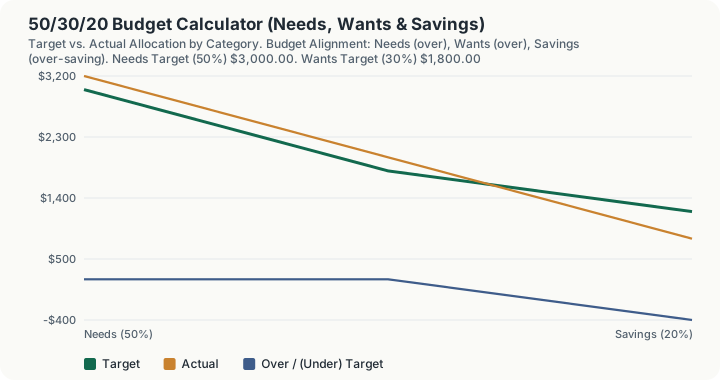
Quick Answer: On $6,000.00 in after-tax monthly income, the 50/30/20 split targets $3,000.00 for needs, $1,800.00 for wants, and $1,200.00 for savings and extra debt payoff. Spending $3,200.00 on needs, $2,000.00 on wants, and $800.00 on savings puts this household $200.00 over on needs, $200.00 over on wants, and $400.00 short on savings.
Overview
The 50/30/20 rule is a budgeting framework popularized by Senator Elizabeth Warren and Amelia Warren Tyagi in All Your Worth: The Ultimate Lifetime Money Plan (2005). It splits after-tax income into three buckets: 50% for needs, 30% for wants, and 20% for savings and extra debt paydown. Its appeal is that it requires no line-item budgeting software or categorized transaction tracking, just three numbers checked against three targets.
This calculator does the arithmetic and, more usefully, the comparison: it takes your after-tax income, computes the three dollar targets, and measures how far your actual spending in each category sits from where the rule says it should be. A household running over on needs and under on savings looks very different from one running over on wants alone, even if the total dollars are similar, and the fix is different in each case.
"Needs" means the spending you cannot eliminate without changing your living situation: rent or mortgage, utilities, groceries, insurance premiums, minimum debt payments, and transportation required to get to work. "Wants" is everything else you choose to spend on: dining out, streaming subscriptions, travel, hobbies, and upgrades beyond the functional minimum. "Savings and debt payoff" covers retirement contributions, brokerage deposits, emergency fund contributions, and any payment on debt beyond its contractual minimum.
How This Is Calculated
- Category targets. Each target is a fixed percentage of after-tax monthly income.
- Category gaps. Each actual entry is compared against its target; a positive difference means overspending relative to the rule, a negative difference in needs or wants means underspending, and a negative difference in savings means under-saving.
- Alignment check. A category is treated as on target when actual spending sits within 1 percentage point of income of its target share.
Worked Example
Using the calculator's default inputs:
- After-Tax Monthly Income: $6,000.00
- Actual Needs Spending: $3,200.00
- Actual Wants Spending: $2,000.00
- Actual Savings & Debt Payoff: $800.00
Step by step:
- Needs target: $6,000.00 × 50% = $3,000.00. Actual is $3,200.00, so needs run $200.00 over target (53.3% of income vs. the 50% target).
- Wants target: $6,000.00 × 30% = $1,800.00. Actual is $2,000.00, so wants run $200.00 over target (33.3% of income vs. the 30% target).
- Savings target: $6,000.00 × 20% = $1,200.00. Actual is $800.00, so savings run $400.00 short of target (13.3% of income vs. the 20% target).
- Total actual spending across all three categories: $3,200.00 + $2,000.00 + $800.00 = $6,000.00, exactly matching income, so nothing is unallocated.
- Net read: this household is not overspending overall, it is misallocating. The combined $400.00 of overspending on needs and wants is the same $400.00 missing from savings.
Why 50/30/20 and Not Zero-Based Budgeting
Zero-based budgeting, where every dollar is assigned to a specific line item before the month starts, gives more precision but takes far more ongoing maintenance. The 50/30/20 rule trades that precision for speed: three categories, three percentages, and a five-minute monthly check-in. It works best as a diagnostic tool, to quickly flag whether a household's broad allocation is out of balance, rather than as a complete replacement for detailed expense tracking when the target is aggressive debt payoff or a specific savings goal on a deadline.
What This Does Not Account For
- High cost-of-living areas. In many major metros, needs alone (particularly housing) can exceed 50% of income for typical households, making the standard split unrealistic without a modified target ratio.
- Debt payoff urgency. Minimum debt payments count as a need, but a household aggressively paying down high-interest debt may rationally want a temporary allocation closer to 50/20/30 or 50/10/40 rather than the standard 50/30/20.
- Pre-tax retirement contributions. This calculator works entirely in after-tax dollars; 401(k) or other pre-tax contributions are not part of the after-tax income figure you enter and are not reflected in the savings category here.
- Irregular income. Commission-based earners, freelancers, and seasonal workers will see the ratio swing month to month; a trailing 3- or 6-month average income is usually more useful than a single month's figure.
- Household size and composition. A single earner and a family of five will experience very different "needs" floors even at identical income levels; the rule does not adjust for dependents.
Common Pitfalls
- Classifying wants as needs. Streaming subscriptions, a car payment on a vehicle nicer than strictly necessary, and dining out are wants, not needs, even when they feel routine. Miscategorizing them hides the real picture.
- Treating minimum debt payments as the only debt line item. Minimum payments belong in needs; anything paid above the minimum belongs in the savings and debt payoff category, since it accelerates net worth the same way a retirement contribution does.
- Chasing a perfect 50/30/20 split every single month. Some months carry irregular needs spending (a car repair, an insurance renewal); a rolling multi-month average is a better signal than any one month in isolation.
- Ignoring the unallocated income line. If actual category spending doesn't sum to income, the difference is either going somewhere untracked or sitting idle in a checking account instead of being deliberately allocated.
- Applying the rule uniformly regardless of goals. A household aggressively saving for a house down payment, or aggressively paying off debt, should deliberately deviate from 50/30/20, not treat it as an inflexible ceiling.
Frequently Asked Questions
Should I use gross income or after-tax income for this calculator?
What counts as a "need" versus a "want"?
What if my needs are naturally more than 50% of my income?
Does minimum debt payment count as a need or as savings/debt payoff?
How often should I recheck my numbers against this calculator?
Sources
- Consumer Financial Protection Bureau: guidance on budgeting frameworks and needs-versus-wants spending categorization. consumerfinance.gov
- Bureau of Labor Statistics: Consumer Expenditure Survey, for benchmarking typical household spending by category. bls.gov/cex
- FDIC, Money Smart financial education program. fdic.gov/consumer-resource-center/money-smart
Also consulted: Warren, Elizabeth and Tyagi, Amelia Warren. All Your Worth: The Ultimate Lifetime Money Plan (Free Press, 2005), the original source of the 50/30/20 framework.