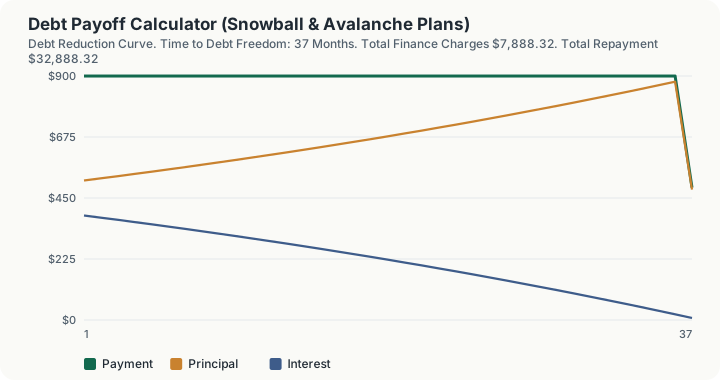
Quick Answer: $25,000 in combined debt at an 18.5% weighted average APR, paid at $650 minimum plus $250 extra each month, clears in about 37 months and costs roughly $7,888 in total interest, a timeline that shrinks fast once extra payment dollars increase.
Overview
Most people carrying debt are not managing a single balance; they are juggling several accounts at once, a credit card here, a personal loan there, maybe a store card with its own rate. This calculator is built for that combined picture. Rather than tracking each account separately, it blends all outstanding balances into one total debt figure and one weighted average APR, then models how a combined minimum payment plus a deliberate extra payment amount pays that total down to zero. It answers the household-budgeting question that matters most: if I commit a specific extra dollar amount each month across everything I owe, how many months until I am debt free, and how much will that extra commitment save in interest.
The two named strategies in the title, snowball and avalanche, describe how to sequence payments across multiple individual accounts: snowball pays off the smallest balance first for psychological momentum, while avalanche targets the highest-APR balance first to minimize total interest paid mathematically. This calculator does not reorder individual accounts; instead, it models the aggregate outcome of consistently directing a combined minimum-plus-extra payment at a shrinking total balance, which is mathematically equivalent to the avalanche approach applied at the portfolio level once accounts are combined into a single weighted rate. Whichever order a specific account-by-account payoff plan uses, the total time and total interest converge toward what this calculator shows once the same total dollars are applied each month.
How This Is Calculated
- Combined payment. The minimum monthly payment and the additional extra payment are summed into a single total monthly payment applied against the blended balance.
- Monthly rate conversion. The weighted average APR across all debts is divided by 12 to produce a monthly periodic rate.
- Monthly interest accrual. Each month, interest accrues on the current total balance at that monthly rate.
- Payment application. The combined payment is applied first to that month's accrued interest, with the remainder reducing principal, capped so the final payment does not exceed what is needed to reach zero.
- Iteration to zero. This repeats month by month, accumulating total interest paid, until the balance reaches zero or 360 months elapse.
Worked Example
Using the calculator's baseline inputs: $25,000 in total debt, an 18.5% weighted average APR, a $650 minimum payment, and a $250 extra payment.
- Combined monthly payment: $650 + $250 = $900
- Month 1 interest: $25,000 × (18.5% ÷ 12) = $385.42
- Month 1 principal paid: $900 − $385.42 = $514.58
- Month 1 ending balance: $25,000 − $514.58 = $24,485.42
- This continues, with the principal share of each $900 payment growing as the balance and its interest charge shrink.
- Total time to debt freedom: approximately 37 months
- Total interest paid: approximately $7,888.32, meaning total repayment of roughly $32,888 against the original $25,000 owed
Increasing the extra payment to $500 on a smaller $15,000 balance at 22% APR, for a $900 combined payment, cuts the payoff to about 21 months, nearly half the time, which illustrates how sensitive total payoff speed is to the size of the extra payment relative to the balance.
The First Year Against the Full 37 Months
The list above runs one month and then jumps to the total. The middle is where the plan is either kept or abandoned.
Step 1 -- Month 1. Interest $385.42, principal $514.58, balance $24,485.42
Step 2 -- Month 2. Interest $377.48, principal $522.52, balance $23,962.90
Step 3 -- Interest charged across the first two months. $385.42 + $377.48 = $762.90
Step 4 -- After twelve payments. Interest paid to date $4,073.55, balance $18,273.55
Step 5 -- Month 37, the final payment. Total interest $7,888.32, balance $0.00
Twelve payments of $900 total $10,800.00, and the balance falls by only $6,726.45. More than half of the entire 37-month interest bill, $4,073.55 of $7,888.32, is charged in the first year, because the 18.5% rate is applied to the largest balances first. The corollary is encouraging rather than discouraging: the second year costs far less interest than the first on identical payments, so the plan gets cheaper the longer it is kept, and the temptation to abandon it is strongest exactly when abandoning it forfeits the most.
What This Does Not Account For
- Individual account interest rates. Because this calculator blends everything into one weighted average APR, it does not capture the benefit of an avalanche strategy that pays down the single highest-rate account first while others accrue at their own individual rates; the weighted average is an approximation of the portfolio's combined cost.
- Snowball-specific psychological sequencing. A true snowball plan pays off the smallest individual balance first regardless of its rate, which can produce a slightly different total interest cost than this calculator's blended model, though usually not dramatically different if the extra payment is consistent.
- New debt accumulation during payoff. This model assumes no new charges or loans are added to the total balance during the payoff period.
- Debt consolidation loan terms. If some of the underlying debt is refinanced into a single lower-rate consolidation loan mid-plan, the weighted average APR entered here would need to be recalculated to reflect the new blended rate.
- Fees associated with balance transfers or consolidation. Origination fees, balance transfer fees, or early payoff penalties on any underlying account are not modeled in this calculator.
Common Pitfalls
- Treating the weighted average APR as a fixed, guaranteed number. It should be recalculated whenever an account is paid off, refinanced, or a new balance is added, since the true weighted average shifts as the underlying mix of debts changes.
- Underestimating how much extra payment is needed to meaningfully shorten the timeline. At 18.5% APR, a large share of the minimum payment alone may be absorbed by interest, so small increases in the extra payment amount can have an outsized effect on total months to freedom.
- Confusing this blended calculator with a per-account snowball or avalanche tracker. For a household with several accounts at very different rates, running each account through a dedicated single-balance calculator can reveal a different optimal order than the blended average suggests.
- Stopping extra payments once progress feels comfortable. The interest savings shown in this model depend on the extra payment being sustained every month; pausing it extends the timeline and increases total interest versus what was originally projected.
- Ignoring the compounding cost of delay. Every month spent paying only the minimum before adding an extra payment amount pushes the total interest bill higher, since interest that same month accrues on a larger balance than it would have with an earlier start.
Frequently Asked Questions
What is the difference between the snowball and avalanche debt payoff methods?
Does this calculator tell me which account to pay off first?
How do I calculate my weighted average APR across multiple debts?
How is this different from the credit card payoff calculator on this site?
Does paying extra always save the same amount of interest regardless of which strategy I use?
Sources
- Consumer Financial Protection Bureau, guidance on debt repayment strategies and minimum payment disclosures. consumerfinance.gov
- Federal Reserve Board, G.19 Consumer Credit statistical release on household debt and revolving credit rates. federalreserve.gov
- Federal Trade Commission, consumer guidance on debt consolidation and credit counseling. consumer.ftc.gov
- Gal, D. and McShane, B. B. (2012), "Can Small Victories Help Win the War? Evidence from Consumer Debt Management," Journal of Marketing Research 49(4). doi.org/10.1509/jmr.11.0272
- Amar, M., Ariely, D., Ayal, S., Cryder, C. E. and Rick, S. I. (2011), "Winning the Battle but Losing the War: The Psychology of Debt Management," Journal of Marketing Research 48. doi.org/10.1509/jmkr.48.spl.s38
Also consulted: National Foundation for Credit Counseling, debt management plan and payoff strategy resources.