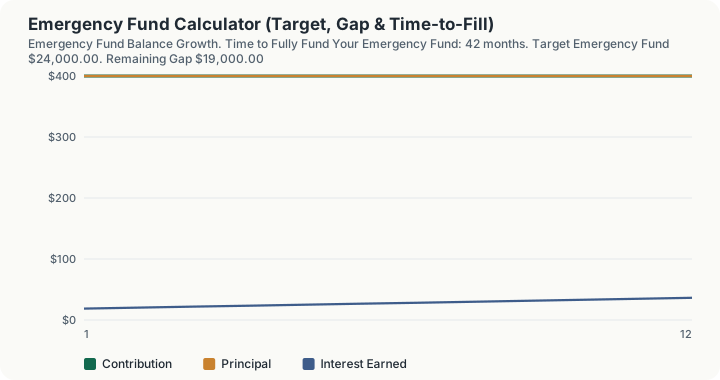
Quick Answer: On $4,000 in monthly essential expenses with a standard 6-month target, you need $24,000.00 set aside. Starting from $5,000.00 saved and contributing $400.00 a month into a 4.5% APY high-yield savings account, you would close the $19,000.00 gap in approximately 42 months.
Overview
An emergency fund is not a savings goal like a vacation or a down payment. It is the buffer that keeps a job loss, a medical bill, or a car repair from turning into credit card debt. The Consumer Financial Protection Bureau and most fee-only financial planners frame the target the same way: a multiple of essential monthly expenses, not a multiple of income, and not a round number picked out of the air.
This calculator does three things. First, it sizes your target based on your actual essential monthly spending and a coverage window you choose. Second, it measures the gap between that target and what you have saved today. Third, it projects how long closing that gap will take at your planned monthly contribution, accounting for interest earned in a high-yield savings account along the way.
The three-to-six-month range assumes a stable, dual-income household. Single-income households, commission-based earners, freelancers, and anyone in a volatile industry should lean toward nine to twelve months. The calculator's scenario buttons switch between these standard bands.
How This Is Calculated
- Target fund. Monthly essential expenses multiplied by the target coverage window in months.
- Gap. The target fund minus current savings, floored at zero.
- Time to fill the gap. Solved with the time-value-of-money NPER function, treating current savings as a starting balance and the monthly contribution as a recurring deposit, both growing at the savings account's monthly-compounded APY, until the balance reaches the target:
where $i$ is the monthly APY (annual APY ÷ 12) and $n$ is solved for in months.
Worked Example
Using the calculator's default inputs:
- Monthly Essential Expenses: $4,000.00
- Target Coverage: 6 months
- Current Savings: $5,000.00
- Monthly Contribution: $400.00
- Savings APY: 4.5%
Step by step:
- Target fund: $4,000.00 × 6 = $24,000.00
- Months of expenses covered today: $5,000.00 ÷ $4,000.00 = 1.25 months
- Gap: $24,000.00 − $5,000.00 = $19,000.00
- Monthly rate: 4.5% ÷ 12 = 0.375%
- Solving the compound-growth equation for the number of months needed for $5,000.00 growing at 0.375%/month, plus $400.00 added each month, to reach $24,000.00, gives n ≈ 41.98, rounded up to 42 months since a partial month still requires waiting for the next full contribution.
- Over those 42 months, the account earns roughly $700 in interest on top of the $16,800 in contributions, which is why 42 months of $400 contributions ($16,800) plus the starting $5,000 ($21,800 total principal) is enough to reach $24,000 once interest is included.
Carrying The First Year Month By Month
- Month one: $400.00 in, $18.75 of interest, closing balance $5,418.75
- Month two: $400.00 in, interest has risen to $20.32, closing balance $5,839.07
- Month twelve: interest reaches $36.35 in that month alone, closing balance $10,129.95
- Interest earned across the twelve months: $10,129.95 - $5,000.00 - ($400.00 x 12 = $4,800.00) = $329.95
- Progress against the target: $10,129.95 / $24,000.00 = 42.2% funded, up from 20.8%
After a full year of disciplined saving the fund covers about two and a half months of expenses rather than six, and the account has earned less than one month's contribution in interest. The APY is not what fills an emergency fund. Twelve months of $400 is, and the remaining thirty months are the real commitment this page is asking about.
How Much Should Actually Be in Your Fund
- 3 months: appropriate for a two-income household with stable employment, low fixed debt, and access to backup credit they don't intend to use.
- 6 months: the standard baseline most planners recommend as a default when no unusual risk factors are present.
- 9 months: appropriate for a single income supporting a household, a mortgage with a large fixed payment, or a job in a cyclical industry.
- 12 months: appropriate for self-employed income, commission-heavy compensation, or a household already dependent on a spouse's income during a job search.
Where to Keep It
The fund needs to be liquid and free of market risk: a high-yield savings account, a money market account, or a no-penalty CD ladder. It should not be invested in a brokerage account, since the entire point is that the money is available at full value the moment it's needed, not whenever the market recovers.
What This Does Not Account For
- Irregular or seasonal expenses. Property tax bills, annual insurance premiums, and holiday spending are not part of "monthly essential expenses" as modeled here and should be budgeted separately.
- Taxes on interest earned. Interest income from a savings account is taxable; this calculator shows gross growth, not after-tax growth.
- Changes to your contribution rate. The projection assumes a constant monthly contribution; it does not model raises, bonuses, or lump-sum additions.
- Access restrictions. Some accounts marketed as "high-yield" have withdrawal limits or holds; verify your specific account has no penalty for emergency withdrawals.
- Employer benefits that reduce the need for a full fund, such as short-term disability insurance or a generous severance policy, which can justify a smaller target for some households.
Common Pitfalls
- Basing the target on income instead of expenses. A high earner with high fixed costs needs a bigger dollar fund than a low earner with low fixed costs, even at the same "months" target, because the target is expenses times months, not income times months.
- Counting retirement or investment accounts as part of the fund. Money in a 401(k) or brokerage account is not liquid without penalties or market timing risk and should not count toward this target.
- Stopping contributions once the fund is "close enough." A fund at 80% of target still leaves a real gap; the calculator's percent-funded figure is meant to be closed, not approximated.
- Ignoring account growth entirely. Manually dividing the gap by the monthly contribution overstates the time needed once a fund reaches a meaningful balance in a competitive high-yield account.
- Setting too aggressive a target and never starting. A 12-month target for a household that can only save $100/month can feel unreachable; starting with a 3-month interim goal and stepping up is often more sustainable than stalling on a bigger number.
Frequently Asked Questions
How many months of expenses should I actually save?
Should the target be based on my income or my expenses?
Does this calculator account for interest earned while I'm saving?
What if I already have more saved than my target?
Where should I actually keep this money?
Sources
- Consumer Financial Protection Bureau: guidance on emergency savings and building financial resilience. consumerfinance.gov
- Federal Deposit Insurance Corporation (FDIC): deposit insurance limits for savings and money market accounts. fdic.gov
- Bureau of Labor Statistics: Consumer Expenditure Survey, for benchmarking typical household essential spending categories. bls.gov/cex