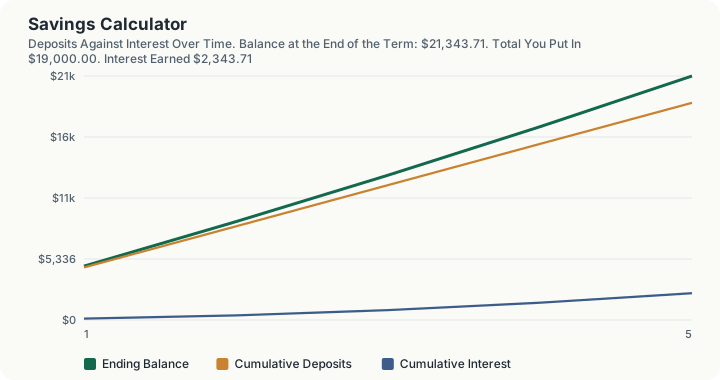
Quick Answer: $1,000 already saved, plus $300 a month at a 4.5% APY, reaches $21,343.71 after five years. You deposited $19,000.00 of that, so interest contributed $2,343.71, or 10.98% of the balance. Reaching a $25,000 goal at this pace takes 70 months.
What does this calculator do?
This is the general savings account tool: a starting balance, a monthly deposit, a quoted APY, and a target. It answers two questions at once, because savers ask both. Where will I be in five years, and how long until I get to the number I actually care about.
The single most important thing it shows is the split between what you put in and what the bank paid you. Over five years at a good rate, deposits are 89% of the balance and interest is 11%. That ratio is the honest picture of short-horizon saving, and it is why the advice to "find a better rate" is worth far less than the advice to raise the deposit. Doubling the monthly deposit from $300 to $600 takes the five-year balance from $21,343.71 to $41,441.24. No available rate does anything remotely comparable.
Over twenty years the picture inverts and interest becomes 37.96% of the balance. Both statements are true, and knowing which regime you are in should determine where you spend your effort.
If you are saving toward a house deposit specifically, the down payment savings calculator models the target as a percentage of a purchase price. If you are sizing a cash buffer against your spending, the emergency fund calculator works in months of expenses. This one is the plain account.
How is this calculated?
The subtle step is the rate. Banks advertise APY, which already includes the effect of compounding. To apply it month by month it must first be converted back to the nominal rate that produces it.
APR = m × [(1 + APY)^(1/m) − 1]; FV = PV(1 + i)ⁿ + PMT((1 + i)ⁿ − 1)/i
Step 1: Convert the quoted APY back to a nominal annual rate. $12 \times (1.045^{1/12} - 1) = 4.4098\%$
Step 2: Divide by twelve for the monthly periodic rate. $4.4098\% \div 12 = 0.367481\%$
Step 3: Count the deposit periods. $5 \times 12 = 60$ months
Step 4: Grow the starting balance for those 60 months. $1,000 \times (1.00367481)^{60} = \$1,246.18$
Step 5: Grow the stream of deposits. $300 \times \frac{(1.00367481)^{60} - 1}{0.00367481} = \$20,097.53$
Step 6: Add the two to get the ending balance. $1,246.18 + 20,097.53 = \$21,343.71$
Step 7: Total up what you actually deposited. $1,000 + (300 \times 60) = \$19,000.00$
Step 8: Subtract to isolate the interest. $21,343.71 - 19,000.00 = \$2,343.71$, which is $2,343.71 \div 21,343.71 = 10.98\%$ of the balance.
Step 9: Solve the same equation for the number of months that reaches the goal. Setting the future value to $25,000 and solving for n gives 69.51 months, rounded up to 70.
Step 10: Solve the same equation for the deposit instead. Holding the horizon at 60 months and solving for the payment gives (25,000 - 1,246.18) × 0.003674811.24618 - 1 = \354.58$ a month to reach the goal in five years. If the starting balance alone already grows past the goal, the required deposit is zero.
Deposits are treated as arriving at the end of each month, which is the conservative convention. The table repeats steps 4 through 8 at the end of each year.
Worked Example
The default account. $1,000 starting, $300 a month, 4.5% APY, five years.
- Monthly rate: 0.367481%
- First month's interest: $1,000 x 0.00367481 = $3.67
- Ending balance: $21,343.71
- Deposited: $19,000.00
- Interest: $2,343.71
That $3.67 in the first month is worth sitting with. It is what the rate feels like at the start, and it is why people conclude that saving does not work and stop.
Move to a big bank at 0.40% APY. Everything else identical, the balance is $19,197.98 and interest is $197.98 instead of $2,343.71. The high-yield account earned about twelve times as much. So the rate does matter; it just matters less than the deposit.
Double the deposit to $600. Balance $41,441.24, interest $4,441.24. You added $18,000 of your own money and gained $20,097 of balance.
Extend to twenty years at the original $300. Balance $117,659.65 against $73,000.00 deposited. Interest is now $44,659.65, or 37.96% of the total. This is the same account and the same rate. Only the time changed.
Carrying the Account Year by Year
Step 10: End of year one. Balance $4,718.66, deposits to date $4,600.00, cumulative interest $118.66
Step 11: End of year two. Balance $8,604.66, deposits to date $8,200.00, cumulative interest $404.66
Step 12: End of year three. Balance $12,665.53, cumulative interest $865.53
Step 13: End of year five. Balance $21,343.71, deposits to date $19,000.00, cumulative interest $2,343.71
Interest in year one is $118.66. In year five, cumulative interest has reached $2,343.71, and $834.57 of that arrived in the final year alone, the difference between the year four and year five rows. The line is bending, but slowly, and after five years the account is still 89% money you put in. That is the honest shape of a five-year savings horizon, and it is why the deposit is the lever.
What does this calculator not account for?
- Tax on interest. Interest in a taxable account is generally taxable income in the year earned, which reduces the effective yield. Nothing here is deducted.
- Variable rates. Savings APYs are not fixed. The rate that makes an account attractive today can be cut without notice, and this projects one constant rate for the whole term.
- Inflation. All balances are nominal. Use the inflation calculator to see what the ending balance buys.
- Withdrawals. The model assumes nothing is taken out. Any withdrawal reduces both the balance and everything it would have earned.
- Fees and minimum balance requirements. Monthly maintenance fees and penalties for dropping below a minimum are not modelled.
- Deposit timing within the month. Deposits are assumed to arrive at month end. Depositing at the start of each month earns slightly more.
- Deposit insurance limits. Balances above the insured limit at a single institution carry a risk this arithmetic cannot see.
What mistakes do people make with this?
- Treating APY as if it were a monthly-applied nominal rate. They differ: a 4.5% APY corresponds to a 4.4098% nominal rate compounded monthly. Applying 4.5% directly each month overstates the balance.
- Chasing rate instead of raising the deposit. Over five years the deposit is the dominant lever by a wide margin.
- Giving up because the first month is small. $3.67 of interest is not a signal about the five-year outcome.
- Assuming the advertised rate is permanent. Introductory and promotional APYs frequently revert.
- Forgetting tax. A 4.5% APY in a taxable account is meaningfully less than 4.5% after tax.
- Ignoring inflation on a long horizon. A twenty-year balance in nominal dollars flatters itself.
Frequently Asked Questions
What is the difference between APR and APY on a savings account?
How much should I save each month?
Why is the interest so small in the first year?
Does a higher APY beat a higher deposit?
Is the interest taxable?
Can I model quarterly or annual compounding instead?
Sources
- U.S. Securities and Exchange Commission, Investor.gov compound interest reference. investor.gov/financial-tools-calculators/calculators/compound-interest-calculator
- FDIC, Money Smart financial education program. fdic.gov/consumer-resource-center/money-smart
There is no statutory source for the future value formula, which is standard financial mathematics. It is implemented as solveFV and solveNPER in engine/primitives/tvm.ts, with golden vectors in engine/vectors/tvm.test.ts.
One real standard does apply to the input. In the United States, the annual percentage yield that banks advertise on deposit accounts is defined and its disclosure required by the Truth in Savings Act, implemented as Regulation DD, 12 CFR Part 1030, with the APY calculation set out in Appendix A to that part. That is why the calculator asks for APY rather than a nominal rate, and why it converts before compounding: an APY is by definition already an annualised, compounded figure. The conversion uses apyToApr in engine/primitives/rate-conversion.ts.
Rates are handed to those primitives as explicit decimal fractions rather than percentages, so that a sub-1% APY such as 0.40% is not misread. That is asserted directly as a test vector.