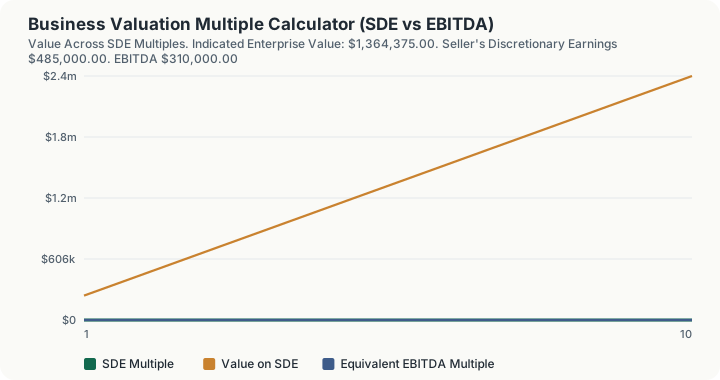
Quick Answer: A business with $310,000.00 of EBITDA and $485,000.00 of seller's discretionary earnings carries an indicated enterprise value of $1,364,375.00, the midpoint of a 2.75x SDE multiple at $1,333,750.00 and a 4.5x EBITDA multiple at $1,395,000.00. After deducting $100,000.00 of net debt, the indicated equity value to the seller is $1,264,375.00.
What does this calculator do?
Two brokers can quote the same business at "2.75 times earnings" and "4.5 times earnings" and both be describing the same money. The difference is which earnings figure sits under the multiple. EBITDA and SDE are not two views of the same number; they are two different numbers, and the gap between them is almost entirely one working owner's compensation.
EBITDA is net income with interest, taxes, depreciation and amortisation added back. It is an accounting construction and it is not in dispute. SDE, seller's discretionary earnings, is a broker convention: EBITDA plus the total compensation of one working owner plus any discretionary or non-recurring expenses run through the business. SDE exists because a buyer of a small owner-operated business is buying a job as well as an asset, and the owner's salary is money that will be available to them. That is a reasonable thing to measure. It is also a much bigger number, which is why the multiple applied to it is smaller.
The useful output of this calculator is not the valuation. It is the translation. Given an SDE multiple, what EBITDA multiple produces the same enterprise value? Once you can answer that, two offers quoted on different bases stop being incomparable.
No published source sets any of these multiples. No government, regulatory or statutory body issues SDE or EBITDA multiples for small businesses. They are market observations from comparable transactions, and the defaults here are illustrative placeholders you are expected to replace with figures from your own broker, appraiser or transaction database.
How is this calculated?
EBITDA = net income + interest + taxes + depreciation and amortisation
SDE = EBITDA + owner compensation + discretionary addbacks
equivalent EBITDA multiple = (SDE × SDE multiple)/EBITDA
Step 1: Build EBITDA from the income statement. $180,000 + $20,000 + $50,000 + $60,000 = $310,000.00
Step 2: Build the owner earnings wedge. $150,000 + $25,000 = $175,000.00
This single figure, one working owner's total compensation plus the discretionary addbacks, is the entire difference between the two earnings bases.
Step 3: Add the wedge to EBITDA to reach SDE. $310,000.00 + $175,000.00 = $485,000.00
Step 4: Apply the SDE multiple. $485,000.00 x 2.75 = $1,333,750.00
Step 5: Apply the EBITDA multiple. $310,000.00 x 4.5 = $1,395,000.00
Step 6: Take the midpoint as the indicated enterprise value. ($1,333,750.00 + $1,395,000.00) / 2 = $1,364,375.00
The midpoint is an indication, not a conclusion. It is what the calculator reports as the headline because neither basis is inherently more correct than the other.
Step 7: Translate the SDE offer into EBITDA units. $1,333,750.00 / $310,000.00 = 4.30x
So a 2.75x SDE offer is exactly the same money as a 4.30x EBITDA offer on this business. That is the number to carry into a negotiation.
Step 8: Bridge to equity value. Net debt: $150,000 - $50,000 = $100,000.00 $1,364,375.00 - $100,000.00 = $1,264,375.00
Step 9: Margins, for context. EBITDA margin: $310,000 / $2,000,000 = 15.50% SDE margin: $485,000 / $2,000,000 = 24.25%
Worked Example
A distribution business does $2,000,000 of revenue. The tax return shows $180,000 of net income after $20,000 of interest, $50,000 of entity-level income tax and $60,000 of depreciation and amortisation. The owner takes a $150,000 total package and runs about $25,000 of personal vehicle, travel and one-off legal costs through the business. There is $150,000 of interest-bearing debt and $50,000 of cash.
Step 1: EBITDA. $180,000 + $20,000 + $50,000 + $60,000 = $310,000.00
Step 2: Wedge. $150,000 + $25,000 = $175,000.00
Step 3: SDE. $310,000 + $175,000 = $485,000.00
Step 4: Broker A offers 2.75x SDE. $485,000 x 2.75 = $1,333,750.00
Step 5: Buyer B offers 4.5x EBITDA. $310,000 x 4.5 = $1,395,000.00
Step 6: The spread. $1,395,000 - $1,333,750 = $61,250.00 in favour of the EBITDA quote.
Step 7: Restate Broker A in EBITDA units. $1,333,750 / $310,000 = 4.30x. The apparently much lower multiple is actually 4.30x on the same business, only 0.20x behind the headline 4.5x it looked so far below.
Step 8: Restate Buyer B in SDE units. $1,395,000 / $485,000 = 2.88x. Buyer B is offering 2.88x SDE, not something incomparable.
Step 9: Equity to the seller at the midpoint. $1,364,375.00 - $100,000.00 net debt = $1,264,375.00
Now consider the absentee case. Set owner compensation and discretionary addbacks to zero and the wedge vanishes: SDE collapses onto EBITDA at $310,000, and the 2.75x SDE quote falls to $852,500 against $1,395,000 on EBITDA. For a business with no owner to add back, an SDE multiple badly undervalues it. This is exactly why buyers of larger businesses refuse to negotiate on SDE at all.
What does this calculator not account for?
- It adds back exactly one working owner. SDE is a broker convention, and the one-owner rule is the convention implemented here. A business with two working owners will not reconcile with a broker's figure that adds back only one salary, or with one that adds back both.
- It takes no view on whether your multiple is reasonable. Supply a 10x SDE multiple and the calculator will apply it. Nothing here validates a multiple against comparables, industry, growth, customer concentration or size.
- No working capital peg. Real transactions set a normalised working capital target and adjust the price at closing for the delta. The equity bridge here is only enterprise value less debt plus cash.
- No earn-outs, seller notes or escrows. A headline price paid partly in contingent consideration is not the same as cash at closing, and none of that structure is modelled.
- No marketability or control discounts, and no minority-interest adjustments.
- The revenue multiple is optional and off by default. When supplied it is reported alongside but is never blended into the indicated enterprise value, which is always the SDE/EBITDA midpoint.
- Addbacks are taken at face value. A buyer will challenge every discretionary addback, and the ones that survive due diligence are usually fewer than the ones on the first spreadsheet.
What mistakes do people make with this?
- Comparing multiples across bases. "They only offered 2.75x and the industry does 4.5x" is not a comparison; it is two different denominators. Convert one into the other before reacting.
- Adding back the owner's salary and then also paying a manager. If the buyer will have to hire someone to do the work you do, that salary is a real cost of the business and adding it back overstates what the buyer will actually earn.
- Padding discretionary addbacks. Every dollar of addback increases the asking price by the full multiple, which is exactly why buyers scrutinise them. Aggressive addbacks that collapse in diligence tend to reprice the whole deal, not just the disputed line.
- Treating enterprise value as the seller's cheque. Debt comes off. On the defaults here the difference between enterprise value and equity value is $100,000.
- Forgetting entity-level tax in the EBITDA build. A pass-through with no entity tax has nothing to add back on that line, so the same net income produces a lower EBITDA than an entity that pays its own tax.
- Using a revenue multiple as anything more than a sanity check. It ignores profitability entirely, which means it prices a business losing money identically to one earning 20% margins.
Frequently Asked Questions
Why are EBITDA multiples always higher than SDE multiples for the same business?
Which basis will a buyer of my business actually use?
What multiple should I use?
Is the indicated enterprise value the right answer?
What is net debt and why is it deducted?
Sources
- U.S. Small Business Administration, the official authority for the business this calculator relates to. sba.gov
Also consulted: EBITDA = net income plus interest, taxes, depreciation and amortisation. A standard accounting construction; SDE = EBITDA plus the total compensation of one working owner plus discretionary and non-recurring addbacks. A broker convention rather than an accounting standard, implemented here with the one-owner rule.
No primary source exists for any valuation multiple, and none is cited here because none exists. No government, regulatory or statutory publication sets SDE or EBITDA multiples for private businesses. Multiples are observations of what buyers have actually paid, and they are available only from brokers, accredited appraisers and private transaction databases. Every multiple in this calculator is a user input with a neutral illustrative default that you should replace. The arithmetic itself rests on two definitions that are not in dispute: The calculator asserts nothing about what a business is worth. It asserts only the arithmetic relationship between the two bases.