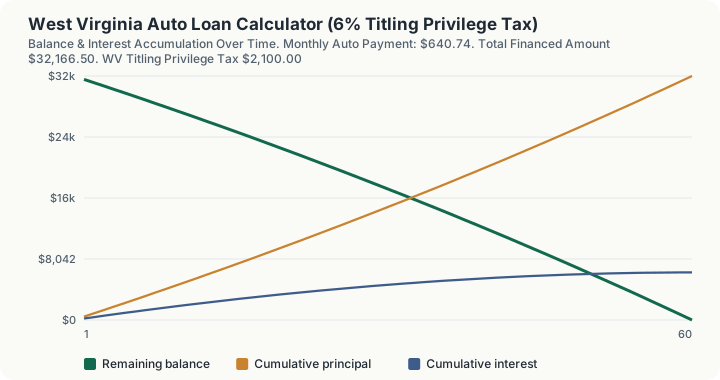
Quick Answer: A $35,000 vehicle in West Virginia with $5,000 cash down, a 60-month term, and a 7.25% APR carries a $640.74 monthly payment. That figure includes $2,100.00 of titling privilege tax at the flat 6% rate and $66.50 in title and registration fees, financing $32,166.50 in total. There is no county or city add-on anywhere in the state, so this rate is the same in Charleston, Morgantown, and Martinsburg.
Overview
West Virginia does not charge sales tax on a car. It charges a titling privilege tax, and the difference matters more than the name suggests.
Under W. Va. Code § 17A-3-4 the tax is a 6% levy on the privilege of titling a vehicle in the state, collected by the Division of Motor Vehicles when you apply for the title, not by the dealer as a line on the buyer's order. It rose from 5% to 6% on 1 July 2017. Because it attaches to titling rather than to a retail sale, it also reaches vehicles you bought elsewhere and bring into the state, and it is measured against the vehicle's sale price rather than against a broader "selling price" that sweeps in dealer charges.
Two consequences follow, and both are unusual enough to catch buyers out.
First, the trade-in deduction is conditional. Most states credit any trade-in. West Virginia deducts only "so much of the sale price as is represented by the exchange of other vehicles on which the tax imposed by this section has been paid by the purchaser." Read plainly, that means the vehicle you trade must have been titled in West Virginia with the privilege tax already paid. Trade in a car you titled in Ohio or Virginia and you get nothing off the tax base.
Second, the tax is uniform statewide. West Virginia municipalities do impose their own 1% sales taxes on ordinary goods, but they do not reach the DMV titling levy. Wherever you live, the vehicle rate is 6%, which is why this page has no rate table.
Auto Loan APR by Credit Score
The APR columns below are national averages, not West Virginia figures. No primary source publishes average auto loan APR by state: Experian's report has no geographic cut, the CFPB publishes state origination volume but no rates, and the New York Fed publishes state delinquency only. The payment column is the part that is specific to West Virginia, because it runs this calculator's own West Virginia tax and fee rules at each tier's rate.
| Credit Tier | VantageScore 4.0 | Avg New APR | Avg Used APR | Est. Payment in West Virginia |
|---|---|---|---|---|
| Super prime | 781-850 | 4.55% | 6.30% | $600.41 |
| Prime | 661-780 | 6.23% | 8.77% | $625.31 |
| Nonprime | 601-660 | 9.67% | 14.03% | $678.23 |
| Subprime | 501-600 | 13.44% | 19.42% | $739.15 |
| Deep subprime | 300-500 | 16.01% | 21.77% | $782.40 |
Payment assumptions: $35,000 vehicle price, $0 trade-in, $5,000 cash down, $0 dealer documentation fee, 60-month term, new-vehicle APR applied to the West Virginia delivered price including tax and statutory fees. At the 6.39% overall new-car average the same purchase costs $627.72 a month.
The score bands are VantageScore 4.0, not FICO. The same borrower can land in a different tier under each model, so a FICO score pulled from a card issuer will not always match the band here. Source: Experian, State of the Automotive Finance Market, Q1 2026, slide 45.
What Moves Your Payment
Each row changes one input and leaves the rest at the baseline below. The dollar effects are this calculator's own output for West Virginia, not a rule of thumb.
| Factor | What Changes | Effect on Monthly Payment | Effect on Total Interest |
|---|---|---|---|
| Vehicle Price | Each extra $1,000 of price raises both the amount financed and the titling privilege tax base, so the tax rises with it. | +$21.11 | +$206.87 |
| Trade-In Allowance | A $1,000 allowance cuts the amount financed by $1,000 and reduces the titling privilege tax base by the same amount, so it saves tax as well as principal. | -$21.12 | -$206.87 |
| Cash Down Payment | A $1,000 larger down payment cuts the amount financed by $1,000. It never reduces the titling privilege tax, which is assessed on the price, not on what you borrow. | -$19.92 | -$195.16 |
| Dealer Doc Fee | A $100 higher documentation fee adds $100 to the amount financed. It sits outside the titling privilege tax base in West Virginia, so it does not raise the tax. | +$1.99 | +$19.51 |
| Longer Term | Stretching the same balance from 60 months to 72 months spreads the principal over twelve more payments at the same rate. | -$88.46 | +$1,319.74 |
Baseline: $35,000 vehicle price, $0 trade-in, $5,000 cash down, $0 documentation fee, 60 months at 7.25% APR, giving a $640.74 payment and $6,277.62 of total interest.
How This Is Calculated
West Virginia's 6% titling privilege tax is collected by the DMV rather than the dealer, with no local component. Five steps.
1. Net taxable sale price. The base is the vehicle price, less any trade-in that qualifies under § 17A-3-4.
The allowance cannot exceed the price of the car you are buying, so an oversized trade takes the base to zero rather than below it.
2. Titling privilege tax. A flat statewide rate with no local component.
3. Title and registration. A fixed $66.50, being the $15 title fee and the $51.50 Class A passenger registration. Class A registration is flat, not weight-based and not value-based.
4. Amount financed. A qualifying trade-in works twice. It lowered the tax base in step one, and it also reduces the balance you borrow. A trade-in that does not qualify for the deduction still reduces the balance.
5. Amortization. The financed amount amortizes as a fixed-rate installment loan:
where $P$ is the financed amount, $i$ is the monthly rate (APR ÷ 12), and $n$ is the term in months.
The County Vehicle Property Tax and the Credit That Cancels It
West Virginia counties levy an annual ad valorem personal property tax on vehicles, billed by the county sheriff with half due 1 October and half due 1 April. On its own that would make West Virginia an expensive state to keep a car in.
Since tax year 2024 it mostly is not. W. Va. Code § 11-13MM-3 created the Motor Vehicle Property Tax Adjustment Credit, a refundable state income tax credit that reimburses timely-paid vehicle property tax. Refundable is the operative word: you get the money back even if the credit exceeds your income tax liability, so for most individual owners the net annual cost approaches zero.
Two practical points survive that. The tax is still levied and still has to be paid first, so it is a cash flow item across the year even when it is not a cost. And the credit turns on timely payment, so a late bill is a real loss rather than a wash. Neither the tax nor the credit appears in the figures on this page, because both are annual and neither is financed into the loan.
Worked Example
West Virginia's 6% titling privilege tax deducts a trade-in only where WV titling tax was already paid on it. An out-of-state trade gets nothing, and that condition is worth $600 on this deal.
- Vehicle price: $35,000
- Trade-in allowance: $0
- Cash down: $5,000
- Dealer doc fee: $0
- Term: 60 months at 7.25% APR
Step 1 -- The taxable sale price. Sale price less the exchange value of a vehicle on which WV titling tax was paid: $35,000 - $0 = $35,000.00
Step 2 -- Titling privilege tax at 6%. $35,000.00 x 6% = $2,100.00
Step 3 -- Title and registration, outside the base. $15.00 title + $51.50 registration = $66.50
Step 4 -- Total delivered price. $35,000 + $2,100.00 + $66.50 = $37,166.50
Step 5 -- Amount financed. $37,166.50 - $0 trade-in - $5,000 cash down = $32,166.50
Step 6 -- The monthly payment. $32,166.50 at 7.25% over 60 months = $640.74
Step 7 -- Month 1. $32,166.50 x (7.25% / 12) = $194.34 interest, $446.40 principal, balance $31,720.10
Step 8 -- Month 2. $31,720.10 x (7.25% / 12) = $191.64 interest, $449.10 principal, balance $31,271.00. Cumulative interest: $385.98
Step 9 -- The accumulation. Interest through month 12 is $2,150.42 with $26,628.04 still owed. Over the full term, $6,277.62
Now add a $10,000 trade-in that was titled in West Virginia. The taxable sale price drops to $25,000, tax falls to $1,500.00, and the payment drops to $429.59. The deduction saved $600 in tax.
Trade in a car titled in another state instead and the tax stays at $2,100.00. The payment still falls, because the $10,000 still reduces what you borrow, but you lose the $600. That $600 is the reason it is worth checking the title history of the car you plan to trade before you negotiate.
What This Does Not Account For
- The annual county vehicle property tax and its offsetting credit. Both are recurring and are settled through the county sheriff and your state income tax return, not at the dealership.
- Dealer documentation fee taxability. West Virginia sets no cap on doc fees and publishes no typical figure, so the input starts at $0. Because the levy is a titling privilege tax measured on the sale price rather than a retail sales tax, whether a separately stated doc fee enters the base is genuinely unresolved. This calculator adds the fee you enter to the delivered price but leaves it out of the tax base. If your dealer says otherwise, confirm with the WV State Tax Department, and add 6% of the fee to your expectation.
- The $10 lien recording fee, which applies when the vehicle is financed. It is not in the $66.50 because it depends on the loan rather than the purchase.
- The reported minimum tax on cheap vehicles. A flat $30 is reported in place of the 6% rate where the net purchase price is $500 or less, but that was not confirmed against statute and is not modeled.
- Alternative fuel vehicle registration surcharges and specialty plate fees.
- GAP insurance, service contracts, and aftermarket add-ons, unless you fold them into the vehicle price yourself.
Common Pitfalls
- Assuming any trade-in cuts the tax. The deduction under § 17A-3-4 reaches only vehicles on which West Virginia privilege tax was already paid. An out-of-state trade is worth $0 against the tax base, which is a $600 swing on a $10,000 trade.
- Using the 5% figure. Static copies of the statute on aggregator sites still read "five percent" because they predate the 2017 amendment. On a $35,000 car that is a $350 understatement.
- Adding a municipal sales tax on top. West Virginia cities do levy local sales taxes on ordinary retail, but the vehicle levy is a state DMV titling tax with no local component. The rate is 6% statewide.
- Expecting the dealer to collect it. The privilege tax is paid to the DMV at titling. On a private-party purchase there is no dealer in the middle at all, and the buyer owes it directly.
- Writing off the county property tax as a reason not to buy here. For an individual owner who pays on time, the refundable credit under § 11-13MM-3 returns it. Paying late forfeits that.
- Judging the loan by the payment. Stretching this $32,166.50 balance from 60 to 72 months drops the payment to $552.28 and raises total finance charges from $6,277.62 to $7,597.35.
Frequently Asked Questions
What is West Virginia's tax rate on a car?
Does a trade-in reduce the tax in West Virginia?
Do West Virginia cities add their own tax on a vehicle purchase?
What are West Virginia title and registration fees?
Do I still pay county property tax on my car?
Is the dealer documentation fee taxed?
Sources
- West Virginia State Tax Department, motor vehicle and personal property tax guidance. tax.wv.gov
- Consumer Financial Protection Bureau, Truth in Lending Act (Regulation Z, 12 CFR § 1026.22) disclosure requirements for installment credit. ecfr.gov/current/title-12/chapter-X/part-1026
Also consulted: W. Va. Code § 17A-3-4 (6% titling privilege tax and the trade-in deduction for previously WV-taxed vehicles); West Virginia Division of Motor Vehicles, title and registration fee schedules; W. Va. Code § 11-13MM-3 (refundable Motor Vehicle Property Tax Adjustment Credit, effective tax year 2024); Experian, State of the Automotive Finance Market, Q1 2026, slide 45 (average new and used auto loan APR by VantageScore 4.0 credit tier; national, no state level cut published).