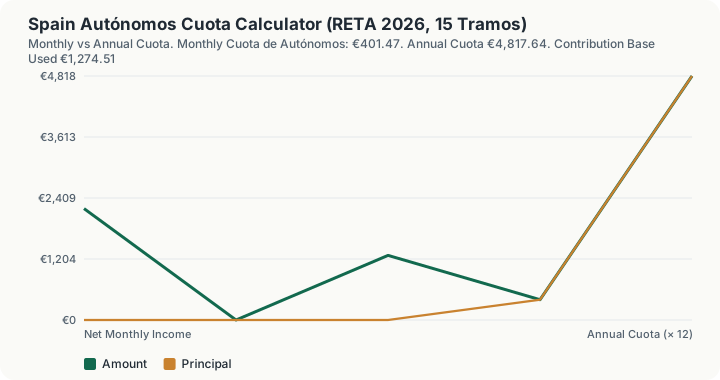
Quick Answer: A self-employed worker (autónomo) in Spain earning €2,200/month in net income falls into Tramo 9 of the RETA income-based system, and choosing the minimum contribution base for that tramo produces a monthly cuota of €401.47. A brand-new autónomo in their first 12 months instead pays a flat €80/month "tarifa plana" regardless of income -- a saving of roughly €321.47/month compared to the standard tramo-based cuota.
Overview
Since 2023, Spain's self-employed and freelance social security contribution (cuota de autónomos, paid into the RETA -- Régimen Especial de Trabajadores Autónomos) has been based on your actual net income, not a flat fee everyone paid regardless of earnings. The system sorts autónomos into 15 income "tramos" (brackets), each with its own minimum and maximum monthly contribution base. Within your tramo, you choose where in that range to set your own base: a lower base means a lower monthly cuota today, while a higher base means paying more now in exchange for a larger future pension and benefit entitlement, since Spanish state pensions and unemployment-style benefits for autónomos are calculated from your contribution history.
New autónomos get a significant break from this system for their first 12 months of activity: a flat "tarifa plana" of €80/month, regardless of what tramo their actual income would otherwise place them in. This calculator computes your standard tramo-based cuota from your estimated net monthly income, or applies the tarifa plana if you're within your first year, and shows you exactly how much the flat rate saves compared to what you'd otherwise owe.
How This Is Calculated
- Determine your income tramo. Your estimated net monthly income (revenue minus deductible business expenses) is matched against the 15-tramo table, each with its own income range and corresponding minimum/maximum contribution base.
- Choose your contribution base. Within your tramo's allowed range, you select a base -- anywhere from the tramo's minimum to its maximum.
- Apply the contribution rate. The chosen base is multiplied by the total 2026 contribution rate (common contingencies plus additional coverages) to produce your monthly cuota.
- Tarifa plana override. If you're a new autónomo within your first 12 months of activity, the calculator ignores the tramo-based calculation entirely and applies the flat €80/month rate instead.
- Annual cuota. Monthly cuota multiplied by 12.
Worked Example
Using the calculator's default inputs (€2,200/month net income, minimum base, standard cuota):
- €2,200/month net income places this autónomo in Tramo 9.
- Choosing the minimum base for Tramo 9: €1,274.51.
- Monthly cuota: 1,274.51 × total rate = €401.47.
- Annual cuota: 401.47 × 12 = €4,817.64.
The Same Income, But as a New Autónomo
The same person, within their first 12 months of self-employment, instead pays the flat tarifa plana:
- Monthly cuota: €80.00, regardless of the €2,200 income that would otherwise place them in Tramo 9.
- Annual cuota: 80 × 12 = €960.00.
- Monthly saving versus the standard cuota: 401.47 − 80 = €321.47/month, or roughly €3,857.64 over the full first year.
Minimum vs. Maximum Base at Higher Income
A higher earner choosing the maximum base within their tramo always pays more per month than choosing the minimum -- the tradeoff being a larger contribution history that increases future pension and benefit calculations.
What This Does Not Account For
- The exact 31.5% total rate split (28.30% common contingencies + 1.30% additional coverages + 0.90% MEI-related items + smaller components) is corroborated by multiple secondary sources and is internally consistent with the published per-tramo cuotas, but was not directly quoted from a single BOE sentence -- flagged as medium-high (not maximum) confidence for that specific breakdown, though the 15-tramo bases themselves are confirmed directly from the official Orden PJC/297/2026.
- Reduced rates for specific groups (e.g. certain disability situations, victims of gender violence or terrorism) are not modeled.
- The tarifa plana's own eligibility conditions (e.g. not having been self-employed in the same activity within a prior period) are not checked -- this calculator assumes you already qualify if you select "yes."
- Multi-activity discounts (pluriactividad), which can reduce contributions for someone who is both employed and self-employed simultaneously, are not modeled.
- Corporate-structure alternatives (operating via a sociedad limitada instead of as an autónomo) are out of scope entirely.
- IRPF income tax on your self-employment earnings is separate from this cuota and not computed here.
Common Pitfalls
- Assuming the cuota is a fixed amount like it was before 2023. The pre-2023 system charged nearly all autónomos a similar flat-ish minimum cuota regardless of real income; the current system ties your cuota directly to your actual net income tramo, and can change year to year as your income changes.
- Forgetting to regularize your estimate. Since the cuota is based on estimated income, Spain's Social Security system reconciles your actual annual income against your estimate the following year, and can bill you for a shortfall or refund an overpayment.
- Choosing the minimum base without considering the pension tradeoff. A lower cuota today means a smaller contribution history, which directly reduces your eventual state pension calculation -- this is a genuine long-term tradeoff, not just an administrative choice.
- Not realizing the tarifa plana is temporary. After 12 months (extendable in some circumstances), you move to the standard tramo-based cuota, which can be a significant month-to-month cost increase if you haven't budgeted for it.
- Confusing tramo with tax bracket. Tramos determine your social security contribution base, not your income tax liability, which is calculated entirely separately under IRPF.
Frequently Asked Questions
Is this the same as a Spanish freelance tax calculator?
Can I change my contribution base during the year?
What happens if my actual income ends up different from my estimate?
Does choosing a higher base always mean a better pension?
Is the tarifa plana available to everyone starting self-employment?
Does this cuota include income tax?
Sources
- Spanish Tax Agency (Agencia Tributaria), the official authority for the national tax authority this calculator relates to. sede.agenciatributaria.gob.es
Also consulted: Orden PJC/297/2026 (BOE-A-2026-7296), developing Real Decreto-ley 3/2026, for the 2026 15-tramo income-based contribution base table -- read directly; Real Decreto-ley 13/2022, establishing the original income-based RETA framework that Real Decreto-ley 3/2026 extends; Multiple corroborating secondary sources for the total contribution rate split (28.30% + 1.30% + 0.90% MEI + remaining components summing to 31.5%), internally consistent with the published tramo cuotas.