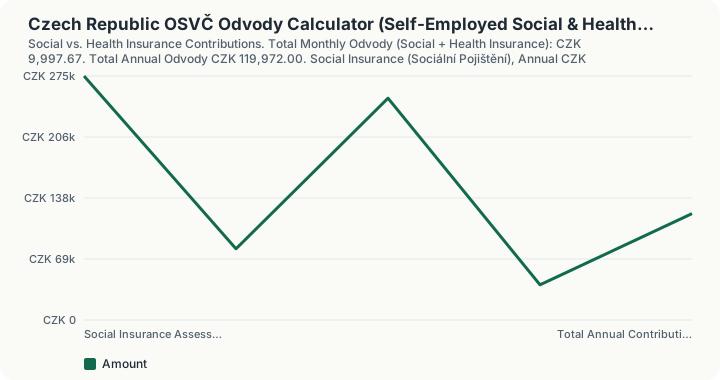
Quick Answer: An OSVČ (self-employed person) in the Czech Republic with CZK 500,000.00 annual profit, in hlavní činnost (main self-employment activity) during the July-December 2026 period, owes an estimated CZK 119,972.00/year in social and health insurance (CZK 9,997.67/month) for 2026 -- CZK 80,300.00 in social insurance and CZK 39,672.00 in health insurance (which is held to its statutory minimum at this profit level).
Overview
Every OSVČ (osoba samostatně výdělečně činná, i.e. self-employed sole trader) in the Czech Republic under the standard tax regime -- as opposed to paušální daň -- owes two separate, mandatory monthly contributions regardless of how income tax itself works out: sociální pojištění (social/pension insurance) and zdravotní pojištění (public health insurance). These are collectively known as "odvody" (levies or contributions), and unlike income tax, both have a statutory minimum payment that applies even in a loss-making year, plus (for social insurance only) a maximum assessment base above which no further contribution is owed.
The rules for 2026 carry an unusual wrinkle: a law amendment retroactively reduced the general minimum monthly social-insurance contribution for OSVČ for the entire 2026 tax year, but applied the change prospectively starting in July 2026 rather than adjusting already-paid months. That means the correct minimum monthly social-insurance contribution genuinely differs between the first half of 2026 (CZK 5,720.00/month) and the second half (CZK 5,005.00/month) -- this calculator lets you pick which period you're estimating for, since it materially changes the answer for lower-profit OSVČ sitting at or near the floor.
This calculator computes both contributions from your annual profit (příjmy minus výdaje, whether from real bookkeeping or a flat-rate expense deduction), applying the correct assessment-base percentage, rate, floor, and (for social insurance) ceiling for each.
The Czech Republic's currency is the koruna (CZK), and every figure in this calculator is denominated in CZK.
How This Is Calculated
- Social insurance assessment base. 55% of annual profit (raised from 50% starting in 2024), capped at the 2026 annual maximum assessment base of CZK 2,350,416.00 (48 times the official 2026 average monthly wage of CZK 48,967.00).
- Social insurance due. 29.2% of that assessment base -- but never less than the statutory minimum monthly contribution for the selected period, multiplied by 12: CZK 5,720.00/month (CZK 68,640.00/year) for January-June 2026, or CZK 5,005.00/month (CZK 60,060.00/year) for July-December 2026.
- Health insurance assessment base. 50% of annual profit, with no upper cap -- the health-insurance ceiling was abolished in 2013 and has not been reinstated.
- Health insurance due. 13.5% of that assessment base -- but never less than the statutory minimum monthly contribution (CZK 3,306.00/month, or CZK 39,672.00/year), which does not change between the two halves of 2026.
- Total odvody. Social insurance plus health insurance, annual and monthly.
Worked Example
Using the calculator's default inputs:
- Annual Profit: CZK 500,000.00
- Period: July-December 2026
Step by step:
- Social insurance assessment base: 55% × CZK 500,000.00 = CZK 275,000.00 (well under the CZK 2,350,416.00 cap).
- Social insurance from profit: 29.2% × CZK 275,000.00 = CZK 80,300.00 -- this is above the CZK 60,060.00/year minimum for July-December 2026, so no floor applies: social insurance due is CZK 80,300.00.
- Health insurance assessment base: 50% × CZK 500,000.00 = CZK 250,000.00.
- Health insurance from profit: 13.5% × CZK 250,000.00 = CZK 33,750.00 -- this is below the CZK 39,672.00/year minimum, so the floor applies: health insurance due is CZK 39,672.00.
- Total: CZK 80,300.00 + CZK 39,672.00 = CZK 119,972.00/year, or CZK 9,997.67/month.
For a lower-profit case, an OSVČ with only CZK 150,000.00 annual profit would see BOTH contributions hit their respective floors: CZK 60,060.00 (social, H2 2026) + CZK 39,672.00 (health) = CZK 99,732.00/year (CZK 8,311.00/month) -- the same total a much higher earner near the floor would also pay, since both figures are simply the statutory minimums at that point. The same CZK 150,000.00 profit estimated for the January-June 2026 period instead owes CZK 68,640.00 (the higher H1 social minimum) + CZK 39,672.00 = CZK 108,312.00/year (CZK 9,026.00/month) -- a CZK 8,580.00/year difference purely from which half of 2026 applies. Treat that gap as a cash-flow difference rather than a permanent one: because the amendment was retroactive to January, an OSVČ who paid the higher H1 minimum is credited the overpayment at the annual přehled, so the settled full-year figure converges on the lower basis.
What This Does Not Account For
- Vedlejší činnost (side self-employment). This calculator models hlavní činnost (self-employment as your main activity) only. OSVČ performing self-employment as a secondary/side activity (alongside employment, retirement, parental leave, or full-time study) have no mandatory minimum social-insurance contribution at all below a separate "rozhodná částka" income threshold -- a materially different and more favorable set of rules not modeled here.
- New OSVČ starting their first activity. Some newly self-employed individuals qualify for temporarily reduced minimums in their first years of operation, which this calculator does not separately model.
- Voluntary higher contributions. OSVČ may elect to pay more than the minimum social insurance to increase their future pension entitlement -- this calculator shows only the mandatory minimum-or-profit-based amount, not any voluntary top-up.
- Sickness insurance (nemocenské pojištění). This is a separate, optional contribution for OSVČ (not included in the mandatory 29.2% modeled here) that provides eligibility for sick pay and maternity/paternity benefits; it is not modeled in this calculator.
- Annual reconciliation timing and installment adjustments. Actual monthly zálohy (advance payments) during the year are based on your PRIOR year's results, with a true-up (doplatek or overpayment) after your annual přehled (overview) is filed; this calculator estimates the full-year total based on the CURRENT year's profit, not the mechanics of provisional monthly payments.
- Employer-side contributions for OSVČ who are also employees (souběh). If you combine self-employment with regular employment, interacting rules on minimum contributions and assessment-base allocation can apply and are not modeled here.
Common Pitfalls
- Using last year's minimum contribution figures. The minimum monthly social-insurance contribution for OSVČ hlavní činnost has increased nearly every year (CZK 4,759.00/month in 2025) and, unusually, changed again mid-2026 -- always confirm the figure for the specific period you're estimating.
- Applying the same 55% share to both social and health insurance. They use different shares of profit: 55% for social/pension insurance, 50% for health insurance. Mixing them up understates or overstates one contribution.
- Forgetting the health-insurance floor even in a loss year. Health insurance's minimum monthly contribution is due even if your business made no profit at all (unless you qualify for a different state-insured category) -- many first-year or slow-year OSVČ are surprised by this.
- Assuming social insurance has no ceiling like health insurance. It's the opposite: social insurance is capped at 48× the average monthly wage, while health insurance has no cap at all -- a distinction that matters a great deal for high-earning OSVČ.
- Not distinguishing hlavní from vedlejší činnost. Applying the hlavní-činnost minimums to a side-hustle self-employment situation overstates what's actually owed, since side activities below the rozhodná částka threshold owe no minimum at all.
Frequently Asked Questions
Why does the calculator ask which half of 2026 I'm estimating for?
What's the difference between the 55% and 50% shares of profit?
Do I have to pay these minimums even if my business lost money?
Is there a maximum I could ever owe?
How is this different from paušální daň?
Sources
- Finanční správa ČR (financnisprava.gov.cz) -- 2026 average monthly wage (CZK 48,967.00), used to derive the social-insurance maximum assessment base. financnisprava.cz
Also consulted: Česká správa sociálního zabezpečení (cssz.gov.cz) -- "Zálohy na pojistné na důchodové pojištění" (29.2% rate, 55% assessment-base share of profit, and the 48x-average-wage maximum assessment base) and "Změna výše minimálních záloh OSVČ v roce 2026" (the January-June vs. July-December 2026 minimum contribution change); VZP ČR -- "OSVČ - minimální výše záloh," current 2026 minimum monthly health-insurance contribution and 50% assessment-base share of profit.