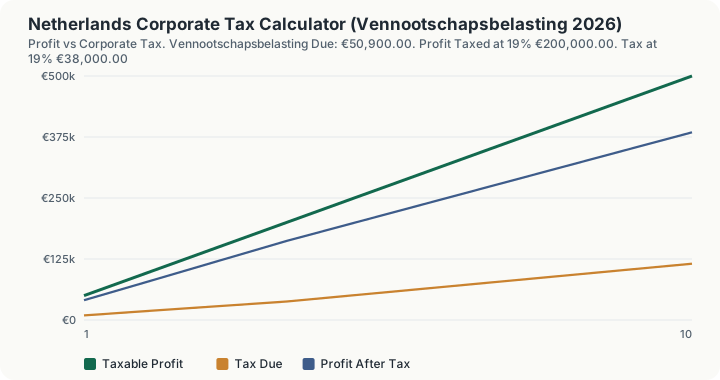
Quick Answer: A company with €250,000 of taxable profit pays €50,900.00 in vennootschapsbelasting. The first €200,000 is taxed at 19% (€38,000) and the remaining €50,000 at 25.8% (€12,900), giving an effective rate of 20.36%. Unlike the UK, there is no marginal relief taper, so the marginal rate never exceeds 25.8%.
What does this calculator do?
Dutch corporate income tax has two rates and one threshold: 19.0% on taxable profit up to €200,000, and 25.8% above it. Both have been stable since 2023.
The structure is genuinely banded, which is worth stating because the neighbouring UK system is not. In the UK, profits between £50,000 and £250,000 attract Marginal Relief, producing a marginal rate of 26.5% that is higher than the main rate. The Netherlands has nothing equivalent: the higher rate applies only to the slice above €200,000, so the marginal rate steps from 19% to 25.8% and stays there.
The effective rate therefore rises asymptotically toward 25.8% without ever reaching it. Even at €1,000,000 of profit it is only 24.44%.
How is this calculated?
The profit is split at the threshold and each slice taxed at its own rate:
Tax = 0.19 × min(P, 200,000) + 0.258 × max(0, P − 200,000)
The effective rate is total tax over total profit. It equals exactly 19% at or below the threshold and approaches 25.8% from below as profit grows.
The marginal rate is 19% below the threshold and 25.8% above it. There is no band in which it is higher than 25.8%.
Worked Example
A BV closes the year with €250,000 of taxable profit, which straddles the bracket threshold.
Step 1: Split the profit at €200,000. Low band €200,000, high band €250,000 - €200,000 = €50,000
Step 2: Tax the low band. €200,000 x 19% = €38,000.00
Step 3: Tax the high band. €50,000 x 25.8% = €12,900.00
Step 4: Total vennootschapsbelasting. €38,000.00 + €12,900.00 = €50,900.00
Step 5: Profit after tax. €250,000.00 - €50,900.00 = €199,100.00
Step 6: The effective rate. €50,900.00 / €250,000.00 = 20.36%
Step 7: The marginal rate on the next euro. 25.80%, because that euro lands in the upper band
The gap between steps 6 and 7 is the whole reason to compute this rather than assume it. Twenty percent of the profit sits above the threshold and it pulls the effective rate up by only 1.36 points.
Where the profit stops at the threshold, the split disappears entirely:
Step 8: Exactly €200,000 of profit. Low band €200,000, high band €0, total tax €38,000.00, and both the effective and marginal rates read 19.00%
Step 9: €1,000,000 of profit. €38,000.00 + (€800,000 x 25.8% = €206,400.00) = €244,400.00, an effective rate of 24.44%
Even at a million the effective rate is still 1.36 points below the headline 25.8%, because the first €200,000 is permanently cheaper. That first-band discount is worth €13,600 a year to every profitable company regardless of size.
The upper band is genuinely flat, which is the point of contrast with the UK:
Step 10: Tax on €300,000. €38,000.00 + €25,800.00 = €63,800.00
Step 11: Tax on €400,000. €38,000.00 + €51,600.00 = €89,600.00
Step 12: The cost of that extra €100,000. €89,600.00 - €63,800.00 = €25,800.00, exactly 25.8%
No taper, no clawback of the low-band benefit, no band in which the marginal rate exceeds the headline rate. UK Marginal Relief does the opposite, and importing that intuition here produces the wrong answer.
Walking the €200,000 Bracket Edge
The vennootschapsbelasting has exactly one threshold, and the ten-row schedule crosses it in the middle of the table. That makes this the cleanest bracket edge in the whole set of calculators, and it is worth pricing precisely.
At €199,900 of taxable profit. The tax is €37,981.00. All of it sits in the low band, the profit taxed at 25.8% reads €0.00, and both the effective and marginal rate outputs read 19.00%.
At €200,100, two hundred euros later. The tax is €38,025.80. The low band is now capped at €200,000 producing €38,000.00, and €100 sits in the high band producing €25.80. The marginal rate output flips to 25.80% while the effective rate still reads 19.00%.
What the step actually costs. Those €200 of extra profit cost €44.80 of tax against the €38.00 they would have cost entirely inside the low band. The edge itself is worth €6.80. There is no cliff and no clawback: crossing €200,000 does not reprice the first €200,000, which is precisely the difference between the Dutch structure and the UK's marginal relief taper.
Each additional €1,000 of profit costs €190.00 below the threshold and €258.00 above it. At the €250,000 baseline the applicable figure is €258.00: raising profit to €251,000 moves the tax from €50,900.00 to €51,158.00.
Reading the schedule across the edge. Rows 1 to 4 rise in even steps of €9,500.00 of tax, from €9,500.00 at €50,000 of profit to €38,000.00 at €200,000, because every one of those tiers is entirely inside the 19% band. From row 5 the step widens to €12,900.00, and the table closes at row 10 with €115,400.00 of tax on €500,000 of profit.
How far the effective rate can climb. At €250,000 it is 20.36%. At €1,000,000 the tax is €244,400.00 and the effective rate is 24.44%, still below the 25.80% marginal rate and approaching it only asymptotically. No Dutch company ever pays 25.8% on its whole profit, because the first €200,000 is always taxed at 19%, a permanent saving of €13,600.00 against a flat 25.8% charge at any profit above the threshold.
What does this calculator not account for?
- Computing taxable profit. This starts from a figure you supply. Depreciation, the investment allowances (KIA, EIA, MIA), and the earnings-stripping interest limitation all sit upstream of it.
- The innovatiebox, which applies an effective 9% rate to qualifying income from self-developed intangible assets.
- The fiscale eenheid, under which a parent and subsidiaries are taxed as one entity, so the €200,000 threshold is available once across the group rather than per company.
- Loss relief, including the restriction limiting the offset of losses above €1 million to 50% of profit.
- The participation exemption (deelnemingsvrijstelling) on qualifying shareholdings.
- Dividend withholding tax on distributions, and the separate box 2 charge on a substantial shareholder.
- The Pillar Two minimum top-up tax for groups above €750 million of revenue.
- The 30% ruling and other employment-side reliefs, which affect payroll rather than corporate tax.
What mistakes do people make with this?
- Applying 25.8% to the whole profit. Only the slice above €200,000 attracts it. On €250,000 that error would overstate the tax by €13,600: €64,500 against the correct €50,900.
- Expecting a UK-style taper. There is none. Dutch companies never face a marginal rate above 25.8%, whereas UK companies face 26.5% through the Marginal Relief band.
- Assuming each group company gets its own €200,000 band. Under a fiscale eenheid the group is taxed as one entity and the threshold applies once.
- Confusing the effective and marginal rates. At €1,000,000 the marginal rate is 25.8% but the effective rate is 24.44%, and using the wrong one distorts any incremental-profit decision.
- Forgetting the loss relief restriction. Losses above €1 million can only shelter 50% of profit, so a loss-making history does not always eliminate a current-year charge.
- Overlooking the innovatiebox. Companies with qualifying IP income can access an effective 9% rate, well below either headline rate.
Frequently Asked Questions
What are the Dutch corporate tax rates for 2026?
Is there a marginal relief taper like the UK?
Why is my effective rate below 25.8%?
Does each company in my group get the €200,000 band?
What is the innovatiebox?
Are dividends I pay deductible?
Sources
- Belastingdienst: "Tarieven voor de vennootschapsbelasting", 19.0% up to €200,000 and 25.8% above, applying to 2026 and unchanged since 2023. belastingdienst.nl/wps/wcm/connect/bldcontentnl/belastingdienst/zakelijk/winst/vennootschapsbelasting/tarieven_vennootschapsbelasting
All figures verified on 30 August 2026
Also consulted: Belastingdienst: "Veranderingen vennootschapsbelasting 2026".