Quick Answer: California has no state-level estate tax, so a $5,000,000 estate owes $0 in California estate tax. Federal exemption rules apply separately.
Why the Headline Never Changes
California's entry in the engine's 2026 state estate tax table carries hasEstateTax: false, an exemption of $0, and an empty bracket array. The primitive reads that flag first and returns before reaching any rate arithmetic.
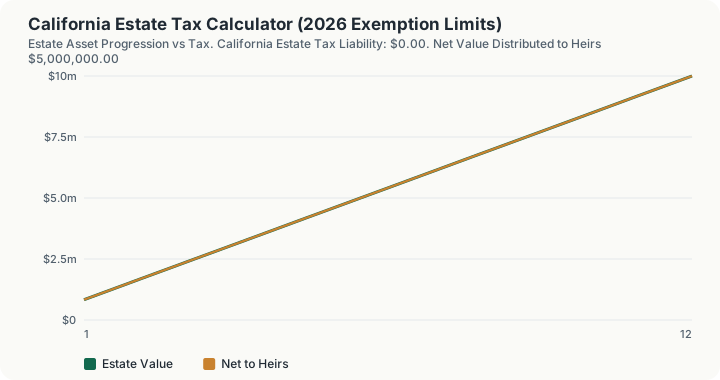
At the default $5,000,000 gross estate the calculator returns $0.00 of California estate tax, an effective rate of 0.00%, an exemption threshold of $0, and $5,000,000.00 distributed to heirs. Raising or lowering the estate value does not move the tax figure. That is the correct California result, and the constancy is the substantive finding on this page.
How This Is Calculated
No California estate tax entry means no exemption to clear and no bracket ladder to walk.
- Value the gross estate. Date-of-death fair market value of all real property, business interests, securities, cash, and life insurance proceeds the decedent owned, entered as one figure.
- Subtract allowable deductions. Deductions are subtracted from the gross and the result floored at zero. The subtraction executes; the state test it feeds has a single outcome in California.
- Look California up in the state estate tax table. The lookup returns
hasEstateTax: false, and the function exits with a tax of $0, an exemption threshold of $0, and a taxable estate above exemption of $0. - Return $0. The net estate passes to beneficiaries with no California reduction at any value.
Worked Example
- Start with the gross estate. A $5,000,000 gross estate at fair market value, before deductions.
- Check California's table entry. No estate tax and no brackets, so no threshold or schedule is loaded.
- Compute the state estate tax due. $0.00.
- Distribute the net estate. The full $5,000,000.00 passes to beneficiaries.
- What this excludes. California's state-level result only; the federal return is separate and is not computed on this page.
Walking the Value Range and Finding No Edge
Each figure is an independent run of this calculator.
At a $1,000,000 estate. California estate tax = $0.00; net to heirs $1,000,000.00.
At a $10,000,000 estate. California estate tax = $0.00; net to heirs $10,000,000.00.
At a $14,999,000 estate, then at $15,001,000. California estate tax = $0.00 in both runs; the step across costs $0.00.
At a $30,000,000 estate. California estate tax = $0.00; net to heirs $30,000,000.00.
At a $50,000,000 estate. California estate tax = $0.00; net to heirs $50,000,000.00.
The marginal cost of the next $1,000,000 of estate value is $0.00 at every point tested, and the effective rate holds at 0.00% across the whole fifty-fold range. The reverse question, how much value can pass before California charges, has no dollar answer: the code path that would charge is never entered, so there is no quantity to report.
That is a real result rather than an omission. On a state with a genuine exemption the two figures either side of the threshold differ, and knowing where they diverge is the whole point of the page. Here they do not diverge anywhere.
Isolating the Deductions Input
Given a zero headline it is natural to wonder whether deductions are producing it. Three runs answer that.
Deductions at $0 on a $5,000,000 gross estate: tax $0.00, net distributed $5,000,000.00. Deductions at $1,000,000: tax $0.00, net distributed $4,000,000.00. Deductions at $5,000,000: tax $0.00, net distributed $0.
Net distributed tracks the deduction exactly; the tax does not respond at all. Claiming the largest deduction tested saves $0.00 of California estate tax. The deductions box is functioning, and in this state it has nothing to bite on.
The $0 Exemption Threshold Is a Sentinel, Not a Limit
The Statutory Exemption Threshold output displays $0 here, which reads as though nothing is exempt. It means no exemption is defined, because no tax is defined.
That field receives a statutory number only when the table gives a state an estate tax. California hits the early return, which sets the threshold to $0 as a null value alongside hasEstateTax: false and a taxable estate above exemption of $0. A regime that genuinely taxed from the first dollar would pair a $0 threshold with a large tax; here the tax at $50,000,000 is $0.00.
The Federal Estate Tax Is Not Computed Here
The engine models no federal estate tax. Its 2026 tables contain no federal exemption, and no part of the code path applies a unified credit, portability of a deceased spouse's unused exclusion, an add-back of lifetime taxable gifts, or the generation-skipping transfer tax.
A $50,000,000 California estate showing $0.00 on this page therefore has a zero state bill and an entirely uncomputed federal position. Given how large California estates can be, that gap between the headline and the total is the most consequential thing to understand about this number.
California is also absent from the engine's separate 2026 state inheritance tax table, whose records cover Pennsylvania, Nebraska, Maryland, Kentucky, and New Jersey only. Estate tax and inheritance tax are distinct charges on different payers, so a zero in one would not settle the other; for California neither table produces a liability.
Single-Jurisdiction Modelling and Real Property
The calculator resolves one state per run. Real property physically located in a state that does levy an estate tax is taxable by that state on its own schedule regardless of the decedent's domicile, and this page has no input capable of representing it. A California estate holding land in a taxing state reads $0.00 here and carries an uncomputed liability there.
What This Does Not Account For
- Federal estate tax under IRC Chapter 11. Not computed, and no federal exemption figure exists in the engine's tables.
- Federal generation-skipping transfer tax under IRC Chapter 13. Not computed.
- Out-of-state situs and apportionment. One jurisdiction per run, with no allocation of value.
- Community property characterisation. The calculator takes a single gross estate figure with no input for splitting value between spouses.
- Valuation discounts. Minority-interest and lack-of-marketability adjustments on closely held entities are not applied.
Common Pitfalls
- Reading the $0 exemption threshold as a first-dollar tax. The tax figure beside it is $0.00 at $50,000,000.
- Crediting deductions with the zero. The tax is $0.00 with deductions at $0 and $0.00 with deductions at $5,000,000.
- Treating the headline as the full death tax bill. It carries no federal component.
- Assuming out-of-state property is included. It is not modelled.
- Expecting a threshold above the tested range. The sweep reaches $50,000,000 and the answer never moves.
Frequently Asked Questions
Does California have a state estate tax?
Does California have an inheritance tax?
Do deductions reduce the California estate tax?
Why does the exemption threshold show $0?
Does $0.00 mean the estate owes no death tax at all?
Sources
- California Franchise Tax Board, the official state tax authority for California rates, rules and forms. ftb.ca.gov
Engine table: engine/tables/2026/state-estate-tax.json, California entry: hasEstateTax: false, exemption 0, empty bracket array.
Engine table: engine/tables/2026/state-inheritance-tax.json, listing Pennsylvania, Nebraska, Maryland, Kentucky, and New Jersey only.