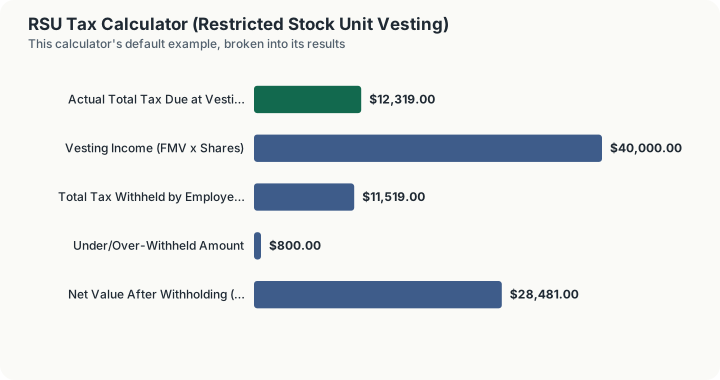
Quick Answer: Restricted stock units are taxed as ordinary income at full fair market value the moment they vest, and because employers typically withhold a flat 22% (or 37% above $1 million) rather than your true marginal rate, many employees end up under-withheld. On the baseline, 500 shares vesting at $80 on $150,000 of other wages carry $12,319 of tax against $11,519 withheld.
Overview
Restricted stock units, almost always shortened to RSUs, are the most common form of equity compensation at established technology and public companies today. An RSU has no strike price and no exercise decision to make, unlike stock options. You are simply granted units that convert into actual shares on a vesting schedule, and the moment they vest, the full value of those shares is treated as ordinary compensation income, exactly as if your employer had paid you a cash bonus and you chose to buy company stock with it.
This creates two distinct calculations that matter to every RSU holder. The first is the actual tax you owe, income tax plus payroll tax, on the value of the shares as they vest. The second, the one that catches far more people off guard, is how much your employer actually withheld on your behalf at that moment. The IRS lets employers use a flat withholding rate on supplemental wages like RSU vesting income rather than calculating your true marginal rate, and for a lot of employees, especially those already in a 24% or higher bracket, that flat rate under-collects. The gap surfaces as a surprise balance due when they file their return the following spring.
How This Is Calculated
The calculator separates what you actually owe from what your employer actually withheld, then shows you the gap.
Vesting income. Shares vesting multiplied by the fair market value per share on the vesting date. There's no strike price to subtract here: RSUs, unlike options, cost nothing to receive, so the entire value is compensation.
Actual ordinary income tax owed. The vesting income is stacked on top of your other W-2 wages for the year using the 2026 federal brackets, and the calculator computes the tax specifically attributable to the vesting income, meaning the tax on (other wages + vesting income) minus the tax on other wages alone. This correctly reflects that vesting income lands on top of your existing salary in the bracket structure, not at the bottom.
Actual FICA owed. Vesting income is W-2 wages, so it is subject to the same 6.2% Social Security tax (up to the annual wage base) and 1.45% Medicare tax as your salary, plus 0.9% Additional Medicare Tax once your combined wages for the year cross the filing-status threshold.
What your employer actually withholds. For supplemental wage payments like RSU vesting, employers generally use a flat statutory rate rather than your marginal rate: 22% on cumulative supplemental wages up to $1,000,000 for the year from that employer, and a mandatory 37% on any amount above $1,000,000. FICA withholding, by contrast, is not optional or approximate; it is calculated using the exact same statutory formula as the "actual" FICA figure above, so the two always match.
The gap. The calculator compares actual total tax due to total tax withheld and reports whether you are under-withheld, meaning you will owe additional tax (and possibly a penalty) when you file, or over-withheld, meaning some of what was withheld will come back as part of your refund.
Worked Example
A standard mid-career vest
500 RSUs vest at a fair market value of $80 a share. You are a single filer with $150,000 of other W-2 wages already earned this year and no prior supplemental wages from this employer.
Step 1 -- Vesting income. 500 shares x $80 = $40,000
Step 2 -- Ordinary income tax attributable to the vest. Tax on $190,000 minus tax on $150,000, both against the 2026 single brackets and standard deduction = $9,600
Step 3 -- Social Security on the vest. The 2026 wage base is $184,500 and $150,000 is already used, so $34,500 remains: $34,500 x 6.2% = $2,139
Step 4 -- Medicare on the vest. $40,000 x 1.45% = $580. Combined wages of $190,000 stay below the $200,000 single threshold, so no Additional Medicare Tax applies.
Step 5 -- Total FICA on the vest. $2,139 + $580 = $2,719
Step 6 -- Actual total tax due. $9,600 + $2,719 = $12,319
Step 7 -- What the employer actually withholds federally. Cumulative supplemental wages stay under $1,000,000, so the flat supplemental rate applies: $40,000 x 22% = $8,800
Step 8 -- Total withheld at vesting. $8,800 + $2,719 = $11,519. FICA withholding is statutory rather than elective, so the FICA figure withheld is the same $2,719 that is owed.
Step 9 -- The gap. $12,319 - $11,519 = $800 under-withheld
That $800 is exactly two percentage points of $40,000, which is the whole story: the vest is taxed at a 24% marginal rate and withheld at a flat 22%. Nothing went wrong, and no payroll department made a mistake. The flat supplemental rate simply is not your rate. The calculator also reports that the withholding was equivalent to 143.99 shares, and that $28,481 of value remains if you do not sell any shares to cover.
The same vest for a higher earner
Change one input: other W-2 wages of $250,000 rather than $150,000.
Step 10 -- Ordinary income tax on the vest. Tax on $290,000 minus tax on $250,000 = $13,330.25
Step 11 -- FICA on the vest. Social Security is nil because $250,000 already exceeds the $184,500 wage base. Medicare is $40,000 x 1.45% = $580, and the whole vest sits above the $200,000 Additional Medicare threshold, so $40,000 x 0.9% = $360. Total = $940
Step 12 -- Actual total tax due, and the gap. $13,330.25 + $940 = $14,270.25 due against $9,740 withheld = $4,530.25 under-withheld
Being past the Social Security wage base cut the FICA bill from $2,719 to $940, but the income tax rose enough to more than swallow it, and the shortfall grew fivefold. The flat 22% gets less accurate the further your marginal rate is from it.
Crossing the $1,000,000 supplemental cliff
A senior employee vests 15,000 shares at $90, having already taken $800,000 of supplemental wages and $800,000 of other W-2 wages this year.
Step 13 -- Vesting income. 15,000 x $90 = $1,350,000
Step 14 -- How much still withholds at 22%. $1,000,000 - $800,000 already paid = $200,000
Step 15 -- How much withholds at the mandatory 37%. $1,350,000 - $200,000 = $1,150,000
Step 16 -- Federal withholding. ($200,000 x 22%) + ($1,150,000 x 37%) = $44,000 + $425,500 = $469,500
Step 17 -- FICA on the vest. Social Security is already exhausted at $800,000 of wages. Medicare and Additional Medicare on $1,350,000 at 1.45% + 0.9% = 2.35% = $31,725
Step 18 -- Actual total tax due. $499,500 of ordinary tax + $31,725 of FICA = $531,225
Step 19 -- The gap. $531,225 - $501,225 = $30,000 under-withheld
That $30,000 is 15% of $200,000, the difference between the 22% applied to the pre-cliff slice and the 37% at which this employee's income is genuinely taxed. The cliff is not the problem; the tranche below it is. Anyone whose income is already in the top bracket is under-withheld on the first $1,000,000 of supplemental wages every single year, and the shortfall compounds if it is not covered by estimated payments.
What This Does Not Account For
This calculator does not model state income tax, which many states withhold and tax separately, often using their own flat supplemental rate that can compound the same under-withholding problem at the state level. It does not model a sell-to-cover strategy in exact share terms; many employers automatically sell a number of shares sufficient to cover the withholding amount, and fractional share and rounding mechanics vary by broker and plan administrator. It does not account for RSU vesting schedules that span a single grant across many small vesting events throughout the year, each of which is its own separate taxable event; this calculator models one vesting event at a time. It does not model double-trigger RSUs common at pre-IPO companies, where vesting requires both the passage of time and a liquidity event, which can cause several years of vested-but-untaxed RSUs to become taxable all at once when a company finally goes public or is acquired. It does not calculate estimated tax payment requirements or underpayment penalties that can result from a large under-withheld vesting event occurring mid-year.
Common Pitfalls
- Assuming the withheld amount equals the actual tax owed. The flat 22%/37% supplemental withholding rate is a payroll convenience, not a calculation of your real liability, and frequently under-withholds for anyone above the 22% ordinary bracket.
- Not setting aside cash for the gap. If shares are not automatically sold to cover taxes, or if the sell-to-cover only covers the flat withholding rate rather than your true marginal rate, you can be left needing to find cash from other sources at filing time.
- Confusing RSU taxation with stock option taxation. RSUs have no strike price and no exercise decision; the entire value at vesting is ordinary income, a simpler but often larger immediate tax event than an option exercise on the same dollar value of stock.
- Ignoring cumulative supplemental wages across the year. The 22%/37% cliff is based on cumulative supplemental wages from the same employer for the calendar year, not on any single vesting event in isolation, so a series of smaller vests can still cross the $1,000,000 threshold partway through the year.
- Forgetting that selling shares immediately after vesting still has a (usually small) capital gains consequence. Any price movement between the vesting-date FMV, which set your cost basis, and your actual sale price is a separate short-term capital gain or loss, even if you sell the same day.
Frequently Asked Questions
Why is my paycheck stub showing 22% withheld on my RSU vest when I'm in a higher bracket?
What happens once my cumulative supplemental wages cross $1,000,000 in a year?
Does RSU income affect my Social Security tax the same way regular salary does?
Should I sell my RSU shares immediately after they vest?
Can I change how much my employer withholds from an RSU vest?
Sources
- Internal Revenue Service, Publication 15 (Circular E), Employer's Tax Guide, Section 7, Supplemental Wages, irs.gov/publications/p15
- Internal Revenue Service, Revenue Procedure 2025-32 (2026 federal income tax brackets and standard deduction), irs.gov/pub/irs-drop/rp-25-32.pdf
- Social Security Administration, 2026 COLA Fact Sheet (Social Security wage base and FICA rates), ssa.gov/news/press/factsheets/colafacts2026.pdf
- Internal Revenue Service, Topic No. 427, Stock Options and equity compensation guidance, irs.gov/taxtopics/tc427