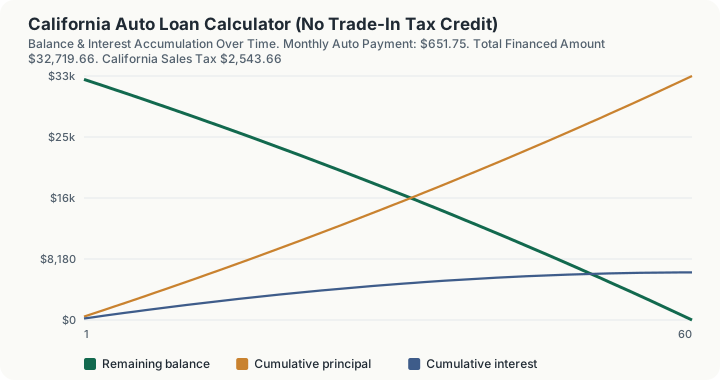
Quick Answer: California gives no sales tax credit for a trade-in. Your dealer must report the full selling price, so a $10,000 trade-in on a $35,000 car saves you nothing in tax, where the same trade would save $725 in most states. That $35,000 car with $5,000 down, an $85 doc fee, a 60-month term, and a 7.25% APR costs $651.75 a month, including $2,543.66 of sales tax at the statewide rate.
Overview
Start with the rule that costs California buyers the most money, because almost every online estimate gets it wrong.
In roughly forty states, trading your old car in at the dealership reduces the price the sales tax is charged on. California does not work that way. Revenue and Taxation Code §§ 6011 and 6012 define gross receipts without any exclusion for property taxed in trade, and CDTFA Publication 34 tells dealers directly: if you accept a trade-in, you must still report the total selling price of the vehicle in your gross receipts, and you cannot deduct the allowance for the trade-in.
The practical effect is that a California trade-in behaves like a manufacturer rebate. It reduces the amount you have to borrow, dollar for dollar, and it reduces nothing else. On the baseline used by this calculator, adding a $10,000 trade-in drops the monthly payment from $651.75 to $452.56 and leaves the sales tax at $2,543.66, unchanged to the cent.
That changes the arithmetic of selling privately. In a credit state, a private sale has to beat the dealer's trade offer by more than the tax credit to be worth the trouble. In California there is no tax credit to beat, so any private sale price above the dealer's offer is pure gain.
The second California rule worth knowing is that district taxes follow the address where the vehicle will be registered, not the dealership. Driving to a low-tax county to buy does not lower your tax if you register the car at home.
Auto Loan APR by Credit Score
The APR columns below are national averages, not California figures. No primary source publishes average auto loan APR by state: Experian's report has no geographic cut, the CFPB publishes state origination volume but no rates, and the New York Fed publishes state delinquency only. The payment column is the part that is specific to California, because it runs this calculator's own California tax and fee rules at each tier's rate.
| Credit Tier | VantageScore 4.0 | Avg New APR | Avg Used APR | Est. Payment in California |
|---|---|---|---|---|
| Super prime | 781-850 | 4.55% | 6.30% | $610.74 |
| Prime | 661-780 | 6.23% | 8.77% | $636.07 |
| Nonprime | 601-660 | 9.67% | 14.03% | $689.90 |
| Subprime | 501-600 | 13.44% | 19.42% | $751.86 |
| Deep subprime | 300-500 | 16.01% | 21.77% | $795.85 |
Payment assumptions: $35,000 vehicle price, $0 trade-in, $5,000 cash down, $85 dealer documentation fee, 60-month term, new-vehicle APR applied to the California delivered price including tax and statutory fees. At the 6.39% overall new-car average the same purchase costs $638.51 a month.
The score bands are VantageScore 4.0, not FICO. The same borrower can land in a different tier under each model, so a FICO score pulled from a card issuer will not always match the band here. Source: Experian, State of the Automotive Finance Market, Q1 2026, slide 45.
What Moves Your Payment
Each row changes one input and leaves the rest at the baseline below. The dollar effects are this calculator's own output for California, not a rule of thumb.
| Factor | What Changes | Effect on Monthly Payment | Effect on Total Interest |
|---|---|---|---|
| Vehicle Price | Each extra $1,000 of price raises both the amount financed and the sales tax base, so the tax rises with it. | +$21.37 | +$209.31 |
| Trade-In Allowance | A $1,000 allowance cuts the amount financed by $1,000, but it does not reduce the sales tax base. California gives no trade-in tax credit, so you are taxed on the full price. | -$19.91 | -$195.16 |
| Cash Down Payment | A $1,000 larger down payment cuts the amount financed by $1,000. It never reduces the sales tax, which is assessed on the price, not on what you borrow. | -$19.91 | -$195.16 |
| Dealer Doc Fee | A $100 higher documentation fee adds $100 to the amount financed and is inside the sales tax base, so it is taxed on top of itself. California caps the fee at $260. | +$2.14 | +$20.93 |
| Longer Term | Stretching the same balance from 60 months to 72 months spreads the principal over twelve more payments at the same rate. | -$89.98 | +$1,342.44 |
Baseline: $35,000 vehicle price, $0 trade-in, $5,000 cash down, $85 documentation fee, 60 months at 7.25% APR, giving a $651.75 payment and $6,385.68 of total interest.
How This Is Calculated
California is the largest of the states that give no trade-in credit at all, so your trade cuts the loan and never the tax. Four steps.
1. Taxable base. The full selling price plus the dealer documentation fee, which CDTFA Publication 34 lists among taxable charges. No trade-in deduction, because the statute gives none.
2. Sales tax. The 7.25% statewide rate plus any district transactions and use tax that applies at your registration address.
The 7.25% figure already contains a 1.25% local component distributed to cities and counties, which is why no California address pays less than 7.25%. Districts stack on top, and combined rates in the state commonly run past 10.75%.
3. Title and base registration. A fixed $91.00, being the $15 title transfer and the $76 base registration under VC 9250.1. This is a floor rather than an estimate, for reasons in the next section.
4. Amount financed and amortization. The trade-in and the cash down payment both reduce the balance borrowed, after tax has already been computed on the full price. The result amortizes as a fixed-rate installment loan:
where $P$ is the financed amount, $i$ is the monthly rate (APR divided by 12), and $n$ is the term in months.
Why California Registration Is Not One Number
The $91 above covers only the title transfer and the base registration. California adds several charges that a flat figure cannot represent:
- CHP fee: $34.
- Vehicle License Fee: 0.65% of the purchase price or value, declining across the first eleven renewal years. On a $35,000 car that is roughly $227 in year one. It is an annual in-lieu-of-property tax, not a purchase charge.
- Transportation Improvement Fee, banded by value: $33 below $5,000, $66 from $5,000 to $24,999, $132 from $25,000 to $34,999, $198 from $35,000 to $59,999, and $231 at $60,000 and above.
- County and district fees, which vary by where you register.
- Zero-emission vehicle fee: a new $100 annual charge on EVs beginning in 2026.
Because the two largest of those depend on the vehicle's value, a California registration total is a function of the car, not a constant. This calculator includes only the two fixed components and leaves the rest out rather than averaging them into a number that would be wrong for most buyers.
The Doc Fee Cap Changed
California is one of the few states that caps dealer documentation fees by statute, and the figure most sources quote is now incomplete.
The baselines in Vehicle Code § 11713.1 are $85 for dealers participating in the DMV's business partner automation program and $70 for everyone else. SB 791, from the 2025-2026 session and reported enrolled on 13 September 2025, authorizes a document processing charge above those amounts, capped at the lesser of 1% of the total price of the vehicle or $260, with that authorization sunsetting on 1 January 2031, after which the $85 and $70 baselines return. The 1% test excludes government charges and optional accessories or services. Sales to the State of California and to local government entities are excluded from the higher charge.
Two cautions. The bill's enrolled status is not the same as a verified chapter number and effective date, so confirm it before treating $260 as your dealer's lawful ceiling. And a calculator cannot know from your address whether your dealer is a business partner automation participant, which is what separates the $85 baseline from the $70 one. This page defaults to $85 and permits up to $260.
Whatever the number, it is taxable. A $260 doc fee costs $260 plus $18.85 of tax at the statewide rate.
Worked Example
California is one of five states that give no trade-in credit at all, and the arithmetic below is worth following mostly for the step that does not happen: the trade-in never touches the tax line.
- Vehicle price: $35,000
- Trade-in allowance: $0
- Cash down: $5,000
- Dealer doc fee: $85
- District rate: 0% (statewide floor)
- Term: 60 months at 7.25% APR
Step 1 -- The taxable base. Gross receipts include the doc fee, and no trade-in deduction is permitted: $35,000 + $85 = $35,085.00
Step 2 -- Sales tax at the 7.25% statewide rate. $35,085.00 x 7.25% = $2,543.66
Step 3 -- Title and base registration, outside the base. $15.00 title + $76.00 registration = $91.00
Step 4 -- Total delivered price. $35,000 + $85.00 + $2,543.66 + $91.00 = $37,719.66
Step 5 -- Amount financed. $37,719.66 - $0 trade-in - $5,000 cash down = $32,719.66
Step 6 -- The monthly payment. $32,719.66 at 7.25% over 60 months = $651.75
Step 7 -- Month 1. $32,719.66 x (7.25% / 12) = $197.68 interest, $454.07 principal, balance $32,265.59
Step 8 -- Month 2. $32,265.59 x (7.25% / 12) = $194.94 interest, $456.81 principal, balance $31,808.78. Cumulative interest: $392.62
Step 9 -- The accumulation. Interest through month 12 is $2,187.43, with $27,086.09 outstanding. Total finance charge over 60 months: $6,385.68
Now add a $10,000 trade-in. The sales tax stays at $2,543.66. The delivered price stays at $37,719.66. Only the financed balance moves, to $22,719.66, and the payment falls to $452.56. Compare that with a state that credits trade-ins at the same 7.25%, where the tax would fall by $725 to $1,818.66.
Add an illustrative 2.5% district rate to the baseline instead and tax rises to $3,420.79, a combined 9.75%, pushing the payment to $669.23. Add the $10,000 trade-in to that case and the tax is still $3,420.79. The district rate makes the missing trade-in credit more expensive, not less.
What This Does Not Account For
- District tax rates. Left at zero because no California district or metro combined rate was confirmed from a primary CDTFA rate table. The default output is the statewide floor, and almost every California buyer pays more than the floor.
- The full registration stack. CHP fee, Vehicle License Fee, Transportation Improvement Fee, county and district fees, and the 2026 zero-emission vehicle fee, all described above.
- The $70 versus $85 doc fee baseline, which depends on the dealer's DMV business partner automation status.
- Electronic filing service fees. A separate charge applies, and from 1 January 2026 an additional $2 fee applies to business-partner e-filed DMV transactions.
- Private-party purchases, where use tax is collected by the DMV at registration rather than by a dealer.
- Partial use tax exemptions and out-of-state purchase rules, which have their own conditions in CDTFA guidance.
- GAP insurance, extended warranties, and aftermarket add-ons, unless you fold them into the vehicle price yourself.
Common Pitfalls
- Assuming your trade-in cuts the tax. It does not, anywhere in California. A calculator that subtracts the trade-in before applying the rate will understate your tax by the allowance times the combined rate, which is $725 on a $10,000 trade at the statewide rate alone.
- Buying in a low-tax district to save money. District tax on a vehicle follows the registration address. The saving does not exist unless you actually live there.
- Using 7.25% as the answer. It is the floor, not the typical rate. Combined rates run past 10.75% in parts of the state, and the difference on a $35,085 base is over $1,200.
- Quoting the $85 doc fee cap as settled. SB 791 reportedly lifts it to the lesser of 1% or $260 through 2031. Ask what your dealer is charging and check it against your price.
- Treating the Vehicle License Fee as a one-time cost. It is annual, based on value, and declines over the first eleven renewals. It is not part of the loan.
- Judging a loan by the monthly payment alone. Stretching this $32,719.66 balance from 60 to 72 months lowers the payment to $561.77 and raises total finance charges from $6,385.68 to $7,728.13.
Frequently Asked Questions
Does a trade-in reduce sales tax in California?
What is California's sales tax rate on cars?
Is California car tax based on where I buy or where I live?
How much can a California dealer charge for a doc fee?
Should I sell my old car privately instead of trading it in California?
What is the California Vehicle License Fee?
Sources
- Consumer Financial Protection Bureau, Truth in Lending Act (Regulation Z, 12 CFR § 1026.22) disclosure requirements for installment credit. ecfr.gov/current/title-12/chapter-X/part-1026
- California Franchise Tax Board, the official state tax authority for California rates, rules and forms. ftb.ca.gov
Also consulted: California Department of Tax and Fee Administration, Publication 34, Motor Vehicle Dealers (no deduction for trade-in allowance; doc fees among taxable charges); Rev. & Tax. Code §§ 6011 and 6012 (definition of gross receipts, with no trade-in exclusion) and § 6051 et seq. (state sales tax); California Vehicle Code § 11713.1 (document processing charge baselines) and SB 791, 2025-2026 session (higher cap through 2031); California DMV, vehicle registration fee schedule (title transfer, base registration under VC 9250.1, CHP fee, Vehicle License Fee, Transportation Improvement Fee bands, zero-emission vehicle fee); Experian, State of the Automotive Finance Market, Q1 2026, slide 45 (average new and used auto loan APR by VantageScore 4.0 credit tier; national, no state level cut published).