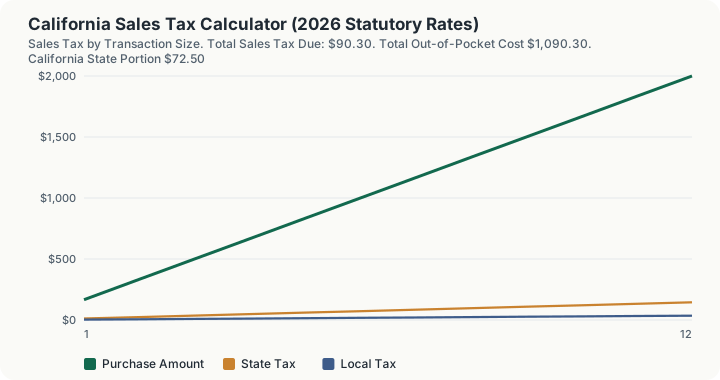
Quick Answer: A $1,000 taxable purchase in California costs $90.30 in combined state and local sales tax, for a total of $1,090.30 out the door.
The Highest State Rate, the Smallest Local Layer
California carries the highest state-level sales tax rate in the country at 7.25%, and the thinnest average district layer of the states on this page: 1.78%, for a combined 9.03%. On the $1,000.00 default the engine returns $90.30 of tax, split $72.50 to the state and $17.80 to districts. Four fifths of a California sales tax bill is the state rate, the reverse of the pattern in Alabama or Colorado.
The proportions are fixed. At $50,000.00 the tax is $4,515.00, of which $3,625.00 is state and $890.00 district. At $100.00 it is $9.03, of which $7.25 is state and $1.78 district. The 1.78% is a population-weighted statewide average and there is no ZIP, city or district input in this calculator's configuration, so it cannot reproduce the combined rate at any specific California address, several of which run points above the average.
How This Is Calculated
California levies the highest state-level sales tax rate in the country at 7.25%, and that figure is before any local district tax. Add the 1.78% average of city, county and special district rates and the combined rate reaches 9.03%, or $90.30 on a $1,000 purchase. The state number is itself a composite: part of it is a statewide local allocation that goes back to counties rather than to Sacramento. California also exempts groceries and prescription medicine, so the effective rate on a household's total spending is well below 9%. This calculator does not apply those exemptions.
For goods taxed at the general rate, the state and district pieces apply to the same base:
The calculator proceeds as follows:
- Take the entered amount as the base. No adjustments are made to the price before tax is computed; a negative entry is clamped to zero.
- No item-level exemption filtering. Grocery and prescription exemptions are not applied. Enter only the taxable portion of a transaction.
- Multiply by the state statutory rate and round to the cent. That produces the state portion as its own rounded figure.
- Multiply by the district surcharge and round to the cent separately. The 1.78% average is weighted by population. Individual district taxes stack in practice, and the combined rate in the highest-taxed California cities runs several points above the statewide average. If the local toggle is off, this term is zero.
- Add the two rounded pieces. The state and local amounts are summed to give total tax, and the total is added back to the price to give the out-of-pocket cost.
Worked Example
For a $1,000 taxable purchase in California:
- Starting purchase price. The buyer rings up a $1,000.00 taxable retail purchase in California, the baseline amount before any tax is applied.
- State portion. California's statutory state sales tax rate of 7.25% applies to the full purchase amount: $1,000.00 × 7.25% = $72.50 owed to the state.
- Local portion. Local municipal, county, and special-district surcharges add an average of 1.78% on top of that: $1,000.00 × 1.78% = $17.80 more.
- Combined tax due. Summing the two pieces, $72.50 in state tax plus $17.80 in local surcharge comes to $90.30 in total sales tax owed on the transaction.
- Total out-of-pocket cost. Adding that $90.30 in tax to the $1,000.00 purchase price brings the buyer's total out-of-pocket cost to $1,090.30.
This example uses California's statewide average local rate of 1.78%; actual combined rates vary by city and district, so a real receipt could show a combined rate above or below the 9.03% average used here.
A Perfectly Straight Sweep
There is no bracket, exemption cliff or cap anywhere in the California sales tax sweep, and the twelve tiers demonstrate it: $15.05 of tax at $166.67, $45.15 at $500.00, $90.30 at $1,000.00, $135.45 at $1,500.00 and $180.60 at $2,000.00. The line continues unbroken beyond the table to $451.50 at $5,000.00, $2,257.50 at $25,000.00 and $4,515.00 at $50,000.00.
The effective rate is identical across that whole range. At $100.00 the tax is $9.03 and at $50,000.00 it is $4,515.00, both exactly 9.03% of the base. Each additional $100 of purchase price costs $9.03, which is why $1,000.00 returns $90.30 and $1,100.00 returns $99.33. One more dollar costs nine cents: $90.30 becomes $90.39 at $1,001.00. On a $1.00 purchase the tax rounds to $0.09.
Pricing the District Layer
The district surcharge toggle is the only step change available on this page. At $1,000.00, switching it off drops the tax from $90.30 to $72.50 and the total cost from $1,090.30 to $1,072.50. At $50,000.00 it drops from $4,515.00 to $3,625.00, an $890.00 swing.
That is the smallest local swing of any state in this family, because California's average district layer is the thinnest, but it is still a modelling choice rather than a real transaction. With the switch on, the engine applies a statewide blend nobody is charged at a specific address; with it off, it reports 7.25%, which is the correct combined rate only in the unusual case of a location with no district tax at all. The highest-taxed California cities sit several points above 9.03%, and the engine has no input capable of expressing that.
A Receipt Total This Engine Cannot Land On
The reverse question is the one people actually search: a receipt totals $1,000.00 including tax, so what was the pre-tax price? The engine only runs net to gross. It takes a pre-tax figure and adds tax; there is no extraction mode and no tax-inclusive input, so the answer has to be found by running the forward calculation at candidate amounts.
For California it cannot be found exactly, and that is a real finding rather than a limitation of the search. The engine rounds the state and district components to the cent separately before adding them, and no whole-cent pre-tax price produces an out-the-door total of exactly $1,000.00. A pre-tax price of $917.17 yields $66.49 of state tax and $16.33 of district tax, $82.82 in total, for $999.99. One cent higher, $917.18, yields $66.50 and $16.33, $82.83 in total, for $1,000.01. The total steps from $999.99 straight past $1,000.00 to $1,000.01. The same separate-rounding behaviour shows up elsewhere in the sweep: at $999.06 the engine returns $90.21 of tax, where applying 9.03% once to the same base and rounding gives a figure one cent higher.
The wrong method, priced. The common error is to take the $1,000.00 tax-inclusive total and multiply it by 9.03%. Entered as a pre-tax amount, $1,000.00 returns $90.30 of tax, where a $1,000.00 receipt embeds $82.82. The overstatement is $7.48 per $1,000.00 of gross, roughly $748 across $100,000 of gross taxable receipts. The right operation is the tax fraction, r divided by (1 + r), not the rate: measured against a tax-inclusive total, California's 9.03% combined rate is about 8.28%. Confusing the two is the whole error, and it compounds silently down every line of a sales journal built from gross figures.
What This Does Not Account For
- Any specific district. The 1.78% figure is one statewide population-weighted average. There is no ZIP, city or district input, and California district taxes stack to combined rates several points above it.
- What you bought. No product taxability classification exists in the engine. California's grocery and prescription medicine exemptions are not applied, so an entered grocery total is taxed at the full 9.03%.
- Exemption and resale certificates, direct pay permits, and sales tax holidays. None are modelled; no input could express them.
- Use tax, marketplace facilitator collection, and economic nexus thresholds for sellers. The engine prices one transaction and computes no registration or filing obligation.
- Special industry excise taxes such as lodging, rental vehicle, alcohol and tobacco levies, which stack on top of the general rate in practice.
- Landing on a target tax-inclusive total. Because the state and district components are rounded separately, some totals are unreachable: $1,000.00 is one of them, with the nearest results being $999.99 and $1,000.01.
Common Pitfalls
- Quoting 7.25% as the California rate. On $1,000.00 that understates the bill by $17.80, and on $50,000.00 by $890.00.
- Assuming the district layer is negligible. It is the smallest of this family in percentage terms and still $890.00 on a $50,000.00 purchase.
- Stripping tax from a gross total at 9.03%. A $1,000.00 tax-inclusive receipt contains about $82.82 of tax, not $90.30.
- Running a grocery total through this page. The engine has no exemption path and returns the full $90.30 on $1,000.00 of food California would not tax at all.
- Expecting a threshold. The sweep is linear from $0.09 of tax on $1.00 to $4,515.00 on $50,000.00, with no rate change at any point.
Frequently Asked Questions
What is the sales tax rate in California?
How much of a California sales tax bill is the state rate?
How much tax is inside a $1,000 California receipt?
Are groceries taxed in California?
How does use tax differ from sales tax?
Sources
- Streamlined Sales Tax Governing Board (SSTGB): State Taxability Matrix. streamlinedsalestax.org/for-businesses/taxability-matrix
- California Franchise Tax Board, the official state tax authority for California rates, rules and forms. ftb.ca.gov
Also consulted: California Department of Tax and Fee Administration (CDTFA): 2026 Sales and Use Tax Rate Schedules.