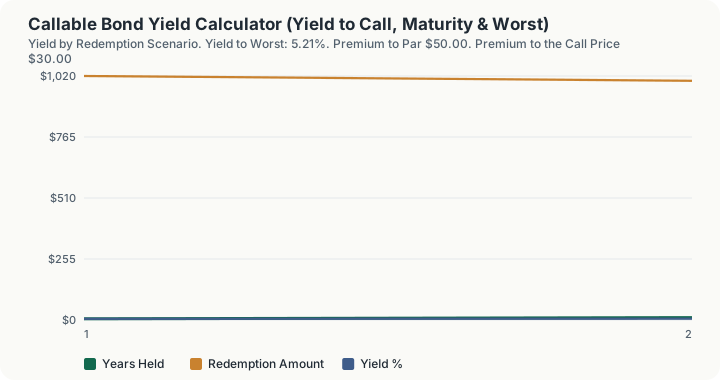
Quick Answer: A 6% semiannual bond bought at $1,050 with $1,000 face, callable in 5 years at $1,020 and maturing in 10, has a yield to call of 5.21% and a yield to maturity of 5.35%. The yield to worst is therefore 5.21%, the call scenario, and the 0.14 percentage points between them is what an early call costs you. The current yield of 5.71% flatters the bond by ignoring the premium you paid.
What does this calculator do?
A callable bond gives the issuer the right to redeem early at a stated call price. You did not buy that option; you sold it, and the coupon you receive includes the premium.
The trouble is that the issuer will exercise it only when doing so suits them, which means when refinancing has become cheap. That is the same environment in which rates have fallen and your bond has become more valuable. The call is exercised precisely in the scenario in which you would most want to keep the bond, and never in the scenario in which you would be glad to be rid of it. That asymmetry is not a detail, it is the entire economics of the instrument.
Because of it, quoting a callable bond's yield to maturity is close to meaningless when the bond trades above its call price. The honest measure is yield to worst: the lowest yield achievable across every redemption date the issuer may choose. This calculator computes yield to call and yield to maturity independently, takes the lower of the two, and reports which scenario produced it.
It also reports the total cash each path delivers, and whether the market price sits above the call price, which is the market's own statement about how likely a call is.
How is this calculated?
Each redemption scenario is a separate bond valuation with the same coupons but a different final payment on a different date.
P = ∑(t = 1 to n) (C/f)/((1 + y/f)ᵗ) + R/((1 + y/f)ⁿ)
where $C$ is the annual coupon computed on face value, $R$ is the redemption amount (the call price for the call scenario, face value for maturity), and $n$ is years to that redemption multiplied by the coupon frequency.
Step 1: Compute the annual coupon. Face value multiplied by the coupon rate. This is unaffected by the price you paid and by the call price; only the final redemption amount differs between scenarios.
Step 2: Build the call scenario. Coupons run to the first call date, and the final period pays the coupon plus the call price.
Step 3: Solve for the yield to call. The calculator solves for the annualised yield that makes the present value of those cash flows equal the market price. It uses bisection rather than Newton's method: price is strictly decreasing in yield, so a bracketed bisection cannot diverge, whereas a Newton seed derived from current yield can on deep-premium bonds with short horizons. The search runs 120 iterations over a bracket from −0.99% to 200%.
Step 4: Build the maturity scenario. The same coupons run to maturity, and the final period pays the coupon plus face value.
Step 5: Solve for the yield to maturity. The same solver, on the same market price.
Step 6: Take the lower of the two. That is the yield to worst, and the calculator records whether it came from the call or from maturity. By construction it is never higher than either.
Step 7: Compute the yield given up if called. Yield to maturity less yield to call, in percentage points. A positive figure means the call costs you.
Step 8: Compute the current yield. Annual coupon divided by market price. This ignores every capital gain or loss and is reported only as a contrast.
Step 9: Compute the two premiums. Price less face value, and price less the call price. The second is the one that matters: a price above the call price means the market is pricing a call as likely.
Step 10: Total the cash on each path. Annual coupon multiplied by years to call, plus the call price. And annual coupon multiplied by years to maturity, plus face value.
Worked Example
Defaults: $1,050 price, $1,000 face, 6.0% coupon, 10 years to maturity, callable in 5 years at $1,020, semiannual coupons.
Step 1: Compute the coupon. $1,000 × 6.0% = $60 a year, or $30 per semiannual period
Step 2: Count the periods to each redemption. Call: 5 × 2 = 10 periods. Maturity: 10 × 2 = 20 periods
Step 3: Solve the call scenario. Ten coupons of $30 plus a final $1,020, priced to equal $1,050, gives a yield to call of 5.21%
Step 4: Solve the maturity scenario. Twenty coupons of $30 plus a final $1,000, priced to equal $1,050, gives a yield to maturity of 5.35%
Step 5: Take the worst. min(5.21%, 5.35%) = 5.21%, produced by the call
Step 6: Price the call's cost. 5.35% − 5.21% = 0.14 percentage points
Step 7: Compute the current yield for contrast. $60 ÷ $1,050 = 5.71%
The current yield is 50 basis points above the yield to worst. That gap is entirely the $50 premium you paid over par, amortised away between now and redemption, which current yield simply does not see.
Step 8: Compare price against the call price. $1,050 − $1,020 = $30 above the call price, so the market is pricing a call as likely
Step 9: Total the cash on each path. If called: ($60 × 5) + $1,020 = $1,320 If held to maturity: ($60 × 10) + $1,000 = $1,600
The call takes $280 of nominal cash off the table, but it also returns your principal five years earlier, which is why the yield gap (0.14 points) is far smaller than the cash gap suggests.
What does this calculator not account for?
- Only one call date. Real callable bonds usually have a call schedule with several dates and a declining premium, sometimes continuously callable after first call. This model prices the first call date and maturity, and the yield to worst is the lower of those two only. A bond with a mid-schedule call at a lower price could have a worse yield than either.
- No option valuation. The calculator does not price the embedded option. There is no option-adjusted spread, no volatility input, no lattice or Monte Carlo. Yield to worst is a scenario floor, not a probability-weighted expected yield.
- The issuer's decision is not modelled. Whether a call actually happens depends on where refinancing rates sit at the call date, which is unknowable here. The calculator shows both outcomes and does not weight them.
- No accrued interest. The price entered is treated as the full present value at a coupon date. A bond bought between coupon dates carries accrued interest that is not separated out.
- No make-whole calls. A make-whole redemption price is a discounted present value, not a fixed dollar amount, and cannot be entered as a fixed call price.
- No credit risk, default or recovery. Every coupon and the redemption amount are assumed to be paid in full.
- No taxes or transaction costs. Market discount rules, de minimis treatment, amortisable bond premium elections and municipal tax treatment are all outside the model.
- No reinvestment assumption is separated out. Like all yield measures, both figures implicitly assume coupons are reinvested at the computed yield, which is a modelling convention rather than a forecast.
- Yields are nominal annual rates on the stated coupon frequency basis, not effective annual yields.
What mistakes do people make with this?
Quoting yield to maturity on a premium callable bond. At $1,050 against a $1,020 call price, the market has already told you it expects a call. The 5.35% yield to maturity describes a scenario the issuer has every incentive to prevent.
Using current yield to compare bonds. Current yield ignores the premium or discount entirely. Here it reports 5.71% on a bond whose worst-case yield is 5.21%. It systematically flatters premium bonds and understates discount bonds.
Assuming the call is always the worst case. It is not. On a discount bond, an early call at par hands you your capital gain sooner, which raises the yield. In that case maturity is the worst case, and this calculator reports it as such.
Ignoring how close the call date is. A premium has to be amortised over the time to redemption. Move the call from five years away to one year away and the same $30 premium over the call price has to be absorbed in a fifth of the time, which crushes the yield to call.
Treating a high coupon as a free lunch. Callable bonds pay above-market coupons precisely because you sold an option. The coupon is the option premium, and the calculator's yield-to-worst figure is what remains of it after the option is exercised against you.
Forgetting coupons are computed on face, not on price or call price. A bond bought at $1,050 still pays $60 a year on $1,000 of face, not 6% of $1,050.
Frequently Asked Questions
What is yield to worst and why does it matter more than yield to maturity?
When will an issuer actually call a bond?
Why is the yield to call lower than the yield to maturity here?
Can the yield to call ever be higher than yield to maturity?
Does yield to worst account for the value of the call option?
What is call protection?
Sources
- U.S. Securities and Exchange Commission, Investor.gov, the official authority for the investing this calculator relates to. investor.gov
Also consulted: Redemption pricing: P = ∑_(t = 1)ⁿ(C/f)(1 + y/f)⁻ᵗ + R(1 + y/f)⁻ⁿ, with coupons computed on face value and $R$ set to the call price or to face value depending on the scenario; Yield solved by bisection on a bracketed monotone function, since price is strictly decreasing in yield; Yield to worst defined as the minimum yield across the redemption scenarios evaluated; Price, face value, coupon rate, call price and dates are all user inputs. No market data is embedded in this calculator, and the defaults are illustrative only.
This page contains no statutory or published data. Yield to call, yield to maturity and yield to worst are cash-flow definitions, implemented in engine/primitives/callable-bonds.ts.