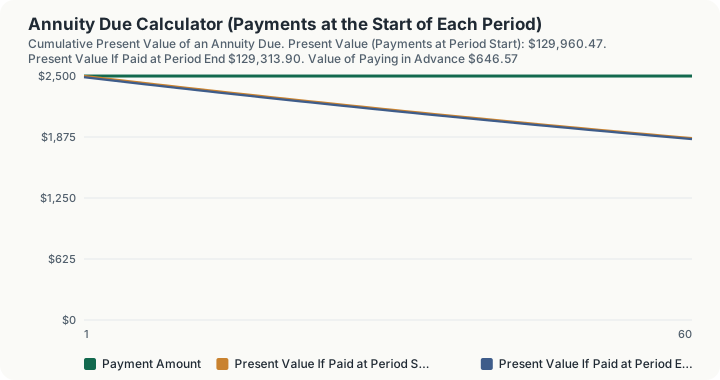
Quick Answer: A payment of $2,500 made at the START of every month for 5 years, discounted at 6% a year compounded monthly, has a present value of $129,960.47. The identical stream paid at the END of each month is worth $129,313.90, so paying in advance is worth $646.57: exactly one period of interest, or 0.50%, no matter how long the term runs.
What does this calculator do?
An annuity due pays at the beginning of each period. An ordinary annuity pays at the end. That is the entire difference between them, and it is the only thing this calculator changes.
The distinction is not academic, because most of the payment streams people actually sign are annuities due. Rent falls on the first of the month. Equipment and vehicle leases are paid on delivery, then on each anniversary. Insurance premiums are paid before the cover period begins. Subscription contracts bill in advance. Meanwhile loans, coupon bonds and most savings deposits are ordinary annuities: interest accrues first, the payment settles afterwards.
Because every cash flow in an annuity due sits one full period earlier than its ordinary counterpart, each one is discounted for one less period. The consequence is a single clean identity that the calculator makes concrete:
PV_due = PV_ordinary × (1 + i); FV_due = FV_ordinary × (1 + i)
The ratio is exactly $(1+i)$ whatever the number of payments is. That is the fact most people get wrong. The advantage of paying in advance does not accumulate over a longer term. A 5-year annuity due and a 30-year annuity due at the same 6% nominal rate are each worth precisely 0.5% more per month than their end-of-period twin. What grows with the term is the dollar size of that 0.5%, never the percentage.
The calculator also inverts the question: it reports the smaller payment that would fund the same present value if it were made in advance rather than in arrears. That is the number to bring to a lease negotiation, because it prices the timing concession in the only unit the counterparty cares about.
How is this calculated?
The calculator converts the annual rate and term into a periodic rate and a period count, values the stream both ways, and reports the gap.
i = r_annual/(100 × m); n = y × m
PV_ordinary = PMT × (1 − (1 + i)⁻ⁿ)/i; PV_due = PV_ordinary × (1 + i)
FV_ordinary = PMT × ((1 + i)ⁿ − 1)/i; FV_due = FV_ordinary × (1 + i)
PMT_advance = PV_ordinary/((1 − (1 + i)⁻ⁿ)/i × (1 + i))
Step 1: Convert the annual rate to a periodic rate. The nominal annual rate is divided by the number of payments per year. No effective-rate conversion is applied.
Step 2: Convert the term to a period count. Years multiplied by payments per year.
Step 3: Value the stream as an ordinary annuity. The standard end-of-period present value factor is applied to the level payment. At a zero rate the code takes a separate branch and simply multiplies payment by period count.
Step 4: Multiply by the timing factor. The ordinary present value is multiplied by $(1+i)$ to shift every cash flow one period earlier. This is the whole of the annuity-due adjustment; no cash flow is re-discounted individually.
Step 5: Do the same on the future-value side. The ordinary future value is computed, then carried forward one extra compounding period by the same factor.
Step 6: Solve for the equivalent advance payment. The ordinary-annuity present value is divided by the annuity-due factor, which is the ordinary payment divided by $(1+i)$. The per-period saving is the stated payment less that figure, and the total saving is that difference multiplied by the number of payments.
Step 7: Build the per-payment table. Each row is the present value that one single payment contributes, computed as the difference between the cumulative value through payment $k$ and through payment $k-1$, under both conventions. The ratio between the two columns on every individual row is $(1+i)$, which is why the totals stand in that same ratio. The table is capped at 600 rows.
Worked Example
The defaults: $2,500 per month, 6.0% annual rate, 5-year term, monthly payments.
Step 1: Find the periodic rate. 6.0% ÷ 12 = 0.50% per month, or 0.005 as a decimal
Step 2: Find the number of payments. 5 × 12 = 60 payments
Step 3: Find the ordinary-annuity present value factor. [1 − (1.005)^−60] ÷ 0.005 = 51.725561
Step 4: Value the stream as an ordinary annuity. $2,500 × 51.725561 = $129,313.90
Step 5: Apply the timing factor to get the annuity due. $129,313.90 × 1.005 = $129,960.47
Step 6: Isolate the value of paying in advance. $129,960.47 − $129,313.90 = $646.57
Step 7: Express that advantage as a percentage. $646.57 ÷ $129,313.90 = 0.50%, which is the periodic rate exactly
Step 8: Value the same stream as an accumulation. Ordinary future value $174,425.08, carried forward one period: $174,425.08 × 1.005 = $175,297.21, an extra $872.13
Step 9: Find the payment that would be equivalent if made in advance. $2,500 ÷ 1.005 = $2,487.56 per period
Step 10: Total the payment concession over the term. $2,500 − $2,487.56 = $12.44 per month, and $12.44 × 60 = $746.40
Total cash handed over is $150,000 either way. Timing changes nothing about that figure, only what it is worth.
What does this calculator not account for?
- Rounding composition. The annuity-due present value is computed by multiplying an ordinary present value that has already been rounded to the cent by $(1+i)$, rather than by carrying full precision through both steps. In the shipped test vector this returns 11,677.02 where the fully unrounded value is 11,677.03. At the defaults on this page both routes round to the same $129,960.47, but on some inputs the last cent will differ from a spreadsheet that never rounds.
- Nominal-to-effective conversion. The periodic rate is the annual rate divided by the frequency. Nothing converts an effective annual rate into a periodic one, so entering an effective rate will overstate value.
- Growth in the payment. Payments are level. Indexed rents, CPI-linked leases and escalating premiums are a growing annuity and are not this model.
- Deferral. Payments begin immediately at period one. A deferred start is a different primitive.
- Taxes, fees, credit risk and default. No counterparty risk is priced. The discount rate is the only place risk can enter, and you supply it.
- Irregular or contingent payments. Life-contingent annuities, where payments stop on death, require mortality and are not modelled here.
- Day-count and settlement conventions. Every period is treated as equal in length.
What mistakes do people make with this?
Assuming the advantage grows with the term. It does not. Lengthening a 5-year lease to 30 years multiplies the dollar advantage but leaves the percentage advantage at exactly one periodic rate. If a proposal claims paying in advance gets better the longer you commit, the arithmetic does not support it.
Applying the wrong convention to a loan. Mortgage and car-loan payments are made in arrears; they are ordinary annuities. Treating them as annuities due understates the balance you owe.
Comparing quotes on different timings. A lease quoted at $2,500 in advance is not the same product as $2,500 in arrears. At these inputs, $2,487.56 in advance is the honest equivalent of $2,500 in arrears.
Forgetting that frequency drives the gap. The advantage equals the periodic rate. Switching from monthly to annual payments at the same annual rate makes the periodic rate twelve times larger, and the percentage advantage twelve times larger with it.
Ignoring the zero-rate case. At a 0% discount rate the timing factor is 1.000 and the two conventions coincide exactly. If a page claims an advance-payment benefit at a zero rate, it is manufacturing one.
Frequently Asked Questions
What is the difference between an annuity due and an ordinary annuity?
Is rent an annuity due or an ordinary annuity?
Why is the percentage advantage the same for a 5-year and a 30-year annuity?
How do I find the payment that makes an advance arrangement equivalent?
Does paying in advance ever make me worse off?
Does the calculator handle quarterly, semiannual or annual payments?
Sources
- Internal Revenue Service, the official authority for the tax rules this calculator relates to. irs.gov
Also consulted: Present value of an ordinary annuity: PMT × [1 − (1 + i)⁻ⁿ]/i; annuity due is that value multiplied by $(1+i)$, provable by reindexing the summation from $t=1..n$ to $t=0..n-1$; Future value of an ordinary annuity: PMT × [(1 + i)ⁿ − 1]/i; annuity due carries it forward one further period; Advance payment factor: the ordinary annuity factor multiplied by $(1+i)$, so the equivalent advance payment is the arrears payment divided by $(1+i)$.
Present-value and future-value annuity formulas are standard closed-form results with no statutory source; the implementation lives in engine/primitives/annuities.ts and is covered by golden vectors.